
Top Biogas Solution Provider Delivering Advanced CSTR Process and GFS Tanks
Global industrial wastewater treatment policies are escalating from "compliance discharge" to mandatory "resource recovery" and "zero liquid discharge." The EU, through its Circular Economy Action Plan, requires member states to increase industrial wastewater reuse rates and extends carbon footprint accounting to the full life cycle of wastewater treatment. China continuously updates and tightens industrial water pollutant discharge standards, with increasingly stringent limits on total nitrogen, total phosphorus, and characteristic pollutants for industries such as chemicals, pharmaceuticals, and printing and dyeing. Some water-scarce regions and highly polluting industries are mandated to adopt zero or near-zero liquid discharge technologies. Germany has established a differentiated pretreatment technical standard system by industry, requiring industrial wastewater to meet specific quality requirements before discharge into municipal wastewater treatment plans, implementing strict source control.
As global environmental regulations grow increasingly stringent, industries must adapt by adopting modern sustainability frameworks. Collaborating with an experienced Biogas Solution Provider ensures that facility operations seamlessly align with evolving compliance standards. This strategic alignment allows organizations to transform regulatory challenges into profitable green energy opportunities.
GFS tanks Adaptable to Extreme Climates
GFS tanks can undergo customized wind and seismic design based on project site climate and geological conditions, with environmental adaptability far superior to concrete tanks. Concrete tanks are cast-in-place monolithic structures, with seismic and wind resistance entirely dependent on on-site construction quality. In remote areas, typhoon-prone zones, and earthquake belts, construction quality is difficult to control. Under strong earthquakes or typhoons, concrete tanks are prone to cracking and base settlement damage, with subsequent reinforcement costs equivalent to rebuilding.
GFS tanks undergo collection of local seismic intensity, maximum wind pressure, and foundation bearing capacity data before construction, with customized thickened steel panels, stiffening ribs, and anchored base components-all factory-prefabricated to standardized specifications. The bolted panel structure has excellent stress distribution capability, making it less prone to overall fracture under seismic and typhoon impacts, and minor foundation settlement will not cause through-cracking. Structural parameters can be flexibly adjusted for mountainous, coastal typhoon-zone, and high-seismic-zone projects, providing long-term protection against extreme natural climate damage.
Selecting robust containment structures is vital for safeguarding long-term capital investments in renewable energy infrastructure. By implementing premium GFS Tanks tailored for extreme climates, project developers effectively eliminate structural vulnerabilities. Furthermore, this unmatched durability provides a secure foundation for deploying advanced biological treatment processes.
CSTR Reaction Process
CSTR operates in continuous feed, continuous reaction, and intermittent/continuous sludge discharge mode, with a concise and coherent process flow. High-solids organic wastewater, after pretreatment to remove large-particle impurities, is fed at a constant rate into the sealed anaerobic reactor via feed pumps. Continuous mechanical stirring maintains uniform mixing throughout the reactor, creating a stable anaerobic environment. Within the reactor, acidogenic bacteria and methanogens decompose macromolecular organic matter in stages, first hydrolyzing and acidifying polysaccharides, proteins, and lipids into volatile fatty acids, then further degrading them into methane and carbon dioxide biogas. Throughout the reaction, no material stratification occurs, pollutants are continuously degraded, treated supernatant overflows from the upper portion of the reactor, aged sludge is periodically discharged from the bottom, and biogas is uniformly collected for resource utilization, maintaining stable sludge concentration and reaction equilibrium for consistent treatment performance.
Maximizing biochemical reaction efficiency requires precise control over microbial communities and organic loading rates. Integrating a well-engineered CSTR Process ensures optimal organic matter breakdown and stable methane production. Consequently, this high-performance reactor design significantly enhances overall biogas recovery yields across complex waste streams.
Key Water Quality Characteristics of Food Waste
Prominent "four highs"-high COD, high oil and grease, high salinity, high suspended solids-with extremely high pollution load and complex composition. COD typically 15,000-80,000 mg/L, with oil separation wastewater exceeding 100,000 mg/L. Animal/vegetable oil content is extremely high at 5,000-20,000 mg/L-oil easily adheres and accumulates on pipe and equipment walls, causing blockages and membrane fouling. High salinity with sodium chloride content of 5,000-15,000 mg/L from seasonings and salt residues. High suspended solids rich in food residue particles, bone fragments, and fibrous impurities. Rich in proteins and amino acids, readily decomposing, emitting odors, and breeding flies. pH is slightly acidic to neutral, BOD/COD approximately 0.4-0.5-good biodegradability but oils and salts pose microbial inhibition risks. Water quality varies with collection volume, season, and dietary habits-higher summer volumes with higher oil content.
Treating complex, high-strength waste streams requires specialized technical expertise and robust equipment specifications. A trusted Biogas Solution Provider can accurately characterize wastewater profiles to design targeted pretreatment systems. This meticulous approach prevents downstream scaling and maintains uninterrupted biological digestion performance.
Indonesia Palm Oil Biogas Project
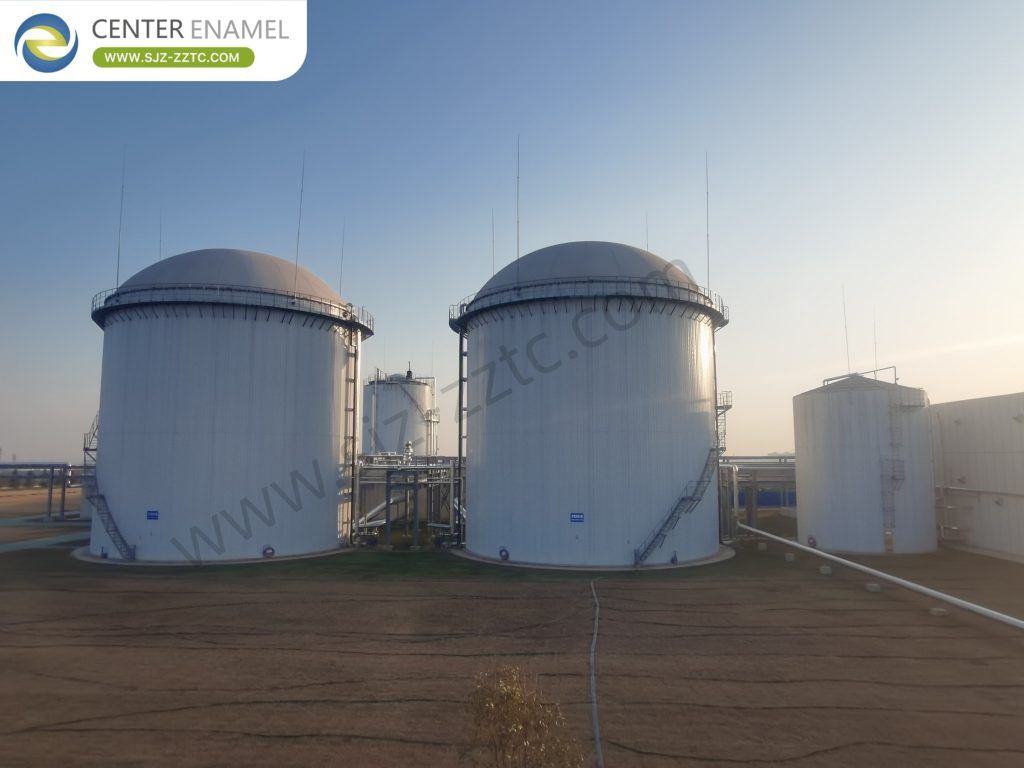
Specifically designed for high-concentration palm oil wastewater treatment with 3 GFS fermentation tanks, each 19.86 m diameter × 8.4 m height. Installation began November 2009 with only 7 construction personnel, completing all tank assembly in 40 days-highly efficient and time-saving. Tanks are fitted with dual-membrane gas storage covers for POME anaerobic digestion-degrading organics and recovering biogas energy while eliminating palm industry pollution. This is an early benchmark POME biogas treatment project in Southeast Asia.
Successful international case studies demonstrate the profound impact of combining modular engineering with robust biological systems. Deploying prefabricated GFS Tanks within large-scale tropical projects dramatically cuts down construction timelines. Moreover, this field-proven reliability ensures maximum environmental compliance and energy recovery for agro-industrial sectors.
Center Enamel Design Team
The design team includes senior engineers registered in the Hebei Provincial Science and Technology Expert Database, with design standards aligned with strict European/American high-end equipment safety standards. The team can provide complete integrated design for differentiated overseas projects in livestock biogas, POME, municipal wastewater, hazardous waste storage, seawater desalination, etc.-covering tank structure, anti-corrosion/sealing systems, biogas piping, and anaerobic process integration.
Pre-design thoroughly investigates local seismic zone, wind pressure, soil bearing capacity, water quality corrosivity, and local environmental discharge standards-applying thickened panels, reinforced anchored bases, and optimized sealing/corrosion structures as needed. Complete customized equipment solutions can be tailored to customer plant area, wastewater load, treatment targets, and budget-balancing safety, economics, and local adaptation-providing compliant, stable, and highly adaptable equipment structural design support for global environmental projects.
Engineering excellence begins with a multidisciplinary team capable of translating complex site data into customized blueprints. A premier Biogas Solution Provider leverages advanced engineering insights to guarantee structural and biochemical safety. By optimizing every parameter from local wind loads to the CSTR Process, projects are built for long-term operational success.
Full-Industry-Chain Integrated Delivery Capability
Center Enamel is the only company globally integrating proprietary enamel frit R&D, self-manufactured tanks, and EPC general contracting-full-process self-control from solution design, equipment production, cross-border logistics, overseas construction, to post-construction O&M-significantly reducing client coordination and time costs.
Streamlining project execution through full-industry-chain integration eliminates unnecessary communication bottlenecks and project delays. Partnering with a vertically integrated Biogas Solution Provider guarantees total quality control from initial design to final commissioning. Backed by proprietary manufacturing of durable GFS Tanks, Center Enamel delivers unmatched value to global environmental projects.