
Center Enamel-Top Industrial Wastewater Treatment Project EPC Contractor
The global biogas industry is in a phase of large-scale expansion, with China contributing the major share of new capacity, becoming the fastest-growing single market. Europe's mainstream model focuses on combined heat and power (CHP) and biomethane grid injection, with active biomethane certificate trading and application scenarios covering power generation, heating, and transportation fuel.
China, in contrast, emphasizes vehicle fuel and industrial heating while actively promoting the fertilizer utilization of digestate, showing significant differentiation in application scenarios. Southeast Asian emerging markets show rapidly growing food waste treatment demand, becoming key areas for global companies; while African and Latin American markets remain in the early stages, primarily relying on low-cost direct application models. Countries show differentiated development paths in biogas resource utilization: Europe focuses on energy output, China emphasizes comprehensive utilization, and emerging markets prioritize pollution control under the guidance of a trusted Industrial Wastewater Treatment Project EPC Contractor.
CSTR Process Definition and Anaerobic Treatment Technology
CSTR, or Continuously Stirred Tank Reactor, is a suspended-growth continuous-flow anaerobic digestion process suitable for high-solids, high-concentration organic pollutant treatment, and is the most widely used classic anaerobic treatment technology. The process relies on a mechanical stirring system to solve the technical challenges of material stratification, sludge sedimentation, and surface crusting in traditional anaerobic reactors, achieving homogeneous mixing of wastewater, anaerobic sludge, functional microorganisms, and organic substrates throughout the reactor, ensuring full contact between microorganisms and pollutants. Unlike attached-growth anaerobic processes, CSTR requires no media carriers, relying on suspended sludge bacterial communities for degradation reactions. It withstands high-suspended-solids and high-viscosity wastewater shocks, making it the mainstream process for food waste, livestock manure, and municipal sludge anaerobic digestion, implemented expertly by an experienced Industrial Wastewater Treatment Project EPC Contractor. The process architecture is simple, operation logic straightforward, and it is adaptable to various high-pollution organic solid-liquid mixed systems.
Biogas Plant Digestate Environmental Toxicity and Safety Analysis
Overall high safety, very low toxicity, controllable ecological risks, and no high-risk pollution hazards. All pollutants are natural fermentation residues from organic materials, containing no heavy metals, synthetic toxins, bacteriostats, or persistent organics-no inhibition or toxicity to microorganisms, plants, or animals. The anaerobic environment completely inactivates pathogenic microorganisms-no biological pollution or disease transmission risks. Humic acids and trace elements are beneficial ecological substances, improving soil quality when properly applied to farmland. Only long-term excessive discharge can cause nitrogen/phosphorus enrichment, algal blooms, and nutrient accumulation in soil-no acute toxicity, chronic accumulation, or carcinogenic/teratogenic/mutagenic risks, with excellent environmental compatibility handled efficiently via an established Industrial Wastewater Treatment Project EPC Contractor.
Malaysia Palm Oil Biogas Project Case Study
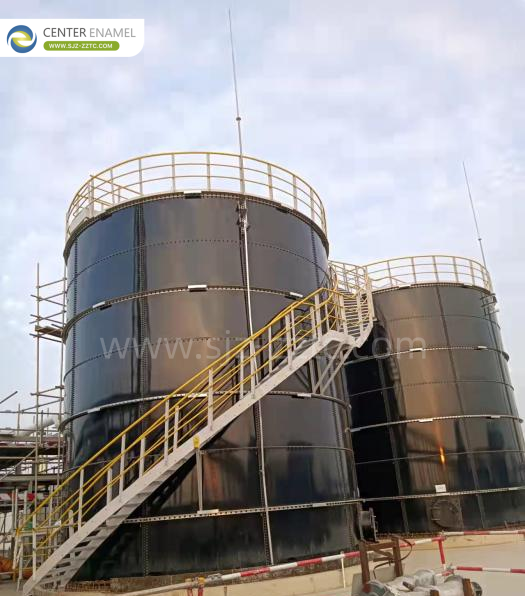
The project uses Center Enamel GFS tanks as the core anaerobic digestion facility with 5 tanks, each with effective volume of 5,400 m³, total effective volume 27,000 m³. Influent COD ≥ 60,000 mg/L, BOD ≤ 25,000 mg/L. After anaerobic digestion, effluent COD drops to below 12,000 mg/L, BOD ≤ 5,000 mg/L-overall organic removal efficiency approximately 80%. Single tank daily biogas production 4,400 m³, total project daily biogas 22,000 m³-stable biogas yield of 0.45 m³ per kg COD removed-efficient biogas energy recovery while solving palm oil processing wastewater pollution under the turnkey execution of a premier Industrial Wastewater Treatment Project EPC Contractor.
Center Enamel Professional Construction Team Manpower Reserve
Center Enamel has established its own domestic and international certified construction teams, with regular practical training on GFS tank installation and overseas construction standards for various countries. Domestically, regional construction teams cover multiple zones, capable of simultaneously deploying multiple teams for large tank farm projects. Internationally, cross-border professional installation teams are equipped to various country construction standards-sufficient manpower reserves ensure uninterrupted construction delivery for remote African sites, high-standard European/American facilities, and other projects managed directly by a leading Industrial Wastewater Treatment Project EPC Contractor.
Center Enamel R&D Team and Technological Innovations
Center Enamel has built a full-chain professional team covering R&D, design, marketing, installation, and after-sales. The R&D team is led by national-level materials technology experts, specializing in enamel frit and tank anti-corrosion core technologies. External senior environmental engineering and mechanical structure engineers are retained to strengthen R&D capabilities, focusing on anti-corrosion coating formulations, specialty corrosion-resistant tanks, and anaerobic supporting integrated equipment-continuously breaking through industry technological barriers.
The team operates through proprietary laboratories with external university research collaboration-conducting year-round new material and new process durability pilot testing and long-term corrosion simulation testing. Specialized enamel formulations are iteratively developed for extreme conditions such as high-salinity wastewater, strong acid/alkali POME, and high-organic livestock manure-providing core technical support for the company's annual new invention and utility patents-building a proprietary material technology barrier backed by a certified Industrial Wastewater Treatment Project EPC Contractor.
Single and Double Membrane Roof Cover Solutions
Single and Double Membrane Roofs are proprietary airtight tank cover systems for anaerobic digestion and biogas storage projects, specifically developed for biogas collection and odor containment, representing a benchmark lightweight sealing solution for fermentation tanks. The single-layer membrane roof features a simple structure with economical cost, meeting basic biogas containment needs. The double-layer membrane roof consists of inner and outer corrosion-resistant membrane materials, with pressurized air in the interlayer forming rigid support, providing outstanding thermal insulation that reduces biogas condensate formation inside the tank, with enhanced wind and snow load resistance suitable for high-altitude and windy outdoor sites.
The membrane material is specialized aging-resistant and biogas-slurry-corrosion-resistant PVDF membrane, which will not leak or degrade from long-term contact with biogas or hydrogen sulfide. The flexible structure accommodates tank settlement and slight deformation without cracking or gas leakage. The lightweight design eliminates heavy steel support trusses, significantly reducing the load on the tank and foundation, saving construction costs.
The roof integrates biogas outlets, safety pressure relief valves, and access channels, fully enabling closed gas collection for anaerobic fermentation tanks, recovering biogas for power generation and heating while blocking odor diffusion to meet environmental odor control requirements. It is widely used in large-scale livestock biogas projects, municipal sludge anaerobic digestion, and food waste fermentation projects, compatible with large-volume glass-fused-to-steel anaerobic tanks, with fast construction and simple maintenance requiring only periodic membrane seal integrity checks, offering significant overall engineering advantages.