
How We Turn Food Waste into Biogas Power with Anaerobic Technologies
The Asia-Pacific region, particularly China, has become the world's largest industrial wastewater treatment market, with the operation and maintenance service segment's contribution continuing to rise, marking a shift from project construction to long-term operational management. The North American market focuses on upgrading existing facilities, while Europe emphasizes high-value-added resource recovery technologies.
Wastewater from the new energy industry chain-lithium batteries, photovoltaics, and hydrogen-has become the most notable emerging growth area due to its complex composition and high treatment difficulty, generating significant demand for customized solutions. The maturity of third-party treatment models in industrial parks continues to improve, driving consolidation in the professional operation market. The Middle East has strong demand for advanced treatment and reuse of industrial wastewater due to water scarcity, while manufacturing transfer in Southeast Asia drives local industrial wastewater treatment facility construction demand. Across all these markets, the common thread is a growing reliance on Anaerobic Technologies to convert organic waste streams into recoverable energy.
Bolted Assembly Construction for Flexible Project Delivery
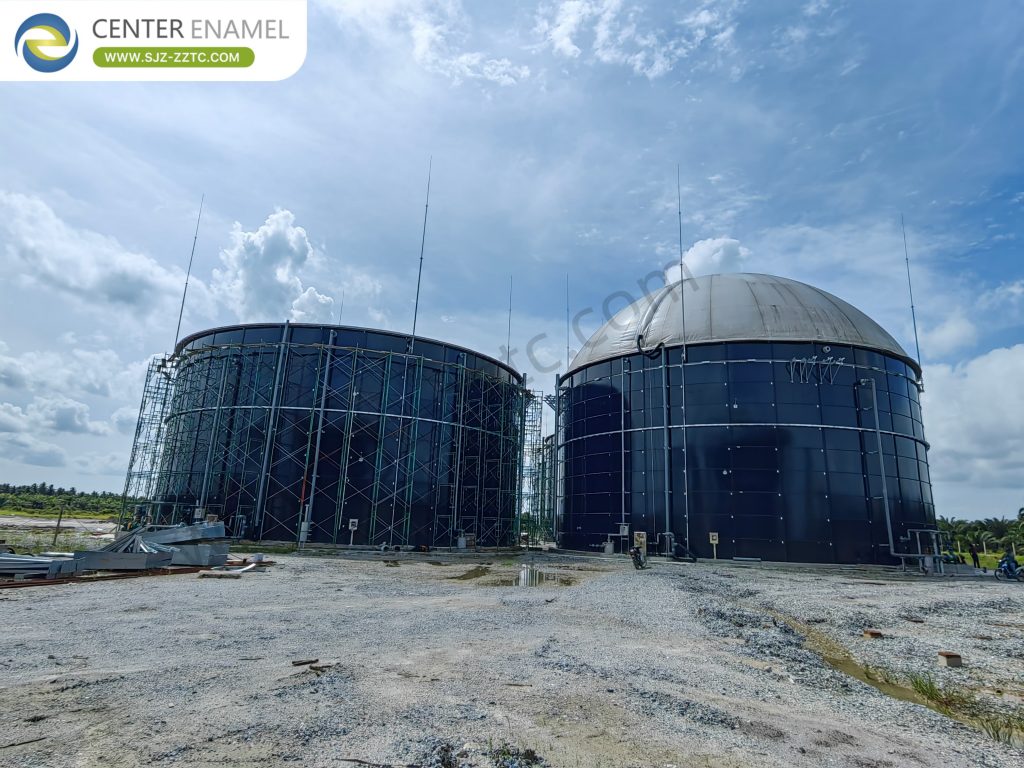
Delivering treatment capacity quickly requires the right tank platform. GFS tanks are assembled on-site from prefabricated panels, with short construction periods and support for expansion, relocation, and reuse-advantages distinctly different from immovable concrete tanks. Concrete tank pouring requires formwork, rebar tying, pouring, and long curing periods, with a single tank construction taking months. Rain, snow, and low temperatures force work stoppages and delays. Once poured, they are permanent fixed structures that cannot be dismantled, expanded, or relocated-project relocation means complete abandonment.
GFS tank panels are all factory-prefabricated, transported to site, and directly assembled in panels with simple procedures. Construction can proceed even in low-temperature, light-rain conditions, with installation time only one-third that of concrete tanks-construction schedules are controllable. For expansion, additional steel panels can be installed to increase volume; for plant relocation, tanks can be fully disassembled with panels transported to new sites for reassembly and reuse, significantly reducing material and construction costs. This is ideally suited for short-term environmental projects, phased expansion projects, and relocated construction projects.
USR Supporting Equipment for High-Solids Wastewater
With the tank platform established, the supporting equipment determines operational reliability. Core equipment is the GFS tank with no complex media or precision three-phase separators, featuring a rugged clog-resistant structure. A bottom large-diameter anti-clogging distribution system suits high-solids wastewater, preventing pipe clogging.
Supporting equipment includes influent lift pumps, simple pretreatment screens, and equalization tanks for impurity removal and water quality balancing. Simple top gas collection devices and biogas conveying and desulfurization equipment enable biogas resource recovery. Temperature, level, and pH online monitoring equipment ensures stable operation. Bottom large-diameter sludge discharge pipes and pumps allow rapid removal of high-concentration residual sludge, suitable for high-solids conditions. The complete system has extremely low failure rates, outstanding wear and clog resistance, and is far easier to maintain than conventional anaerobic processes.
Standardized Food Waste Treatment Solutions
These components come together in a complete treatment train. Core treatment uses a combination process of "pretreatment oil, grease, and solids removal + anaerobic digestion + aerobic treatment + advanced treatment," specifically addressing high oil, high salt, and high organic load characteristics.
Pretreatment uses mechanical sorting and crushing or screening to remove inorganic impurities like plastics and bone fragments. Three-phase separators recover oil for sale, significantly reducing wastewater oil content, while DAF further removes emulsified oil to prevent oil entry into biological systems. The main stage uses the CSTR anaerobic process, suitable for high-solids, high-oil organic fermentation with strong shock resistance, simultaneously producing biogas for energy recovery. Anaerobic effluent is followed by A/O or A²O aerobic processes for nitrogen and phosphorus removal. High-salinity wastewater requires salinity load control, with dilution or halophilic bacteria acclimation as needed. Final membrane treatment or constructed wetlands provide polishing for compliance. Digester tanks use Center Enamel GFS tanks, resistant to oil and high-salt corrosion with excellent sealing to prevent odor escape. The recovered biogas becomes the fuel source for a Biogas Power Plant, turning a disposal cost into an energy revenue stream.
Global Integrated Standardized Service System
Even the best-designed system depends on dependable service. Leveraging regional sales centers in China and overseas local agent networks, Center Enamel has established a complete after-sales service loop covering all markets. The system provides four core service pillars: 24/7 rapid response mechanism, on-site domestic and overseas installation services, full-project-cycle after-sales support, and long-term warranty protection-forming a complete service chain from preliminary site survey, mid-term construction management, to long-term inspection and maintenance.
The entire system is uniformly adapted to both domestic and international project service standards, coordinating personnel scheduling, material support, and on-site coordination for simultaneous projects across multiple regions-significantly reducing customer multi-party coordination costs and ensuring efficient domestic and overseas project delivery.
Global Service Coverage
| Service Pillar | Capability |
| Response Time | 24/7 rapid response |
| Installation | Domestic & overseas on-site teams |
| Project Support | Full-cycle after-sales coverage |
| Warranty | Long-term protection |
| Coverage | 100+ countries and regions |
Comprehensive International Authoritative Certifications
Supporting global project delivery, Center Enamel holds CE, NSF, WRAS, ISO9001, BSCI, ASME, and other global certifications-fully clearing EU, North American, Southeast Asian, and African project tendering barriers-providing critical hard credential advantages for large overseas project bidding.
Aluminum Geodesic Dome Roof for Gas Storage
Completing the system, the Aluminum Geodesic Dome Roof independently developed by Center Enamel is manufactured using high-strength aluminum alloy plates through integral stamping. It features a triangular grid spherical self-supporting structure, enabling large-span full coverage without internal support columns.
Made of aluminum alloy, the roof offers excellent weather resistance and corrosion resistance, capable of long-term protection against acid rain, salt spray, and UV radiation, suitable for various extreme outdoor climate conditions. The structural design complies with international AWWA D108 standards, with aluminum plate thickness, rib cross-sections, and joint connections all verified by finite element stress analysis, ensuring wind and snow load resistance that meets building code requirements across different global regions.
The weight of the Aluminum Geodesic Dome Roof is only one-third to one-half of a steel roof with the same span, significantly reducing the load on the tank top and allowing direct installation without tank wall reinforcement. The roof provides superior overall sealing performance, with double sealing between panels using specialized sealant strips and mechanical interlocking, enabling both airtight gas storage and enclosed odor control. This makes it suitable for biogas collection and storage, wastewater tank odor control, and drinking water contamination prevention. The support-column-free design does not interfere with the installation and operation of internal equipment such as mixers and water distributors. The aluminum material does not support microbial growth, requiring no anti-corrosion maintenance over long-term use, resulting in low total life-cycle costs-making it an ideal cover for the biogas storage stage of a Biogas Power Plant.
Ready to convert your food waste stream into electricity and heat? Send us your feedstock data today and our engineers will size a Biogas Power Plant for your site.
From anaerobic digestion design to final grid connection, get in touch with Center Enamel for a complete solution backed by 1000+ biogas projects and global certification coverage.
FAQ
How does food waste become biogas power?
Food waste undergoes pretreatment to remove oil and solids, then anaerobic digestion converts organics into biogas. This biogas fuels a Biogas Power Plant to generate electricity and heat.
Why are Anaerobic Technologies better than aerobic treatment for food waste?
Anaerobic Technologies handle high COD and oil loads, produce biogas for energy recovery, generate less sludge, and resist shock loads-making them ideal for food waste's 15,000-80,000 mg/L COD.
What certifications ensure project acceptance worldwide?
Center Enamel holds CE, NSF, WRAS, ISO9001, BSCI, and ASME certifications, clearing tendering barriers in the EU, North America, Southeast Asia, and Africa.