
Cost-Effective Turnkey Solution with GFS Tanks for Palm Oil Wastewater Treatment
The competitive landscape shows divergence, with leading companies building integrated service capabilities through technical integration and capital operations, and industry concentration gradually increasing. Chinese companies continue to consolidate their advantages in mid-tier equipment exports. International giants target high-end customers and complex industrial wastewater markets, while local players occupy the mid-to-low-end and industrial park centralized treatment markets with service responsiveness and cost advantages.
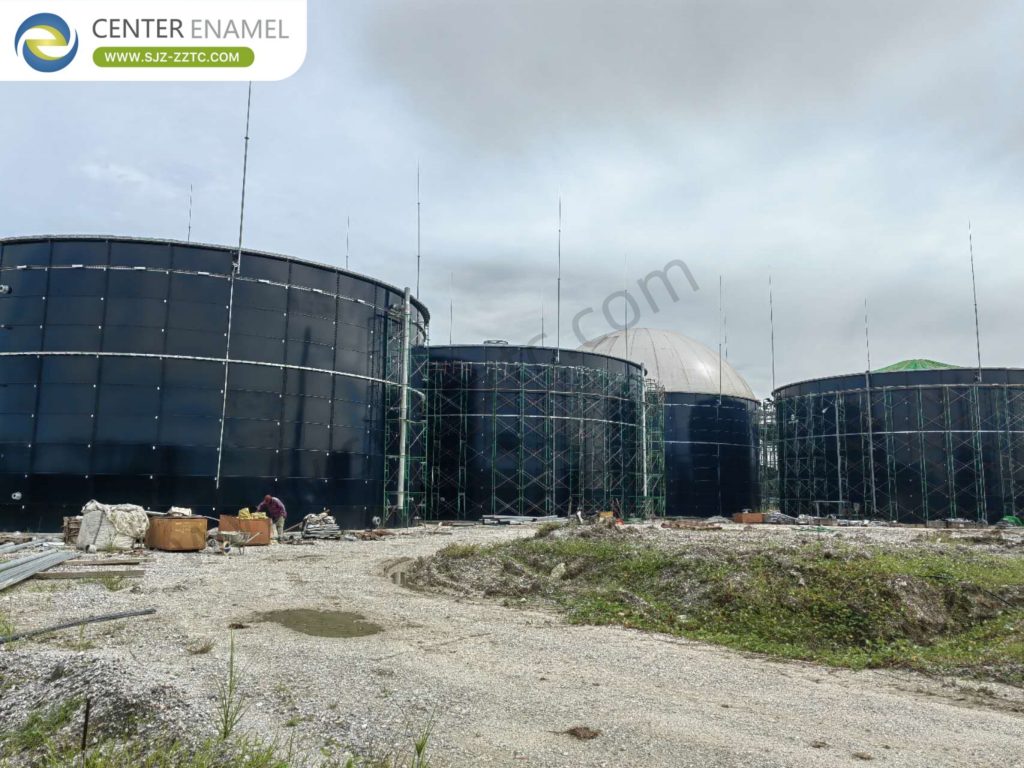
In the anaerobic process segment, UASB, EGSB, and IC anaerobic reactors, with advantages of high loading rates, small footprints, and stable operation, are widely used in high-concentration organic wastewater pretreatment in food processing, pharmaceutical fermentation, alcohol brewing, chemical, and other industries. These reactors use steel tank shells, and their corrosion resistance and gas-tightness directly determine long-term operational stability. The application value of glass-fused-to-steel tanks in such scenarios is increasingly prominent.
This market divergence places a premium on delivery models that combine technical integration with cost efficiency. One technology that consistently meets this demand is the prefabricated GFS Tanks system, whose bolted assembly model directly addresses the construction and corrosion challenges outlined above.
GFS Tanks Bolted Assembly Construction
GFS tanks are assembled on-site from prefabricated panels, with short construction periods and support for expansion, relocation, and reuse — advantages distinctly different from immovable concrete tanks. Concrete tank pouring requires formwork, rebar tying, pouring, and long curing periods, with a single tank construction taking months. Rain, snow, and low temperatures force work stoppages and delays. Once poured, they are permanent fixed structures that cannot be dismantled, expanded, or relocated — project relocation means complete abandonment.
GFS tank panels are all factory-prefabricated, transported to site, and directly assembled in panels with simple procedures. Construction can proceed even in low-temperature, light-rain conditions, with installation time only one-third that of concrete tanks — construction schedules are controllable. For expansion, additional steel panels can be installed to increase volume; for plant relocation, tanks can be fully disassembled with panels transported to new sites for reassembly and reuse, significantly reducing material and construction costs for new construction and reconstruction. This is ideally suited for short-term environmental projects, phased expansion projects, and relocated construction projects.
The construction flexibility of GFS Tanks becomes especially valuable when paired with anaerobic treatment processes that must tolerate high-solids and high-impurity wastewater. The USR Process is a clear example of this synergy.
What Are the Advantages of USR Process
High solids tolerance, clog resistance, and strong adaptability, perfectly suited for high-suspended-solids, high-impurity, high-solids organic wastewater. Extremely simple equipment structure, no precision wear parts, low capital investment, long service life, virtually no clogging failures, and extremely low subsequent maintenance costs. No strict requirements on sludge morphology — no need to cultivate mature granular sludge, flocculent sludge can operate stably, with fast start-up and short sludge acclimation period for rapid commissioning. Gentle hydraulic disturbance results in low sludge washout and high sludge utilization, with stable organic pollutant degradation. Simple operation with low automation requirements and high error tolerance, suitable for remote sites, farms, and other settings with limited O&M capabilities — outstanding stability and practicality advantages.
These operational advantages matter most in applications where the influent is both highly concentrated and environmentally sensitive. Palm oil mill effluent is the defining example — and understanding its toxicity profile explains why proper treatment is non-negotiable.
POME Environmental Toxicity
POME pollutants are primarily natural plant organics with no synthetic toxic chemicals, heavy metals, or persistent organics — low acute chemical toxicity, but high-concentration organic and oil pollution have severe ecological impacts. High-concentration organics discharged to natural waters rapidly deplete dissolved oxygen — BOD load far exceeds self-purification capacity, causing severe oxygen depletion, anaerobic production of hydrogen sulfide and ammonia, black-odor conditions, mass mortality of fish and benthic organisms, and complete ecosystem collapse. High-concentration oil forms surface films blocking atmospheric-water oxygen exchange — exacerbating oxygen depletion; oil adheres to fish gills and aquatic organism surfaces, directly affecting respiration, feeding, and movement; oil degrades slowly, causing persistent ecological damage. Acidic raw water (pH 4-5) acidifies receiving waters, causing pH drops beyond aquatic organism tolerance — leading to fish kills and aquatic vegetation die-off; acidic conditions promote heavy metal mobilization from sediments, creating secondary pollution risks. High suspended solids settle and cover riverbed sediments, blocking benthic habitats and fish spawning grounds; fruit pulp and fiber decomposition consumes sediment oxygen, causing anaerobic conditions and hydrogen sulfide accumulation. High ammonia nitrogen undergoes nitrification consuming dissolved oxygen — exacerbating eutrophication. Nitrogen and phosphorus nutrient enrichment triggers algal blooms (water blooms, red tides) — further degrading water quality. In Southeast Asian palm oil producing regions with dense mill concentrations, untreated POME discharge can cause severe water quality degradation over tens of kilometers of rivers, with irreversible aquatic ecosystem damage — POME is a core source of water pollution in tropical regions, with increasingly strict environmental regulations.
Given this severity, the credibility of any Palm Oil Wastewater Treatment approach depends on real-world delivery. Center Enamel's track record includes municipal and industrial projects across multiple continents — including a reference installation in West Africa.
Ghana Municipal Domestic Wastewater Treatment Project
Completed installation in 2021, treating 1,800 m3/day of municipal wastewater using UBF anaerobic + A2/O nitrogen/phosphorus removal mature processes. Equipped with multiple Center Enamel GFS tanks including 1 UBF anaerobic reactor, 1 secondary clarifier, and 2 internal/external double-layer A2/O biological tanks. Influent has high COD, BOD, suspended solids, and nitrogen/phosphorus concentrations — after full treatment, effluent parameters are significantly reduced with pH stable at 6.5-9.0, fully meeting local environmental discharge standards. Corrosion-resistant, conveniently assembled GFS tanks efficiently solve urban domestic wastewater pollution while balancing treatment effectiveness and O&M economics — a mature municipal wastewater case in Africa.
Delivering projects like this at scale requires not only proven tank technology but also disciplined on-site execution. That execution capability is built into Center Enamel's dedicated installation teams.
Installation and Construction Team
The installation team has practical experience from over 10,000 GFS tank projects globally, strictly following standardized construction procedures — full control over project mobilization, civil coordination, tank assembly, piping, and commissioning schedules and quality.
The team is proficient in complete standardized installation processes for GFS tanks, dual-membrane gas storage covers, USR/CSTR/IC anaerobic reactors, and biogas desulfurization/piping systems — adaptable to large-scale farms, industrial parks, remote mountainous sites, coastal high-corrosion sites, and other complex locations — strictly implementing unified global safety construction standards. For large overseas cross-border projects, the team can be deployed as complete units for on-site construction, technical training, and local worker practical instruction — full control over construction details, air-tightness testing, and corrosion protection — ensuring timely and stable commissioning of global environmental projects through standardized delivery capability.
This standardized delivery capability is what allows Center Enamel to operate as a true Turnkey Solution provider — from design and manufacturing through installation and long-term service — across a project portfolio that spans more than 100 countries.
Center Enamel's Extensive Global Benchmark Project Cases
Center Enamel's project portfolio covers over 100 countries across Southeast Asia, Africa, Europe, and the Americas — 30,000+ mature projects — accumulating complete industry solutions across palm oil, livestock, municipal, brewing, and food waste biogas — rapidly matching customized solutions for different regional climates, water quality, and regulations.
Frequently Asked Questions
What is a Turnkey Solution for wastewater treatment?
A Turnkey Solution covers design, equipment manufacturing, installation, commissioning, and ongoing service from one provider. Center Enamel delivers this model using GFS Tanks and anaerobic process integration, reducing coordination costs and accelerating project timelines.
Why are GFS Tanks preferred for Palm Oil Wastewater Treatment?
GFS Tanks offer strong corrosion resistance, gas-tightness, and rapid bolted assembly. They tolerate the high-solids, high-oil, low-pH conditions of POME and support expansion, relocation, and reuse — ideal for palm oil mills with changing capacity needs.
How does the USR Process handle high-solids wastewater?
The USR Process uses a rugged, clog-resistant structure without precision wear parts. It tolerates high suspended solids, requires no granular sludge cultivation, and delivers fast start-up with low maintenance — well suited to remote sites and palm oil applications.