
Advanced Wastewater Treatment Technology: Delivering Turnkey Solutions for Complex Industries
The industrial wastewater market is experiencing a clear divergence. Leading companies are building integrated service capabilities through technical integration and capital operations, gradually increasing industry concentration. Chinese firms continue to consolidate their advantages in mid-tier equipment exports. Meanwhile, international giants target high-end and complex industrial markets, while local players capture mid-to-low-end and industrial park centralized treatment markets with service responsiveness and cost advantages.
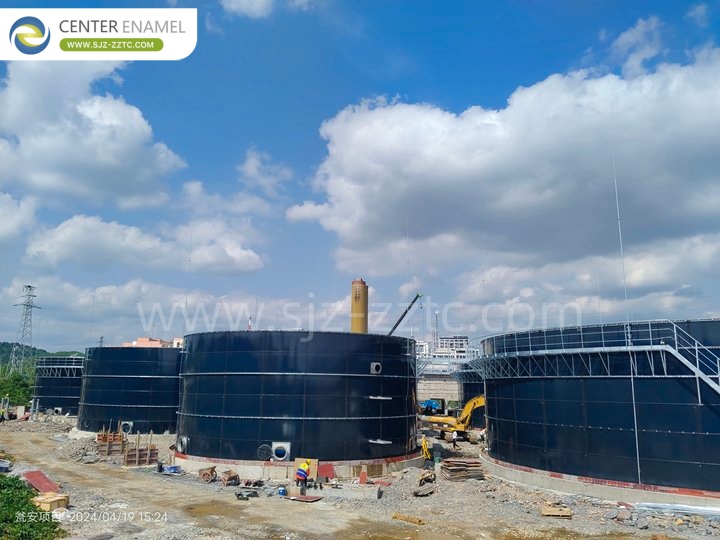
In the anaerobic process segment, UASB, EGSB, and IC reactors are widely applied to pretreat high-concentration organic wastewater in food processing, pharmaceutical fermentation, alcohol brewing, and chemical industries. These reactors rely heavily on steel tank shells, where corrosion resistance and gas-tightness directly dictate long-term operational stability. This is precisely where glass-fused-to-steel (GFS) tanks excel, making their application value increasingly prominent.
Engineering Integration: The IC Supporting Equipment
To deliver a highly functional Wastewater Treatment Technology, equipment integration is key. The core of the IC reactor system is a GFS tank equipped with a built-in gas-lift internal circulation system and upper/lower three-phase separators, which handle autonomous circulation and sludge-water separation. At the bottom, a precision distribution system and pressure-regulating feed device ensure uniform influent, supported by lift pumps, equalization tanks, and flow meters.
At the top, high-efficiency biogas collection, desulfurization, dehydration, and storage equipment work alongside high-precision online monitoring for temperature, pH, and COD. Dedicated sludge discharge pipes and recirculation devices eliminate the need for external return pumps. The entire system is highly integrated, compact, and features high automation-forming the robust backbone of modern Wastewater Treatment Technology.
Flexible Construction: GFS Tanks vs. Concrete Tanks
Reliable infrastructure is the foundation of any Turnkey Solution. GFS tanks are assembled on-site from prefabricated panels, offering short construction periods and support for expansion, relocation, and reuse-advantages distinctly different from immovable concrete tanks. Concrete pouring requires formwork, rebar tying, and long curing periods, taking months. Rain, snow, and cold force work stoppages. Once poured, concrete structures cannot be dismantled or relocated; moving the project means abandoning the tanks.
By contrast, GFS tank panels are factory-prefabricated and assembled directly on-site. Construction proceeds even in low-temperature, light-rain conditions, with installation time only one-third that of concrete tanks. If you need to expand, you simply add steel panels. If you relocate your plant, the tanks can be fully disassembled and reused, significantly reducing construction costs.
| Feature | GFS Tanks | Concrete Tanks |
| Installation Time | One-third of concrete | Months per tank |
| Weather Impact | Workable in light rain/cold | Stoppages in rain, snow, cold |
| Expansion | Add steel panels | Not possible |
| Relocation | Fully disassemblable/reusable | Permanent, abandoned on move |
Tailored Wastewater Treatment Technology for Dairy Processing
High-strength dairy wastewater requires a specific approach. Center Enamel utilizes a mature treatment train: "oil separation pretreatment + anaerobic digestion + aerobic treatment + advanced treatment," tailored for high-oil, high-protein, easily biodegradable organic wastewater.
Pretreatment uses screens and equalization tanks to balance flow. Oil separation tanks and DAF remove free and emulsified oil to prevent biological system fouling. High-concentration CIP wastewater is collected separately and fed in batches to avoid shock loading. The main stage relies on UASB/IC anaerobic processes to degrade lactose and milk proteins, generating high biogas and significant energy recovery. Subsequent A/O or contact oxidation processes deeply degrade residual organics and remove nitrogen/phosphorus. Finally, sedimentation, filtration, and disinfection ensure compliance. The anaerobic digesters use GFS tanks specially resistant to milk fatty acids and hydrogen sulfide corrosion, perfectly accommodating the dairy industry's intermittent discharge patterns.
Global Delivery and Comprehensive Certifications
Executing a global Turnkey Solution requires rigorous standards and robust service networks. Center Enamel holds CE, NSF, WRAS, ISO9001, BSCI, ASME, and other global certifications, fully clearing EU, North American, Southeast Asian, and African project tendering barriers.
Leveraging regional sales centers and overseas local agent networks, we provide four core service pillars: a 24/7 rapid response mechanism, on-site domestic/overseas installation services, full-project-cycle after-sales support, and long-term warranty protection. This complete service chain spans preliminary site surveys, mid-term construction management, and long-term inspection and maintenance.
Robust Covers: The Aluminum Geodesic Dome Roof
For optimal gas collection and odor control, Center Enamel independently developed the Aluminum Geodesic Dome Roof. Manufactured from high-strength aluminum alloy plates via integral stamping, it features a triangular grid spherical self-supporting structure, enabling large-span coverage without internal support columns.
The design complies with international AWWA D108 standards, verified by finite element stress analysis for wind and snow load resistance. Its weight is only one-third to one-half of a steel roof, significantly reducing the load on the tank top without needing wall reinforcement. The roof provides superior sealing through double sealant strips and mechanical interlocking, enabling airtight gas storage and odor control. Because aluminum does not support microbial growth, it requires no anti-corrosion maintenance, resulting in low total life-cycle costs.
Frequently Asked Questions
What types of anaerobic reactors do you provide?
We offer advanced IC reactors that use built-in gas-lift circulation, eliminating the need for external return pumps and ensuring high treatment efficiency.
Do GFS tanks require concrete foundations?
While they need a level foundation, GFS tanks are much lighter and faster to install than concrete tanks, and they can be expanded or relocated.
Can you provide a complete Turnkey Solution?
Yes. We manage the entire project lifecycle, from process design and equipment manufacturing to global shipping, on-site assembly, and ongoing after-sales support.
Ready to upgrade your facility with a reliable Turnkey Solution? Share your wastewater parameters and site conditions, and our engineers will design a customized plan tailored to your specific needs.
Contact Center Enamel today to learn how our advanced Wastewater Treatment Technology and certified equipment can guarantee long-term operational stability for your industrial project.