
How Center Enamel Turns High-Strength Livestock Wastewater into Biogas Power Plant Revenue
Livestock wastewater is one of the most punishing feedstocks in environmental engineering-high in COD, ammonia nitrogen, phosphorus, and suspended solids, with quality that swings with production cycles and seasons. Left untreated, it drives eutrophication and odour problems; handled correctly, it becomes fuel for a Biogas Power Plant that offsets energy costs and generates revenue.
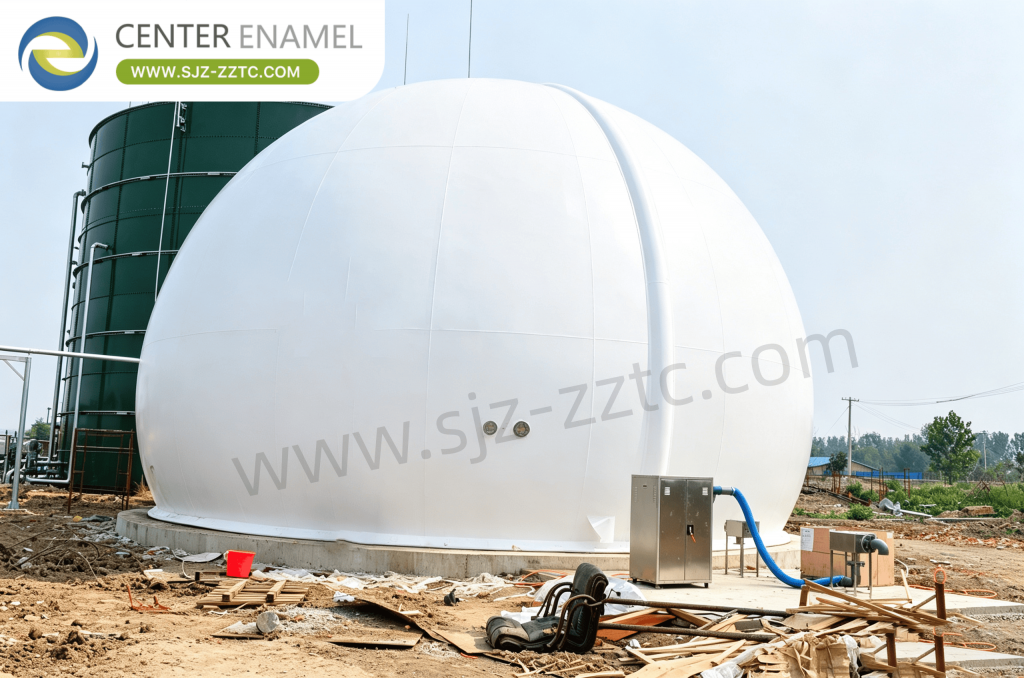
The difference between those two outcomes comes down to two things: a reactor process that tolerates high solids without clogging, and containment that survives decades of corrosive attack. Center Enamel supplies both-pairing proprietary GFS Tanks with the USR Process and full EPC delivery. This article covers the policy drivers, our material technology, the treatment process, real project data, and the manufacturing and installation capacity behind every project.
Global Policy Shifts Reshaping Manure Management
Regulatory pressure is the primary force pushing livestock operations toward resource recovery rather than simple disposal. The global livestock manure treatment policy system, with the US and EU as typical representatives, is shifting from end-of-pipe treatment to full-process nutrient management. The US establishes a manure management framework covering the entire livestock production process through Comprehensive Nutrient Management Plans.
The EU, through its Nitrates Directive, strictly limits manure application amounts, with Germany and the Netherlands using tax instruments to mandate nitrogen and phosphorus recovery rates, and Denmark demonstrating distinctive features in livestock regulation and ecological compensation. The Netherlands uses a management mechanism linking manure treatment with phosphate quotas. China has issued a series of environmental regulations, with the current legal system providing comprehensive regulation of pollution from large-scale livestock operations. For operators, these policies converge on one practical conclusion: manure must be treated and its nutrients and energy recovered-which is precisely the function of a well-designed Biogas Power Plant.
Why GFS Tanks Adapt to Complex Operating Conditions Across Industries
Containment determines whether a Biogas Power Plant survives its operating environment. Center Enamel has independently developed over 200 specialized enamel frit formulations and supporting patents, capable of customizing anti-corrosion enamel based on customer storage media, with adaptability comprehensively superior to concrete tanks. Concrete tanks use a single material and are only suitable for neutral clean water storage. When storing corrosive materials such as livestock manure, palm oil mill effluent, chemical wastewater, food waste digestate, or high-salinity wastewater, additional anti-corrosion linings must be applied. These linings are prone to failure, preventing long-term stable operation and cannot adapt to alternating high and low concentration storage conditions.
GFS Tanks solve this through material engineering rather than added protection. They can be specifically formulated with specialized enamels resistant to strong acids, strong alkalis, high organic content, and high salinity. A single tank can switch between multiple wastewater and fermentation feedstock storage requirements. They are universally applicable across biogas anaerobic digestion, municipal wastewater, livestock farming, food processing, and industrial water treatment scenarios, eliminating the need to rebuild tanks for media changes and perfectly meeting the needs of diversified, multi-condition environmental protection projects. This formulation flexibility is what makes GFS Tanks the standard containment choice for livestock biogas applications where feedstock composition varies seasonally.
The USR Process: Clog-Resistant Anaerobic Treatment for High-Solids Manure
With containment addressed, treatment performance depends on reactor design. High-solids organic wastewater, after simple pretreatment to remove large debris, is uniformly fed into the reactor through the bottom distribution system. The upward flow drives solid substrates and anaerobic sludge to slowly rise and thoroughly mix. In the sealed anaerobic environment, microorganisms sequentially hydrolyze and acidify, then methanogenically ferment, degrading macromolecular organic pollutants and generating biogas and treated water. Because there are no complex separation structures, gentle hydraulic disturbance prevents clogging.
The mixed liquor rises to the upper portion of the reactor where natural gas-liquid-solid separation occurs. Biogas is collected, effluent overflows, and solid sludge and unreacted substrate settle back to the lower reaction zone for continued reaction, with a small amount of aged sludge periodically discharged-enabling continuous stable operation. For livestock operations, this design is essential: manure slurry carries fibrous bedding, feed residues, and grit that would rapidly blind the internal structures of higher-rate reactors, making the USR Process the practical choice for reliable Biogas Power Plant operation.
Water Quality Characteristics of Livestock Wastewater
Designing effective treatment requires precise feedstock characterization. Livestock wastewater is a typical high-concentration organic wastewater with "four highs"-high COD, high ammonia nitrogen, high total phosphorus, and high suspended solids-carrying a very high pollution load. COD can exceed 8,000 mg/L, with high turbidity and suspended solids. Nitrogen and phosphorus levels far exceed discharge standards, making them the primary cause of eutrophication. The wastewater is rich in manure, feed residues, and metabolic waste, and readily turns black and odorous. Water quality fluctuates significantly with production cycles, seasons, and washing frequency. Aquaculture wastewater has lower pollutant concentrations but significant nitrogen and phosphorus accumulation issues, causing algal blooms and water quality deterioration with long-term discharge. These characteristics explain both the environmental risk of untreated discharge and the energy potential available to a properly designed Biogas Power Plant.
Case Study: Bangladesh Large-Scale Poultry Farm Manure Resource Recovery Project
Operational data is the clearest proof of process performance. Center Enamel's Bangladesh project targets local poultry farm manure resource recovery with daily treatment of 47 tons. Influent COD, BOD, and SS reached as high as 50,000 mg/L, 25,000 mg/L, and 50,000 mg/L respectively. After CSTR + UASB anaerobic treatment, all three parameters were reduced to below 200 mg/L, 100 mg/L, and 100 mg/L-effluent fully compliant with local environmental discharge standards. The project produces approximately 4,900 m³ of biogas daily, and each cubic meter of biogas can generate 2 kWh of electricity, yielding daily power generation of 9,800 kWh. This simultaneously achieves pollutant reduction and clean energy recovery, establishing it as a benchmark project for livestock waste recycling in Southeast Asia.
Treatment Performance (Bangladesh Poultry Manure Project)
| Parameter | Influent | Effluent | Compliance |
| COD | 50,000 mg/L | < 200 mg/L | Meets local discharge standards |
| BOD | 25,000 mg/L | < 100 mg/L | Meets local discharge standards |
| SS | 50,000 mg/L | < 100 mg/L | Meets local discharge standards |
Biogas Power Plant Energy Output (Bangladesh Poultry Manure Project)
| Metric | Value |
| Daily treatment capacity | 47 tons |
| Daily biogas production | ~4,900 m³ |
| Electricity yield | 2 kWh per m³ biogas |
| Daily power generation | 9,800 kWh |
| Outcome | Pollutant reduction + clean energy recovery |
Manufacturing Scale Behind Every Biogas Power Plant
Project delivery depends on production capacity that can meet schedule without compromise. Center Enamel's core intelligent manufacturing base is located in Hebei Province, China, covering a total area of over 150,000 m², with a mature Phase I manufacturing facility and a Phase II high-end environmental equipment industrial park-dual-base synergy ensuring stable production capacity.
Manufacturing Base Capabilities and Certifications
| Category | Details |
| Base area | Over 150,000 m² across two phases |
| Facilities | R&D office buildings, proprietary material laboratories, finished product testing centers |
| Quality systems | ISO, NSF, CE, and other international standards |
| Environmental certification | Provincial Green Factory (green manufacturing standards) |
| Domestic network | 6 marketing service centers across China |
| Logistics | Adjacent to expressway networks and major logistics hubs; complete container shipping capability |
| Workforce | Over 500 staff; multiple parallel automated production lines |
The base includes dedicated R&D office buildings, proprietary material laboratories, and finished product testing centers, with full-process quality control systems meeting ISO, NSF, CE, and other international standards. The facility operates to green manufacturing standards, certified as a Provincial Green Factory-balancing efficient production with energy conservation and emission reduction. The company has 6 marketing service centers across China, establishing a nationwide production-sales network that ensures stable global order delivery. The base is adjacent to expressway networks and major logistics hubs, with complete container shipping capabilities supporting simultaneous large-scale tank projects globally. With over 500 staff and multiple parallel automated production lines, the facility scale and production capacity firmly place it among the global top tier of GFS Tanks equipment manufacturers.
Over a Decade of Proven Global Installation Experience
Manufacturing scale must be matched by field execution across diverse climates and standards. Center Enamel holds unmatched global practical experience among domestic peers-over a decade covering multiple regions and all industry sectors. In 2009, the company completed its first overseas GFS Tanks installation, sending a team to Niger, Africa for drinking water storage tank installation. In 2015, it broke industry ground with China's first GFS Tanks export and installation to the United States, passing strict US acceptance standards. All installed projects have operated stably for many years, covering livestock biogas, POME, municipal wastewater, and drinking water storage applications.
Construction has covered Southeast Asia, Africa, the Americas, and other regions, accumulating specialized solutions for complex sites including mountainous terrain, coastal salt spray, tropical high temperatures, and high-standard European and American facility conditions-maturely addressing global special construction requirements. For a Biogas Power Plant in a remote agricultural location, this experience directly reduces construction risk.
Want to know how much power your livestock operation could generate? Send Center Enamel your herd size and manure volume for a Biogas Power Plant feasibility estimate and GFS Tanks specification. Contact our team for a tailored proposal covering design, equipment supply, and turnkey installation.
Frequently Asked Questions
Q: How does a Biogas Power Plant handle high-solids livestock manure?
The USR Process tolerates high suspended solids without complex separators that clog. Manure slurry is fed through bottom distribution, mixed by upflow hydraulics, and converted to biogas-while GFS Tanks resist the resulting corrosion.
Q: Why are GFS Tanks better than concrete for manure storage?
With 200+ enamel formulations, GFS Tanks resist acids, alkalis, high organics, and salinity. Concrete requires linings that fail, while GFS Tanks handle alternating concentrations and last 30+ years with minimal maintenance.
Q: What energy output can livestock manure generate?
In our Bangladesh project, 47 tons per day produced ~4,900 m³ biogas and 9,800 kWh electricity daily. Output scales with feedstock volume-revenue typically offsets O&M costs significantly.