
Types of Gasholders for Biogas Plants: Engineering Designs and Storage Solutions
In anaerobic digestion facilities, biological biogas production is a continuous biochemical process, whereas energy consumption (such as combined heat and power [CHP] units, boilers, or grid injection) often operates on varying schedules. Installing an efficient storage mechanism is vital to balance these supply and demand fluctuations, maintain constant operational pressure, and prevent unnecessary flaring.
Selecting the appropriate types of gasholders for biogas plants directly impacts plant safety, capital expenditure, and overall system efficiency. This guide breaks down the core engineering designs utilized in modern agricultural, municipal, and industrial biogas facilities.
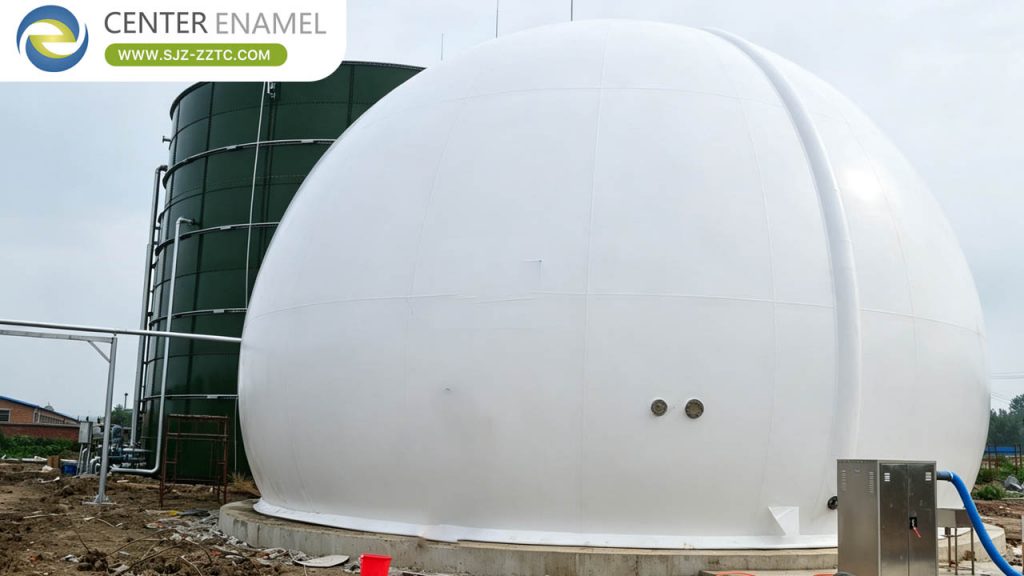
1. Classification Framework: Internal vs. External Gasholders
Biogas storage technologies are broadly divided into two main categories based on their structural relationship to the main reactor:
- Internal (Integrated) Gasholders: Storage spaces built directly into the top of the anaerobic digester (such as fixed domes or integrated flexible covers). They minimize land footprint and reduce overall capital construction costs.
- External (Separate) Gasholders: Stand-alone autonomous storage tanks or bladders positioned away from the main reactor. They are essential for large commercial plants to buffer extreme production-consumption gaps or connect multiple reactors.
2. Major Types of Biogas Gasholders
A. Double Membrane Gasholders (Modern Commercial Standard)
- Design & Mechanism: The industry standard for large commercial and industrial biogas plants (often paired with Glass-Fused-to-Steel [GFS] tanks). They feature three specialized polymer layers: a bottom membrane (for slab-mounted units), an inner membrane that expands and contracts as it holds the actual biogas, and an outer membrane that acts as a weatherproof protective shell.
- Support System: An active air blower continuously pumps air into the space between the inner and outer membranes, maintaining stable structural overpressure against wind and snow loads.
- Key Advantage: High storage volume capacity, excellent resistance to corrosive hydrogen sulfide (H2S), and precise pressure stabilization for downstream equipment.
B. Floating-Drum Gasholders
- Design & Mechanism: A traditional design consisting of an inverted movable metal or fiberglass drum that floats directly on top of the fermentation slurry or inside a dedicated water jacket. A vertical guide frame keeps the drum aligned.
- Key Advantage: Delivers a constant operating gas pressure governed by the weight of the drum, coupled with an instant visual indicator of gas volume based on the drum's physical height.
- Operational Consideration: Traditional steel drums are vulnerable to corrosion from H2S and require routine repainting and maintenance.
C. Fixed-Dome Gasholders (Integrated)
- Design & Mechanism: Built as an immovable, rigid masonry or concrete dome directly integrated into the top of underground digesters. As gas accumulates, it displaces liquid slurry into an external expansion chamber.
- Key Advantage: Zero moving parts and robust underground construction guarantee a multi-decade operational lifespan (20 to 30+ years) without mechanical wear.
- Operational Consideration: Operates under variable gas pressure that fluctuates depending on storage volume.
D. Balloon / Bag-Type Gasholders (Flexible Low-Pressure)
- Design & Mechanism: Constructed from heavy-duty, UV-resistant reinforced plastic sheeting (such as PVC or HDPE) shaped into a sealed pillow or tubular envelope.
- Key Advantage: Highly portable, rapid to deploy, and very cost-effective for small-scale rural farms or temporary storage setups.
- Operational Consideration: Operates under very low pressure, requiring protective housing or fencing to prevent punctures from environmental hazards or animals.
E. Medium- and High-Pressure Gas Storage Cylinders
- Design & Mechanism: Engineered steel pressure vessels designed to compress cleaned biogas or upgraded biomethane (Bio-CNG) to pressures ranging from 8 to 200+ bar.
- Key Advantage: Significantly reduces the spatial volume required for storage, making it ideal for vehicle fuel dispensing or grid injection.
- Operational Consideration: Requires rigorous gas scrubbing (removal of H2S, moisture, and CO2), expensive compression machinery, and certified safety relief valves.
Comparative Data Table: Biogas Gasholder Types
| Gasholder Type | Primary Structural Material | Operating Pressure | Ideal Facility Scale | Key Engineering Feature |
| Double Membrane | PVC-coated polyester membranes | Low (20 to 50 mbar) | Large commercial & industrial | Dual-layer air-supported shell, massive capacity |
| Floating-Drum | Steel sheet / FRP / Plastic | Constant low pressure | Small to medium farms | Direct visual volume gauge, steady pressure |
| Fixed-Dome (Integrated) | Reinforced concrete / Masonry | Variable pressure | Rural households & small farms | Zero moving parts, underground thermal protection |
| Balloon / Bag-Type | Heavy-duty PVC / HDPE sheeting | Very low flexible pressure | Small-scale / Developing regions | Low capital cost, highly portable, easy setup |
| High-Pressure Cylinders | High-tensile forged steel | High (up to 200+ bar) | Biomethane / Bio-CNG plants | Dense energy storage for transport and vehicle fuel |
Frequently Asked Questions (FAQ)
Q1: Why are double membrane gasholders preferred in modern commercial biogas plants?
A: Double membrane gasholders offer large storage volumes, excellent resistance to corrosive gases like hydrogen sulfide (H2S), and stable pressure regulation via an automated support air blower. They can be mounted directly on top of commercial GFS digester tanks or installed as standalone pads, maximizing operational flexibility.
Q2: What is the difference between constant pressure and variable pressure gasholders?
A: Constant pressure gasholders (such as floating drums and double membrane systems) maintain a steady gas delivery pressure regardless of how full the tank is, protecting downstream burners and CHP engines from surging. Variable pressure systems (such as fixed-dome digesters) experience fluctuating pressure that rises when gas storage is high and drops as it empties.
Q3: Can raw biogas be stored directly in high-pressure steel cylinders?
A: No. Raw biogas contains corrosive moisture, hydrogen sulfide (H2S), and carbon dioxide (CO2) that can rapidly destroy high-pressure metal cylinders. Biogas must first be thoroughly scrubbed and upgraded into pure biomethane (Bio-CNG) before it can be safely compressed for high-pressure storage.