
Proven UASB Process and Biogas Power Plant Solutions for Beverage Wastewater Treatment Projects
As a leading Beverage Wastewater Treatment Project EPC Contractor, Shijiazhuang Zhengzhong Technology Co., Ltd (Center Enamel) delivers integrated solutions that combine the proven UASB Process with premium Glass-Fused-to-Steel (GFS) tanks. The Asia-Pacific region, particularly China, has become the world's largest industrial wastewater treatment market, with the operation and maintenance service segment's contribution continuing to rise, marking a shift from project construction to long-term operational management.
Regional Development Trends Shape the Global Industrial Wastewater Market
The North American market focuses on upgrading existing facilities, while Europe emphasizes high-value-added resource recovery technologies. Wastewater from the new energy industry chain (lithium batteries, photovoltaics, hydrogen) has become the most notable emerging growth area due to its complex composition and high treatment difficulty, generating significant demand for customized solutions. The maturity of third-party treatment models in industrial parks continues to improve, driving consolidation in the professional operation market. The Middle East has strong demand for advanced treatment and reuse of industrial wastewater due to water scarcity; manufacturing transfer in Southeast Asia drives local industrial wastewater treatment facility construction demand. In response to these diverse regional needs, Center Enamel's advanced UASB Process and robust GFS tanks offer a versatile and reliable solution, adaptable to the specific requirements of any project, from North American facility upgrades to new builds in Southeast Asia.
UASB Reaction Process Enables Efficient Organic Degradation and Biogas Recovery
Understanding the core biological process is essential for any Beverage Wastewater Treatment Project. After pretreatment through screens and equalization tanks to remove impurities and balance water quality and flow, wastewater is uniformly fed into the reactor through the bottom distribution system. The wastewater rises at a constant rate through the high-concentration granular sludge bed at the bottom, where anaerobic microorganisms rapidly degrade most organic matter, converting it into biogas, clean water, and a small amount of sludge. Gentle hydraulic mixing maintains sludge suspension, expanding microbial contact area. Remaining pollutants continue to degrade in the mid-section suspended sludge layer, with the mixed liquor finally entering the top three-phase separator for gas, solid, and liquid separation. Biogas is collected upward for utilization, sludge settles back to the reaction zone, treated effluent overflows from the top, and aged sludge is periodically discharged-fully automated continuous operation. This highly efficient UASB Process is the cornerstone of any Biogas Power Plant design, maximizing energy recovery while minimizing operational costs.
Key Water Quality Characteristics of Beverage Wastewater
The specific properties of beverage wastewater make it ideally suited for the UASB Process. High COD, high sugar content, low suspended solids, slightly acidic, excellent biodegradability-with significant fluctuations. COD typically 3,000-20,000 mg/L, with high-concentration CIP cleaning wastewater peaking above 50,000 mg/L. Core pollutants are soluble sugars-sucrose, fructose, glucose-highly degradable organics, with BOD/COD typically 0.5-0.65-industry-leading biodegradability. Low suspended solids-primarily fruit pulp, tea residues, fiber impurities. pH slightly acidic-juice wastewater pH 3-4, carbonated beverage wastewater contains phosphoric acid. Clear to slightly turbid-color varies by beverage type (juice high color, tea with tea color). Moderate temperature-20-40°C. Water quality fluctuates intermittently with CIP cleaning cycles and product changeovers-alternating high-concentration CIP and low-concentration filling wastewater. Understanding these characteristics is crucial for any Beverage Wastewater Treatment Project EPC Contractor to design an effective treatment train that handles variable loads and maintains consistent performance.
Indonesia Palm Oil Biogas Project Demonstrates Proven Field Performance
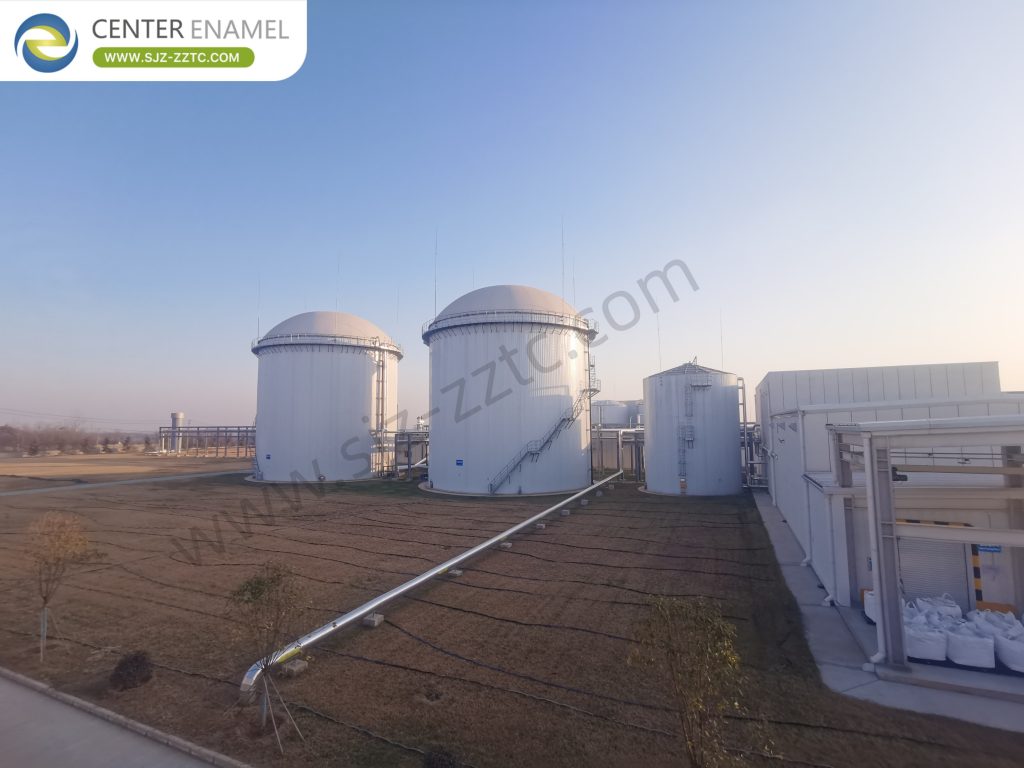
The real-world application of these technologies is validated by successful projects worldwide. Commissioned in 2013 as the core anaerobic digestion reactor for the POME treatment station, with 3 GFS tanks in two sizes: 17.58 m dia. × 8.4 m height / 16.82 m dia. × 7.2 m height. The tanks serve as the core anaerobic reaction equipment specifically for high-organic palm oil production wastewater-anaerobic digestion degrades pollutants and recovers biogas. Tanks are adapted to local palm industry wastewater needs. GFS tank assembly is convenient with corrosion resistance for Southeast Asia's hot humid high-corrosion environment-a mature biomass energy environmental benchmark project. This long-standing project illustrates Center Enamel's extensive experience in delivering Biogas Power Plant solutions, with the plant having operated successfully for over 15 years, demonstrating the durability of GFS tanks and the effectiveness of the UASB Process in challenging tropical climates.
Over a Decade of Global Installation Experience Ensures Project Success
The global reach of Center Enamel ensures that clients worldwide can benefit from its expertise. Unmatched global practical experience among domestic peers-over a decade covering multiple regions and all industry sectors. In 2009, Center Enamel completed the first overseas GFS tank installation-sending a team to Niger, Africa for drinking water storage tank installation. In 2015, it broke industry ground with China's first GFS tank export and installation to the US-passing strict US acceptance standards. All installed projects have operated stably for many years, covering livestock biogas, POME, municipal wastewater, and drinking water storage applications. Construction has covered Southeast Asia, Africa, the Americas, and other regions-accumulating specialized solutions for complex sites including mountainous terrain, coastal salt spray, tropical high temperatures, and high-standard European/American facility conditions-maturely addressing global special construction requirements. This extensive history demonstrates the company's ability to deliver reliable, code-compliant infrastructure anywhere in the world, making it a trusted Beverage Wastewater Treatment Project EPC Contractor.
Professional Design Team Delivers Customized Engineering Solutions
The expertise behind these solutions is built on decades of dedicated innovation. The design team includes senior engineers registered in the Hebei Provincial Science and Technology Expert Database, with design standards aligned with strict European/American high-end equipment safety standards. The team can provide complete integrated design for differentiated overseas projects in livestock biogas, POME, municipal wastewater, hazardous waste storage, seawater desalination, etc.-covering tank structure, anti-corrosion/sealing systems, biogas piping, and anaerobic process integration.
Pre-design thoroughly investigates local seismic zone, wind pressure, soil bearing capacity, water quality corrosivity, and local environmental discharge standards-applying thickened panels, reinforced anchored bases, and optimized sealing/corrosion structures as needed. Complete customized equipment solutions can be tailored to customer plant area, wastewater load, treatment targets, and budget-balancing safety, economics, and local adaptation-providing compliant, stable, and highly adaptable equipment structural design support for global environmental projects. This expert team ensures that every Biogas Power Plant and Beverage Wastewater Treatment Project receives not just equipment, but a tailored solution that navigates local regulations and maximizes return on investment.
Aluminum Alloy Trough Deck Roof Provides Cost-Effective Tank Cover Solutions
For ancillary storage needs, a practical and economical cover solution is available. Aluminum Alloy Trough Deck Roof is a cost-effective economical tank cover solution for clean water and wastewater storage scenarios, primarily designed for drinking water, production wastewater, and firewater reserve tanks, balancing practicality and cost advantages. The main body is integrally formed from anti-corrosion aluminum alloy plates, paired with aluminum support trusses. Its lightweight design imposes less load on the tank foundation, reducing civil construction investment.
A naturally formed dense oxide protective layer on the surface resists rain and mild wastewater corrosion, withstands outdoor sun and rain exposure, and effectively blocks wind, rain, insects, fallen leaves, and odor volatilization, protecting water quality by preventing dust and debris from falling in and causing secondary contamination. The flat roof structure is neat and orderly, allowing installation of maintenance walkways, guardrails, vents, and level monitoring ports on top, facilitating daily inspection and equipment maintenance.
The simple sealing structure enables straightforward installation with short construction timelines, and virtually eliminates the need for anti-corrosion painting maintenance, resulting in extremely low operational costs. It is suitable for various small, medium, and large atmospheric pressure water storage tanks, and has been widely implemented in waterworks clear water tanks, industrial circulating water tanks, park firewater tanks, and domestic wastewater temporary storage facilities. It is highly compatible with water storage applications that do not require biogas collection or high-pressure sealing.
Frequently Asked Questions (FAQ)
1. Why is the UASB Process the preferred choice for beverage wastewater treatment?
The UASB Process excels in treating high-strength organic wastewater typical of beverage production. Beverage effluent is characterized by high COD (3,000-20,000 mg/L), excellent biodegradability (BOD/COD 0.5-0.65), and contains soluble sugars which are rapidly degraded by anaerobic granular sludge, achieving over 80% COD removal while producing valuable biogas for energy recovery.
2. How does the UASB Process contribute to a Biogas Power Plant's energy efficiency?
The UASB Process converts high-concentration organic pollutants into biogas, a renewable energy source. This biogas can be captured and used for plant heating, electricity generation, or as a fuel, significantly offsetting operational energy costs and even generating surplus revenue, making it a cornerstone of any efficient Biogas Power Plant.
3. What makes Center Enamel a reliable Beverage Wastewater Treatment Project EPC Contractor?
With over 30 years of experience, proprietary anti-corrosion enamel technology, global installation coverage across 100+ countries, and successful delivery of over 30,000 environmental projects, Center Enamel provides end-to-end EPC services. Our integrated approach combines the efficient UASB Process with durable GFS tanks, ensuring high biogas yields, operational stability, and long-term reliability in diverse climatic conditions.