
How Can We Use Anaerobic Digestion to Treat Chemical Wastewater?
Industrial wastewater regulation is no longer a matter of meeting discharge limits and moving on. Global policy frameworks are escalating from "compliance discharge" toward mandatory resource recovery and zero liquid discharge. The EU's Circular Economy Action Plan requires member states to raise industrial wastewater reuse rates and extends carbon footprint accounting across the full treatment life cycle. China continuously tightens pollutant discharge standards, with increasingly strict limits on total nitrogen, total phosphorus, and characteristic pollutants for chemicals, pharmaceuticals, and printing and dyeing.
Some water-scarce regions and highly polluting industries are now mandated to adopt zero or near-zero liquid discharge. Germany has built a differentiated pretreatment standard system by industry, requiring wastewater to meet specific quality thresholds before entering municipal plants. For chemical producers, these converging pressures point to one conclusion: treatment must be designed for recovery, not just removal-and Anaerobic Digestion sits at the center of that shift.
Why Is Anaerobic Digestion the Backbone of Modern Chemical Wastewater Treatment?
Chemical wastewater is notoriously hostile to biological treatment. COD ranges from 5,000 to 80,000 mg/L, with coal chemical streams exceeding 100,000 mg/L. BOD/COD ratios below 0.25 reflect large quantities of synthetic refractory macromolecules. The effluent carries benzene series, phenols, cyanides, sulfides, halogenated hydrocarbons, and toxic characteristic pollutants, alongside inorganic salts reaching tens of thousands to over 100,000 mg/L. pH fluctuates wildly between strong acid and strong alkaline batches. In this environment, Anaerobic Digestion offers a decisive advantage: it degrades high-strength organics without the energy-intensive aeration that aerobic processes demand, while converting pollutant load into biogas that can offset plant energy costs. The key is configuring anaerobic treatment to survive the toxicity, salinity, and shock loads that define chemical effluent-and that is precisely where the IC reactor earns its place.
How Does the IC Reactor Support Anaerobic Digestion in Chemical Service?
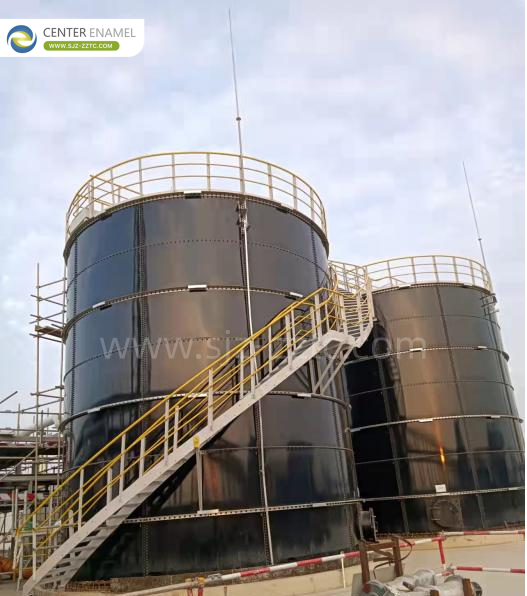
The IC reactor, or Internal Circulation Anaerobic Bioreactor, uses biogas lift to recirculate degassed mixed liquor from the upper gas-liquid separator back to the reactor bottom-creating autonomous internal circulation with no external return pumps. For chemical wastewater, this delivers three practical benefits. The circulation dilutes incoming toxic and shock loads, shielding anaerobic biomass from inhibition. High upflow velocity keeps granular sludge expanded, maximizing contact between microorganisms and recalcitrant pollutants. And the two-stage reaction zone provides built-in polishing: the lower zone handles the bulk of degradation while the upper zone captures residual organics, stabilizing effluent quality. Core equipment includes the GFS tank shell with built-in gas-lift circulation system and upper/lower three-phase separators, supported by a precision bottom distribution system and pressure-regulating feed device for uniform influent. Biogas collection, desulfurization, dehydration, and storage are integrated at the top, while high-precision online monitoring tracks temperature, pH, COD, and level in real time. The result is a compact, highly automated system with no excess external equipment.
What Does a Standardized Chemical Wastewater Treatment Train Look Like?
Chemical effluent rarely yields to a single process. A standardized solution follows a long combined train: segregated pretreatment, advanced oxidation, anaerobic digestion, aerobic treatment, and final advanced treatment. Pretreatment separates streams by type-oily wastewater through oil separation and DAF, phenolic wastewater through solvent extraction, high-salinity streams through evaporation crystallization, high-cyanide through cyanide destruction, and heavy-metal-bearing streams through chemical precipitation. Advanced oxidation (Fenton, ozone catalytic oxidation, electrochemical oxidation) then breaks down macromolecular toxic organics and improves biodegradability before the main biochemical stage, where IC/UASB anaerobic reactors couple with A/O or SBR aerobic processes. High-salinity streams require halophilic bacteria acclimation. Final advanced treatment relies on activated carbon adsorption, reverse osmosis, and evaporation crystallization to ensure compliance or reuse. Because this train involves multiple equipment sets and complex controls, tank selection matters enormously-GFS tanks resistant to high salinity, strong acids and bases, and strong oxidant corrosion are the preferred choice for these aggressive conditions.
Why Do GFS Tanks Outperform Concrete in Corrosive Chemical Service?
The corrosion resistance and gas-tightness of the tank shell directly determine long-term operational stability in chemical service. GFS tanks are fully factory-prefabricated to standardized specifications, and their finished quality far exceeds cast-in-place concrete. Concrete tanks are built in the open air, where rebar tying, pouring, and curing are heavily influenced by worker skill, temperature, and rainfall. Wall thickness, density, and strength vary between batches, and hidden defects such as honeycombing, voids, and insufficient wall thickness are common-quality cannot be uniformly controlled. By contrast, GFS steel panels, seals, and reinforcement components are mass-produced in automated factories. Steel stamping, high-temperature enameling, and dimensional cutting are CNC-controlled, with each panel's parameters and enamel thickness following unified national standards. Full-process inspection from raw material to finished component eliminates the uncontrollable risks of on-site construction, delivering consistent performance tank after tank-a decisive advantage when the internal environment is sulfide-rich, saline, and pH-volatile.
How Does Center Enamel Support Projects from Planning to Certification?
Technology alone does not deliver a compliant plant. Center Enamel's marketing team combines environmental industry multi-skilled professionals with multilingual foreign trade specialists, bringing deep expertise in global biogas, wastewater treatment, and biomass new energy markets across Southeast Asia, Africa, Europe, and the Americas. The team is proficient in various countries' wastewater discharge regulations, biogas subsidy policies, and carbon trading rules, providing one-stop preliminary site survey, solution planning, and investment return analysis. Multilingual capabilities in English, French, Spanish, and Arabic allow precise matching of regional industrial resources, project budgets, and environmental requirements, with GFS tank and anaerobic reactor solutions customized to production capacity, treatment targets, and gas production expectations. On the credential side, Center Enamel holds CE, NSF, WRAS, ISO9001, BSCI, and ASME certifications-clearing EU, North American, Southeast Asian, and African tendering barriers and providing hard credential advantages for large overseas project bids.
Table 1: Chemical Wastewater Characteristics & Treatment Response
| Parameter | Typical Range | Treatment Implication |
| COD | 5,000–80,000+ mg/L | High-rate anaerobic digestion required |
| BOD/COD ratio | Below 0.25 | Advanced oxidation pretreatment needed |
| Salinity | Tens of thousands to 100,000+ mg/L | Halophilic acclimation; corrosion-resistant tanks |
| pH | Strong acid to strong alkaline | GFS tank resistance to pH fluctuation |
| Characteristic pollutants | Benzene, phenols, cyanides, sulfides | Segregated pretreatment by stream type |
| Regulatory driver | ZLD / resource recovery mandates | Full train with reuse and crystallization |
Table 2: Certification & Project Credentials
| Item | Detail |
| Global certifications | CE, NSF, WRAS, ISO9001, BSCI, ASME |
| Regional market coverage | Southeast Asia, Africa, Europe, Americas |
| Regulatory expertise | Discharge rules, biogas subsidies, carbon trading |
| Languages supported | English, French, Spanish, Arabic |
| Demonstration project | Pakistan food waste + Napier grass biogas, 100 m³/day |
| Core process portfolio | IC reactor, UASB, CSTR, GFS tank systems |
Frequently Asked Questions
Q: Can Anaerobic Digestion handle high-salinity chemical wastewater?
A: Yes. With halophilic bacteria acclimation and corrosion-resistant GFS tanks, anaerobic systems operate stably at salt concentrations exceeding 100,000 mg/L.
Q: Why choose an IC reactor over conventional UASB?
A: The IC reactor's biogas-driven internal circulation dilutes shock loads, improves sludge-pollutant contact, and delivers a smaller footprint with no external return pumps.
Q: Do GFS tanks meet international project standards?
A: Center Enamel GFS tanks hold CE, NSF, WRAS, ISO9001, BSCI, and ASME certifications, clearing tendering barriers across EU, North America, Southeast Asia, and Africa.
Share your effluent profile with our engineers and receive a tailored Chemical Wastewater Treatment configuration, including anaerobic digestion sizing and tank specifications.
Talk to Center Enamel about your project's compliance targets-our team will map the right Anaerobic Digestion pathway from pretreatment through final discharge or reuse.