
How Do We Use GFS Tanks to Help Pharmaceutical Plants Treat Wastewater?
Industrial wastewater treatment today is defined by a convergence of escalating pressures. The core challenges center on the "three highs"-high difficulty, high cost, and high energy consumption. Wastewater from new energy, chemical, and pharmaceutical industries is complex in composition with numerous characteristic pollutants, and traditional treatment processes are difficult to remove effectively.
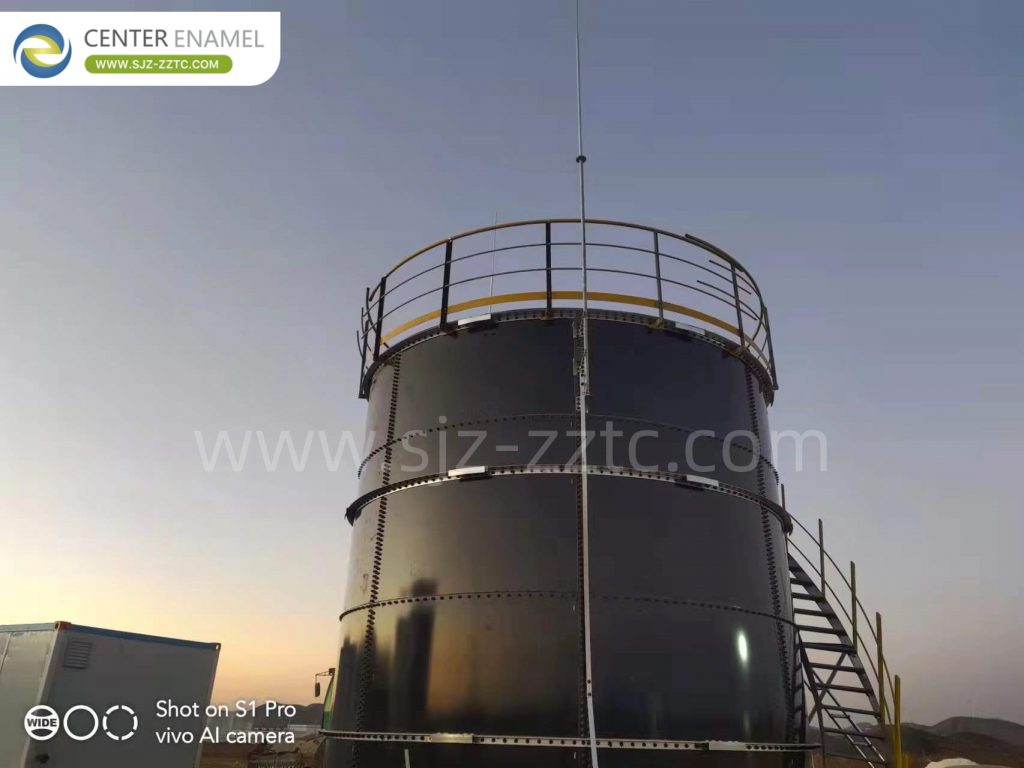
Chinese companies have significant price advantages in the mid- to low-end equipment segment, yet the industry faces continuous technological upgrade pressure from increasingly stringent emission standards, alongside new requirements for digitalization and low-carbon transformation on operational refinement management capabilities. For anyone planning a Pharmaceutical Wastewater Treatment Project, these pressures converge into a single critical question: what containment material can withstand the corrosive conditions while supporting the biological processes required for compliance?
GFS Tanks Adaptable to Complex Operating Conditions Across All Industries
The answer lies in glass-fused-to-steel technology. Center Enamel has independently developed over 200 specialized enamel frit formulations and supporting patents, capable of customizing anti-corrosion enamel based on customer storage media, with adaptability comprehensively superior to concrete tanks. Concrete tanks use a single material, only suitable for neutral clean water storage. When storing corrosive materials such as livestock manure, palm oil mill effluent, chemical wastewater, food waste digestate, or high-salinity wastewater, additional anti-corrosion linings must be applied. These linings are prone to failure, preventing long-term stable operation and cannot adapt to alternating high/low concentration storage conditions.
GFS Tanks solve this problem at the material level. They can be specifically formulated with specialized enamels resistant to strong acids, strong alkalis, high organic content, and high salinity. A single tank can switch between multiple wastewater and fermentation feedstock storage requirements. They are universally applicable across biogas anaerobic digestion, municipal wastewater, livestock farming, food processing, and industrial water treatment scenarios, eliminating the need to rebuild tanks for media changes and perfectly meeting the needs of diversified, multi-condition environmental protection projects. This versatility is precisely what a Pharmaceutical Wastewater Treatment Project demands, where influent characteristics can shift dramatically from batch to batch.
IC Process Supporting Equipment: An Integrated System Built on GFS Tanks
The containment vessel is not a passive component-it is integral to process performance. In the IC Process, core equipment is the GFS tank with a built-in gas-lift internal circulation system and upper/lower three-phase separators-key components for autonomous circulation and sludge-water separation. The bottom precision distribution system and pressure-regulating feed device ensure uniform, stable influent. Supporting equipment includes influent lift pumps, equalization tanks, and flow meters for precise influent control, along with top high-efficiency biogas collection, desulfurization, dehydration, and storage integrated equipment. High-precision online monitoring equipment provides real-time temperature, pH, COD, and level monitoring. Bottom and mid-section dedicated sludge discharge pipes and recirculation control devices complete the system-no external return pumps are needed for internal circulation. The complete system is highly integrated, with no excess external equipment, compact structure, and high automation.
The choice of GFS tanks for this system is deliberate. The glass coating's smooth, non-porous surface prevents material buildup and biofilm formation that could interfere with circulation hydraulics. The gas-tight construction supports efficient biogas collection. And the corrosion resistance ensures that the tank shell does not degrade under the aggressive conditions inside an anaerobic reactor treating pharmaceutical wastewater.
Pharmaceutical Wastewater: Why a Combined Treatment Train Is Essential
Pharmaceutical wastewater cannot be treated by a single process. Compliance requires a combined treatment train of "pretreatment + anaerobic digestion + aerobic treatment + advanced treatment." Pretreatment uses coagulation/sedimentation, DAF, advanced oxidation, and desalination processes to remove macromolecular organics, suspended impurities, and toxic/inhibitory substances, reducing biological toxicity and improving biodegradability. The main stage uses IC/CSTR anaerobic + A/O coupled processes to target high-concentration organic pollutants. End-stage Fenton oxidation, activated carbon adsorption, and UF/RO advanced treatment processes remove residual recalcitrant pollutants and salts.
The full treatment train is lengthy, equipment is complex, operation and control are demanding, chemical and energy consumption are high, and toxic sludge hazardous waste disposal costs are substantial-requiring strict O&M expertise and equipment corrosion resistance. Throughout this train, tanks preferentially use Center Enamel GFS tanks to withstand high-salinity, highly corrosive wastewater. Without this level of corrosion protection, the containment infrastructure would become the weakest link in an otherwise well-designed Pharmaceutical Wastewater Treatment Project.
Proven Anaerobic Performance: Pakistan Biogas Demonstration Project
Center Enamel's anaerobic expertise is validated by real-world project delivery. The Pakistan Food Waste + Napier Grass Biogas Demonstration Project exemplifies the company's capability as general contractor. CSTR served as the core anaerobic process, using food waste and Napier grass as mixed fermentation feedstock. The system is equipped with a mechanical mixing system ensuring thorough mixing of feedstock and anaerobic microorganisms, achieving efficient organic degradation with stable daily biogas production of 100 m³. This is the local official demonstration project for validating gas production efficiency and long-term continuous operational stability. After successful pilot operation, multiple large-scale Napier grass biogas projects are planned locally to promote biomass clean energy and support regional low-carbon development.
| Project | Location | Process | Feedstock | Biogas Output | Key Features |
| Pakistan Food Waste + Napier Grass Biogas Demonstration Project | Pakistan | CSTR | Food waste + Napier grass (mixed fermentation) | 100 m³/day | Mechanical mixing system; official local demonstration project; validates gas production efficiency and long-term operational stability |
This project demonstrates that anaerobic treatment systems built on GFS tanks can operate stably over the long term-a critical validation for pharmaceutical wastewater applications where reliability is non-negotiable.
Full-Category Product Matrix
Center Enamel has built a complete product matrix of "core storage tanks + supporting covers + specialty pressure vessels + complete environmental engineering services"-the only company globally to achieve integrated enamel frit R&D, self-manufacturing, and GFS tank application.
| Category | Product | Key Features | Primary Applications |
| Core | Proprietary GFS Tanks | Double-sided hot-rolled double-layer enamel anti-corrosion technology; resistant to strong acids/alkalis, high salinity, microbial corrosion; modular quick assembly | All strong-corrosion conditions in wastewater, biogas, and chemical applications |
| Supporting | Fusion Bonded Epoxy Tanks | Produced on China's first intelligent standardized production line | Drinking water, fire water, neutral medium storage |
| Sealing | Aluminum Dome Covers | Proprietary high-strength aluminum alloy self-supporting structure; meets international waterproof and load-bearing standards | Tank sealing and biogas collection |
| Other Tanks | Carbon Steel Tanks, Stainless Steel Tanks, Composting Tanks, Non-Standard Pressure Vessels | Customizable to project requirements | Diverse industrial and environmental applications |
| Engineering Services | Environmental EPC General Contracting, Anaerobic Process Section Subcontracting | One-stop coverage across food waste, leachate, municipal wastewater, livestock biogas, petrochemical/metallurgical, and seawater desalination industries | Customizable tank volume, corrosion protection grade, and complete process solutions |
For a Pharmaceutical Wastewater Treatment Project, this matrix means every major component-from the anaerobic reactor shell to the gas collection cover-can be sourced, manufactured, and integrated by a single responsible partner.
Global Integrated Standardized Service System
Equipment quality alone does not ensure project success. Leveraging regional sales centers in China and overseas local agent networks, Center Enamel has established a complete after-sales service loop covering all markets. The system provides four core service pillars: a 24/7 rapid response mechanism, on-site domestic/overseas installation services, full-project-cycle after-sales support, and long-term warranty protection-forming a complete service chain from preliminary site survey, mid-term construction management, to long-term inspection and maintenance.
The entire system is uniformly adapted to both domestic and international project service standards, coordinating personnel scheduling, material support, and on-site coordination for simultaneous projects across multiple regions. This significantly reduces customer multi-party coordination costs and ensures efficient domestic and overseas project delivery-a critical capability when GFS tanks must be shipped, assembled, and commissioned across different regulatory environments and site conditions.
Ready to specify GFS Tanks for your pharmaceutical wastewater treatment project? Contact Center Enamel today to discuss tank sizing, enamel formulation, and integration with IC anaerobic process design.
Frequently Asked Questions
Why are GFS Tanks preferred for pharmaceutical wastewater treatment projects?
GFS Tanks resist high salinity, strong acids/alkalis, and microbial corrosion, and a single tank can handle alternating high/low concentration wastewater-ideal for pharmaceutical applications.
What is the service life of GFS Tanks?
Center Enamel's proprietary double-sided double-layer enameling technology provides a corrosion service life exceeding 30 years, far surpassing concrete and ordinary equipment.
Can GFS Tanks be used for both wastewater storage and biogas collection?
Yes. With aluminum dome covers, GFS Tanks provide airtight sealing for biogas collection while also serving as corrosion-resistant anaerobic reactor vessels.