
How We Use GFS Tanks to Solve High-Salinity Pharmaceutical Wastewater Challenges?
The core challenges of industrial wastewater treatment center on the "three highs"-high difficulty, high cost, and high energy consumption. Wastewater from new energy, chemical, and pharmaceutical industries is complex in composition with numerous characteristic pollutants, and traditional treatment processes are difficult to remove effectively. Chinese companies have significant price advantages in the mid- to low-end equipment segment. The industry also faces continuous technological upgrade pressure from increasingly stringent emission standards, as well as new requirements for digitalization and low-carbon transformation on operational refinement management capabilities.
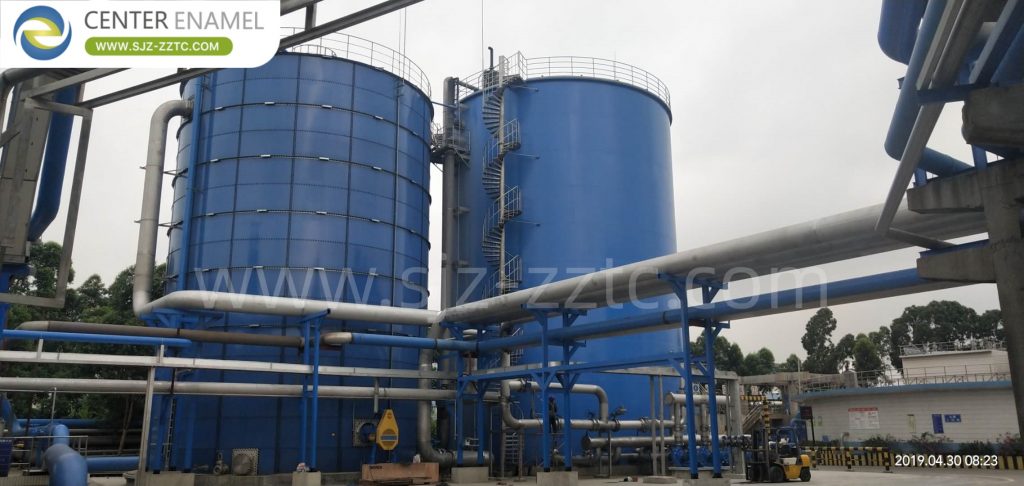
For pharmaceutical manufacturers in particular, these pressures converge. Meeting discharge standards requires more than a single process-it demands corrosion-resistant equipment and an integrated treatment train. This is where GFS Tanks and a well-designed Pharmaceutical Wastewater Treatment Project become essential.
GFS Tanks: Corrosion Resistance Far Superior to Traditional Concrete Tanks
Center Enamel's independently developed double-sided double-layer enameling technology is the industry's leading coating anti-corrosion technology, with corrosion resistance completely surpassing concrete tanks. Concrete tank interiors are riddled with pores, allowing wastewater and acid/alkaline media to easily penetrate and corrode the structural layer. Long-term use leads to irreversible problems such as internal wall spalling, water seepage, and rebar corrosion, which are difficult to repair and cannot be fundamentally resolved.
GFS tanks feature high-temperature enameling on both the interior and exterior surfaces of steel panels, with a dense, non-porous enamel finish that completely blocks corrosive liquids and biogas permeation. The enamel layer has extremely strong chemical stability, resisting acids, alkalis, salts, and microbial corrosion. Concrete tanks will develop extensive corrosion and leakage after 5-8 years of use, while GFS tank anti-corrosion service life can exceed 30 years, with no need for frequent internal lining repairs throughout the service life, significantly reducing long-term anti-corrosion maintenance investment and fundamentally eliminating environmental risks of medium leakage contaminating sites and groundwater. Compared to traditional concrete and FRP tanks, GFS tank coatings have no risk of peeling or blistering, and are adaptable to highly corrosive conditions such as palm oil mill effluent, livestock manure, and chemical high-salinity wastewater, with outstanding long-term comprehensive cost advantages.
Table 1: GFS Tanks vs. Traditional Concrete Tanks
| Feature | GFS Tanks | Concrete Tanks |
| Corrosion Resistance | Excellent (30+ years) | Poor (5–8 years) |
| Porosity | Non-porous enamel | Highly porous |
| Repair Needs | No lining repairs | Frequent spalling/seepage |
| Chemical Stability | Acids, alkalis, salts, microbes | Degrades over time |
| Environmental Risk | Minimal leakage risk | Groundwater contamination risk |
IC Supporting Equipment
Core equipment is the GFS tank with built-in gas-lift internal circulation system and upper/lower three-phase separators-key components for autonomous circulation and sludge-water separation. Bottom precision distribution system and pressure regulating feed device ensure uniform stable influent. Supporting equipment includes influent lift pumps, equalization tanks, and flow meters for precise influent control. Top high-efficiency biogas collection, desulfurization, dehydration, and storage integrated equipment. High-precision online monitoring equipment for real-time temperature, pH, COD, and level monitoring. Bottom and mid-section dedicated sludge discharge pipes and recirculation control devices-no external return pumps needed for internal circulation. The complete system is highly integrated, with no excess external equipment, compact structure, and high automation.
Pharmaceutical Wastewater Standardized Treatment Solutions
Cannot rely on a single process for compliance-must use a combined treatment train of "pretreatment + anaerobic digestion + aerobic treatment + advanced treatment." Pretreatment uses coagulation/sedimentation, DAF, advanced oxidation, and desalination processes to remove macromolecular organics, suspended impurities, and toxic/inhibitor substances, reducing biological toxicity and improving biodegradability. The main stage uses IC/CSTR anaerobic + A/O coupled processes to target high-concentration organic pollutants.
End-stage Fenton oxidation, activated carbon adsorption, and UF/RO advanced treatment processes remove residual recalcitrant pollutants and salts. The full treatment train is lengthy, equipment complex, operation and control demanding, chemical and energy consumption high, and toxic sludge hazardous waste disposal costs substantial-requiring strict O&M expertise and equipment corrosion resistance. Tanks preferentially use Center Enamel GFS tanks to withstand high-salinity, highly corrosive wastewater.
Table 2: Pharmaceutical Wastewater Treatment Train
| Stage | Processes | Purpose |
| Pretreatment | Coagulation, DAF, advanced oxidation, desalination | Remove macromolecules, toxins; improve biodegradability |
| Main Stage | IC/CSTR anaerobic + A/O | Target high-concentration organics |
| Advanced Treatment | Fenton, activated carbon, UF/RO | Remove residual pollutants and salts |
Pakistan Food Waste + Napier Grass Biogas Demonstration Project
Center Enamel is the general contractor, with CSTR as the core anaerobic process using food waste and Napier grass as mixed fermentation feedstock. Equipped with mechanical mixing system ensuring thorough mixing of feedstock and anaerobic microorganisms-efficient organic degradation with stable daily biogas production of 100 m³. This is the local official demonstration project for validating gas production efficiency and long-term continuous operational stability. After successful pilot operation, multiple large-scale Napier grass biogas projects are planned locally to promote biomass clean energy and support regional low-carbon development.
Center Enamel Marketing Team
The marketing team brings together environmental industry multi-skilled professionals and multilingual foreign trade specialists, with deep expertise in global biogas, wastewater treatment, and biomass new energy markets-accumulating extensive practical project experience in Southeast Asia, Africa, Europe, and the Americas.
The team is proficient in various countries' wastewater discharge regulations, biogas subsidy policies, and carbon trading rules-providing one-stop preliminary site survey, solution planning, and investment return analysis consulting services. With multilingual capabilities (English, French, Spanish, Arabic), the team effectively communicates with clients worldwide-precisely matching regional industrial resources, project budgets, and environmental requirements-customizing high-cost-performance GFS tanks and anaerobic reactor solutions based on client production capacity, treatment targets, and gas production expectations. Leveraging extensive overseas project experience, the team proactively helps clients avoid risks in overseas approvals, equipment import, and construction implementation-building a globally adaptable integrated environmental equipment business service system.
Comprehensive International Authoritative Certifications
Center Enamel holds CE, NSF, WRAS, ISO9001, BSCI, ASME, and other global certifications-fully clearing EU, North American, Southeast Asian, and African project tendering barriers-providing critical hard credential advantages for large overseas project bidding. These certifications give clients confidence that every Pharmaceutical Wastewater Treatment Project is backed by internationally recognized quality and safety standards.
Ready to protect your pharmaceutical wastewater treatment project with corrosion-resistant GFS tanks? Contact Center Enamel today for a tailored engineering solution.
Our multilingual team is ready to guide you from site survey to commissioning-reach out now to discuss your compliance and treatment goals.
Frequently Asked Questions
Why are GFS tanks better than concrete for pharmaceutical wastewater?
GFS tanks resist acids, alkalis, salts, and microbial corrosion for 30+ years, while concrete tanks leak and spall within 5–8 years.
What processes does a pharmaceutical wastewater treatment project need?
A combined train: pretreatment, anaerobic digestion (IC/CSTR), aerobic treatment (A/O), and advanced treatment like Fenton or UF/RO.
What certifications does Center Enamel hold?
CE, NSF, WRAS, ISO9001, BSCI, and ASME-clearing tendering barriers across the EU, North America, Southeast Asia, and Africa.