
How Do We Use GFS Tanks to Treat Complex Industrial Wastewater?
Few engineering decisions carry more risk than choosing storage and reactor tanks for complex industrial wastewater. The streams involved-chemical, pharmaceutical, food processing and new energy effluents-combine aggressive corrosives, high salinity, high organic loads and constant composition swings that punish the wrong material choice within months.
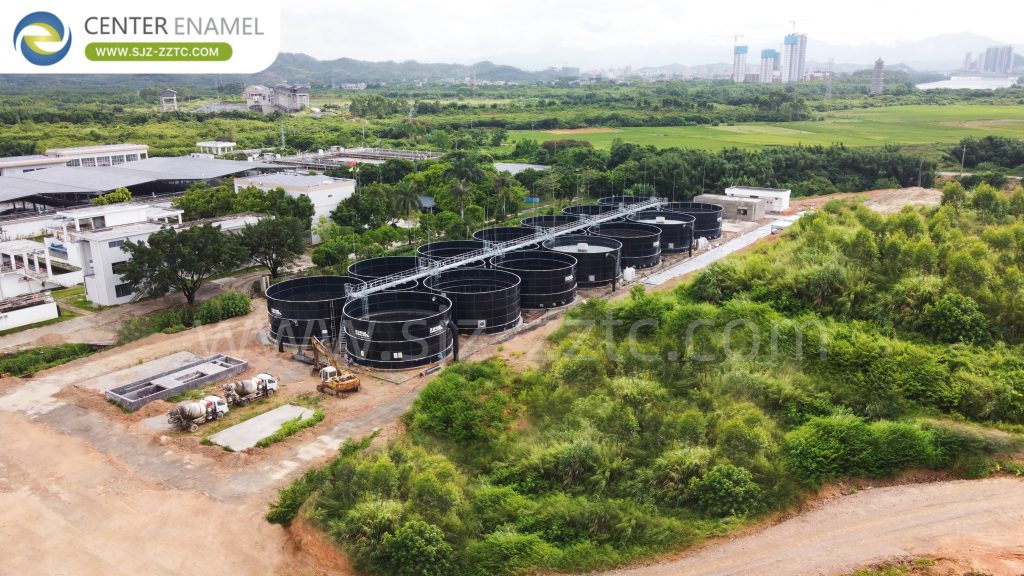
This is where GFS tanks have earned their place at the center of modern industrial wastewater treatment design. Glass-fused-to-steel technology fuses a vitreous enamel layer to structural steel at high temperature, producing a tank that is simultaneously corrosion-proof, structurally strong and rapidly assembled. With more than 30,000 overseas projects across 100+ countries, Center Enamel (Shijiazhuang Zhengzhong Technology Co., Ltd) applies this technology across biogas, municipal, livestock and industrial water treatment worldwide. Here is how our GFS tanks solve the toughest wastewater challenges-and why they outperform traditional construction.
The Three Highs Defining Industrial Wastewater Treatment
The starting point for any serious industrial wastewater treatment strategy is an honest diagnosis of the challenge. The industry summarizes it in three words: high difficulty, high cost and high energy consumption. Wastewater from new energy, chemical and pharmaceutical industries is complex in composition and carries numerous characteristic pollutants that traditional treatment processes cannot remove effectively, forcing owners to look beyond conventional equipment. Chinese manufacturers hold significant price advantages in the mid-to-low-end equipment segment, yet the real pressure on every operator comes from tightening emission standards, which continuously push technology upgrades, and from new demands for digitalization and low-carbon transformation, which test operational refinement and management capability.
When processes must handle so much variability, the equipment envelope becomes the decisive factor-and that is precisely where tank material and design enter the conversation.
Why GFS Tanks Outperform Concrete for Corrosive Duty
For decades, concrete dominated the tank landscape, and its limits are now well understood. Concrete is a single-material system suited mainly to neutral clean water storage. Once corrosive media enter the picture-livestock manure, palm oil mill effluent, chemical wastewater, food waste digestate, high-salinity streams-concrete tanks require additional anti-corrosion linings. Those linings are prone to failure, prevent long-term stable operation, and cannot adapt to alternating high and low concentration storage conditions.
Center Enamel's GFS tanks were engineered to eliminate these weaknesses. We have independently developed more than 200 specialized enamel frit formulations and supporting patents, allowing us to customize anti-corrosion enamel for the specific media a customer stores. Specialized enamels resist strong acids, strong alkalis, high organic content and high salinity, and a single GFS tank can switch between multiple wastewater and fermentation feedstock storage requirements without modification. The result is universal applicability across biogas anaerobic digestion, municipal wastewater, livestock farming, food processing and industrial water treatment-with no need to rebuild tanks when media change, perfectly meeting the needs of diversified, multi-condition environmental protection projects.
Table 1-GFS Tanks vs. Concrete Tanks
| Comparison Point | GFS Tanks | Concrete Tanks |
| Material adaptability | 200+ enamel frit formulations, customized per storage media | Single material, suitable mainly for neutral clean water |
| Corrosion resistance | Resists strong acids, strong alkalis, high organics, high salinity | Requires anti-corrosion linings for corrosive media |
| Media switching | One tank handles multiple wastewater and feedstock types | Linings prone to failure; no alternating concentration duty |
| Application scope | Biogas, municipal, livestock, food processing, industrial | Limited to clean and neutral water storage |
Pairing GFS Tanks with High-Efficiency Anaerobic Processes
Storage durability, however, is only half the equation in complex wastewater duty; treatment performance is the other half. In modern design, GFS tanks are not merely storage vessels-they are the structural home of high-rate anaerobic processes. The IC reactor, for instance, targets high-concentration, high-flow soluble industrial organic wastewater from brewery, beverage, starch, pharmaceutical, chemical and papermaking facilities. It suits land-constrained projects with demanding efficiency requirements in large industrial wastewater treatment facilities, serving as the primary process for high-strength wastewater with rapid COD/BOD removal. In centralized industrial park WWTPs and large enterprise proprietary systems, it handles significant quality fluctuations and extremely high pollutant concentrations with ease.
Two boundaries matter in honest engineering: IC reactors are not designed for high-solids or high-viscosity wastewater, and the reactor shell must match the process's aggressiveness. When the tank is a gas-tight, corrosion-resistant GFS tank, the IC system-already the preferred anaerobic process for modern high-efficiency industrial wastewater treatment-gains the long-term structural reliability it needs.
Cutting the True Cost of Chemical Wastewater Treatment
Why does tank selection matter so much commercially? Because chemical wastewater carries one of the heaviest operating and maintenance burdens in the entire industrial wastewater treatment sector, second only to pharmaceutical effluent. Strong toxicity and high salinity force extensive segregated pretreatment equipment-high capital investment and complex operation. Advanced oxidation stages consume expensive chemicals such as hydrogen peroxide, ozone and catalysts continuously, while evaporation crystallization and reverse osmosis for high-salinity streams demand enormous electricity and steam energy.
The cost spiral continues downstream. Salt-bearing and toxic sludge is hazardous waste whose compliant disposal can exceed 30% of total treatment costs. Equipment in high-salt, highly corrosive, strongly oxidizing environments suffers frequent corrosion damage, driving repair and replacement costs and forcing owners to invest in premium corrosion protection. Water quality fluctuations require dedicated 24/7 monitoring and adjustment, adding labor costs-while resource recovery benefits remain minimal. With investment far exceeding returns, every durable, corrosion-proof component-and every GFS tank that avoids lining failure and premature replacement-directly protects the project's economics.
Proven in the Field: A Brewery Wastewater Project in South Africa
The technology's practical value is best shown by delivered projects. In South Africa, Center Enamel addressed high-concentration organic wastewater from the brewing industry-a stream defined by high COD, high sugar content and rapid biodegradability, ideal for anaerobic treatment. GFS tanks served as the primary anaerobic digestion system, efficiently converting the brewery's organic load, while stainless steel tanks handled wastewater transfer and chemical storage in the supporting process. The complete package offered excellent corrosion resistance and flexible assembly, delivering long-term stable treatment of brewery production and cleaning wastewater while solving a long-standing pollution challenge for the local industry. Today, this mature brewery wastewater treatment case stands as a reference for GFS tank applications across Africa.
Table 2-South Africa Brewery Wastewater Treatment Project at a Glance
| Project Element | Details |
| Industry | Brewing (high-strength organic wastewater) |
| Wastewater Profile | High COD, high sugar content, readily biodegradable |
| Core Treatment Stage | Anaerobic digestion in GFS tanks |
| Supporting Equipment | Stainless steel tanks for wastewater transfer and chemical storage |
| Key Equipment Features | Corrosion resistance, flexible modular assembly |
| Project Outcome | Long-term stable treatment of production and cleaning wastewater; mature reference case in Africa |
A Global Footprint Built on GFS Tanks
Projects like this repeat across the world because the tank itself is a proven global asset. Center Enamel's business covers more than 100 countries and regions, with 30,000+ successful overseas projects and a well-established localized service network spanning Europe, the Americas, the Middle East, Africa, Southeast Asia and Latin America. Domestically, marketing regions across North, South, Central, East and Southwest China serve environmental, water utility, livestock and petrochemical customers nationwide.
Internationally, we follow a "standardized products + localized adaptation" model, adjusting tank corrosion protection, sealing and pressure standards for different national water quality and environmental regulations. Landmark projects-large-volume GFS tanks in Italy, 20 m tower water supply tanks in Colombia, coastal seawater treatment tanks in Costa Rica and large municipal wastewater aluminum dome projects in Saudi Arabia-demonstrate the range of conditions our tanks handle, and long-term strategic partnerships with many Fortune 500 companies attest to sustained trust.
Delivering GFS Tank Projects in Every Climate and Regulation
That global trust is backed by delivery capability that leaves nothing to chance. As the pioneer of Chinese GFS equipment exports, Center Enamel provides installation service coverage across more than 100 countries and regions, possessing full delivery capability across climates, regulations and geographies. Our reach includes Southeast Asia (Vietnam, Thailand, Malaysia, Indonesia, Cambodia, Bangladesh, Nepal), Africa (Ghana, South Africa, Mali, Guinea, Zambia, Kenya, Pakistan), Europe and the Americas (Sweden, USA, Russia), the Middle East and Latin America-adapting to tropical rainy high-salt spray, high-altitude mountainous terrain, Nordic severe cold and high-standard European and American facility conditions.
Execution relies on a dual-service model of own cross-border construction teams plus overseas local agent coordination, whether clients are in developed countries or remote developing regions. One-stop services include on-site survey, on-site installation, process commissioning and operator training, with complete coverage of biogas engineering, municipal wastewater, industrial wastewater, livestock manure and drinking water storage projects-the full delivery capability to undertake large-scale tank farm projects in any country worldwide.
Frequently Asked Questions
Q1: What makes GFS tanks suitable for complex industrial wastewater treatment? More than 200 enamel frit formulations can be customized per storage media, resisting strong acids, strong alkalis, high organics and high salinity. One tank switches between media without rebuilding-unlike lined concrete tanks.
Q2: Which industries use Center Enamel GFS tanks?
Biogas anaerobic digestion, municipal wastewater, livestock farming, food processing and industrial water treatment, including brewery, beverage, starch, pharmaceutical, chemical and papermaking facilities.
Q3: Does Center Enamel deliver GFS tank projects internationally?
Yes-30,000+ overseas projects in 100+ countries, delivered by our own cross-border construction teams and local agents with on-site survey, installation, commissioning, training and 24/7 after-sales support.
Facing a complex industrial wastewater treatment challenge? Contact Center Enamel today and let our engineers specify the right GFS tank solution for your media and site. With 30,000+ overseas projects and 200+ enamel formulations behind us, we deliver corrosion-proof storage engineered to last decades-send us your requirements for a tailored proposal.