
How an EPC Contractor Uses GFS Tanks to Treat Papermaking Wastewater?
Papermaking effluent is rarely described as "simple." It arrives with high suspended solids, strong alkalinity, lignin-laden black liquor and fibers that silt up rivers-and it comes from mills that cannot afford downtime. Delivering a treatment plant that handles all of this on schedule and on budget takes more than good process design; it takes an EPC Contractor with standardized equipment and field-proven execution. At Center Enamel, that combination is built on GFS Tanks and a full engineering, procurement and construction capability refined across 30,000+ projects in more than 100 countries.
The Three Highs Facing Industrial Wastewater Today
The core challenges of industrial wastewater treatment center on the "three highs": high difficulty, high cost and high energy consumption. Wastewater from new energy, chemical and pharmaceutical industries is complex in composition with numerous characteristic pollutants, and traditional treatment processes struggle to remove them effectively. Chinese companies hold significant price advantages in the mid- to low-end equipment segment, but the industry also faces continuous technological upgrade pressure from increasingly stringent emission standards, alongside new requirements for digitalization and low-carbon transformation in operational management.
These pressures explain why mills increasingly turn to a single accountable EPC Contractor rather than piecing together vendors-one party responsible for process, tanks, installation and commissioning, with GFS Tanks providing the standardized, corrosion-resistant foundation the whole train depends on.
Factory-Standardized GFS Tanks Beat Cast-in-Place Construction
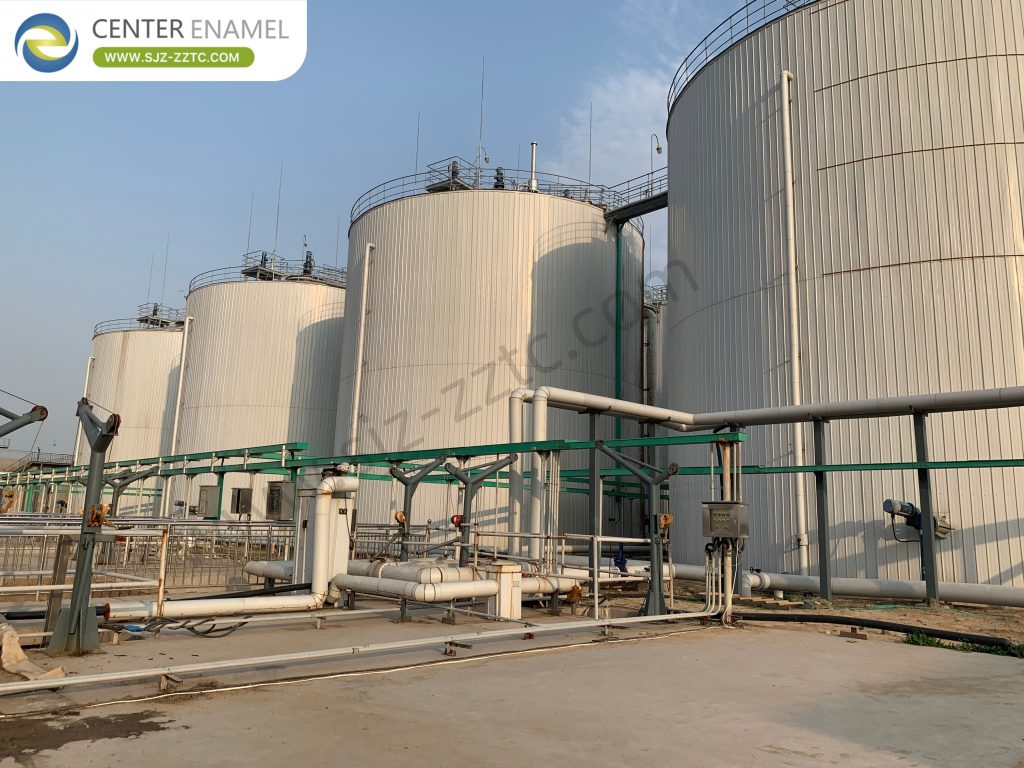
GFS tanks are fully factory-prefabricated to standardized specifications, and finished-product quality stability far exceeds cast-in-place concrete tanks. All concrete tank processes are completed in the open air, with rebar tying, pouring and curing heavily influenced by worker skill, temperature and rainfall. Wall thickness, density and strength vary significantly between batches, and hidden defects such as honeycombing, voids and insufficient wall thickness are common-quality cannot be uniformly controlled.
Center Enamel's GFS Tank steel panels, seals and reinforcement components are all mass-produced in automated factories. Steel stamping, high-temperature enameling and dimensional cutting are controlled by CNC equipment, with each panel's parameters and enamel thickness strictly following unified national standards. All components are uniformly packaged and transported to site, with assembly following standardized construction drawings. Full-process quality inspection from raw materials to finished components ensures highly consistent performance, completely eliminating the uncontrollable quality risks of on-site concrete construction-so every tank delivers stable, consistent performance.
IC Process Advantages That Make the EPC Model Work
Inside the treatment train, the IC reactor delivers top-tier treatment efficiency with a footprint only one-third that of traditional anaerobic processes for the same capacity-a significant compactness advantage for space-constrained mills. Its built-in gas-lift internal circulation requires no external recirculation equipment, providing autonomous forced mixing of sludge and water. Strong hydraulic mixing ensures thorough microbe-pollutant contact, greatly improving degradation efficiency and withstanding high water quality and hydraulic shock loads. The dual-zone configuration combines high-efficiency degradation with deep polishing for stable effluent quality.
The process also achieves a high degree of sludge granulation, strong activity and very low washout. High automation, stable operation, low failure rates, large biogas production and outstanding resource recovery benefits follow-with long-term energy and O&M costs far lower than traditional anaerobic processes. This makes the IC Process suitable for large-flow, high-concentration industrial wastewater, and it is precisely the kind of process an experienced EPC Contractor can integrate with GFS Tanks into a single, tightly managed delivery.
Why Papermaking Pollutants Demand a Tailored Train
Papermaking wastewater pollutants are primarily natural plant extracts with relatively low chemical toxicity, but high suspended solids and high alkalinity cause significant pollution impacts. High-concentration suspended fibers and fillers settle on water bodies, covering riverbed sediments and blocking fish spawning grounds and benthic habitats. Lignin, cellulose and other organics decompose consuming dissolved oxygen, causing oxygen depletion and fish suffocation. Strong alkaline black liquor directly raises receiving water pH, harming aquatic life and disrupting acid-base balance. Resin acids and tannins have some toxic effects on fish, and high color affects light penetration, inhibiting aquatic plant photosynthesis. Large quantities of fibers and fillers cause siltation of rivers and reservoirs.
Overall, the pollution is primarily physical sedimentation and oxygen-demanding organic pollution, with no heavy metals or synthetic toxics-environmental recovery periods are moderate. That profile shapes the treatment strategy: recover fiber and filler early, neutralize alkalinity, then degrade dissolved organics anaerobically and aerobically. As an EPC Contractor, Center Enamel designs this train end to end, with GFS Tanks specified for the alkaline, lignin-bearing vessels where concrete and standard-coated steel would fail.
Case Proof: South Africa Brewery High-Strength Wastewater Project
The credibility of any EPC Contractor is demonstrated in the field. Center Enamel's South Africa brewery project focuses on high-concentration organic wastewater in the brewing industry, featuring both GFS tanks and stainless steel tanks as core equipment. GFS tanks serve as the primary anaerobic digestion system, suited to brewery wastewater's high-COD, high-sugar, readily decomposable characteristics for efficient organic pollutant degradation. Stainless steel tanks handle wastewater transfer and chemical storage supporting processes. The complete package offers excellent corrosion resistance and flexible assembly, providing long-term stable treatment of brewery production and cleaning wastewater-solving local brewing industry pollution challenges and standing as a mature brewery wastewater reference in Africa.
The table below summarizes representative deliveries where GFS Tanks and EPC execution carry the load.
| Project | Industry | Core Treatment | Main Equipment | Key Challenge | Outcome |
| South Africa Brewery | Brewing / beverage | Anaerobic high-load digestion | GFS tanks + stainless steel tanks | High COD, high sugar, seasonal peaks | Stable year-round treatment, mature African reference |
| Pulp & Paper Mill (EPC) | Paper / pulp | White water recirculation + anaerobic + aerobic | GFS reactors, epoxy tanks, aluminum covers | High alkalinity, lignin corrosion, fiber loss | 60–80% discharge reduction, fiber recovery, compliant effluent |
| POME / Palm Oil Mill | Agro-processing | High-rate anaerobic biogas system | GFS digesters, dual-membrane roofs | High temperature, oil and solids | Biogas recovery + effluent reuse |
| Livestock / Swine Farm | Agricultural | Anaerobic manure digestion | GFS digesters, gas-tight roofs | High solids, odor, nutrient load | Odor control, biogas, nutrient stabilization |
Installation Teams That Deliver on Remote and Complex Sites
Standardized tanks only perform if they are erected correctly. Center Enamel's installation team brings practical experience from over 10,000 GFS tank projects globally, strictly following standardized construction procedures-full control over project mobilization, civil coordination, tank assembly, piping, and commissioning schedules and quality.
The team is proficient in complete standardized installation processes for GFS Tanks, dual-membrane gas storage covers, USR/CSTR/IC anaerobic reactors, and biogas desulfurization and piping systems-adaptable to large-scale farms, industrial parks, remote mountainous sites, coastal high-corrosion sites and other complex locations-strictly implementing unified global safety construction standards. For large overseas cross-border projects, the team can be deployed as complete units for on-site construction, technical training and local worker practical instruction, maintaining full control over construction details, air-tightness testing and corrosion protection-ensuring timely and stable commissioning of global environmental projects through standardized delivery capability. This is what separates a reliable EPC Contractor from a tank supplier.
A Global Portfolio That Speeds Up Customization
Center Enamel's project portfolio covers over 100 countries across Southeast Asia, Africa, Europe and the Americas-30,000+ mature projects-accumulating complete industry solutions across palm oil, livestock, municipal, brewing and food waste biogas. This breadth allows rapid matching of customized solutions for different regional climates, water quality and regulations, shortening the path from inquiry to engineered proposal.
The table below summarizes the scale behind that capability.
| Metric | Figure | What It Means for Clients |
| Total projects delivered | 30,000+ | Proven execution across climates and regulations |
| Wastewater projects | 2,000+ | Deep experience in high-strength industrial effluent |
| Biogas projects | 1,000+ | Strong resource-recovery track record |
| GFS tank installation experience | 10,000+ projects | Standardized erection, air-tightness and corrosion control |
| Countries served | 100+ | Global EPC and after-sales coverage |
Frequently Asked Questions
Q: How do GFS tanks resist the alkalinity and lignin in papermaking wastewater?
A: GFS tanks use double-sided hot-rolled double-layer enamel technology resistant to strong acids and alkalis, high salinity and microbial corrosion-ideal for black liquor and white water circuits where concrete or standard-coated steel would deteriorate.
Q: What does an EPC Contractor handle beyond tank supply?
A: Center Enamel covers process design, equipment manufacturing, GFS and stainless steel tanks, covers, global installation, commissioning and after-sales support-one accountable partner from first drawing to startup.
Q: How fast can a tailored proposal be delivered?
A: Share your flow rate, COD range and target discharge standard, and our engineers typically return a tailored process and tank configuration within two business days.
Are you still wrestling with papermaking effluent that clogs equipment, corrodes tanks and threatens compliance? Contact Center Enamel today with your wastewater flow, COD range and target discharge standard, and our engineers will return a tailored process and tank configuration. Reach out to our EPC team now-whether you are upgrading an existing paper mill or building a new treatment line, we are ready to turn your effluent challenge into a compliance and recovery advantage.