
Expert Biogas Plant Design with USR Process for Livestock Manure Treatment
The global livestock manure treatment policy system, with the US and EU as typical representatives, is shifting from end-of-pipe treatment to full-process nutrient management. The US establishes a manure management framework covering the entire livestock production process through Comprehensive Nutrient Management Plans. The EU, through the Nitrates Directive, strictly limits manure application amounts, with Germany and the Netherlands using tax instruments to mandate nitrogen and phosphorus recovery rates, and Denmark demonstrating distinctive features in livestock regulation and ecological compensation.
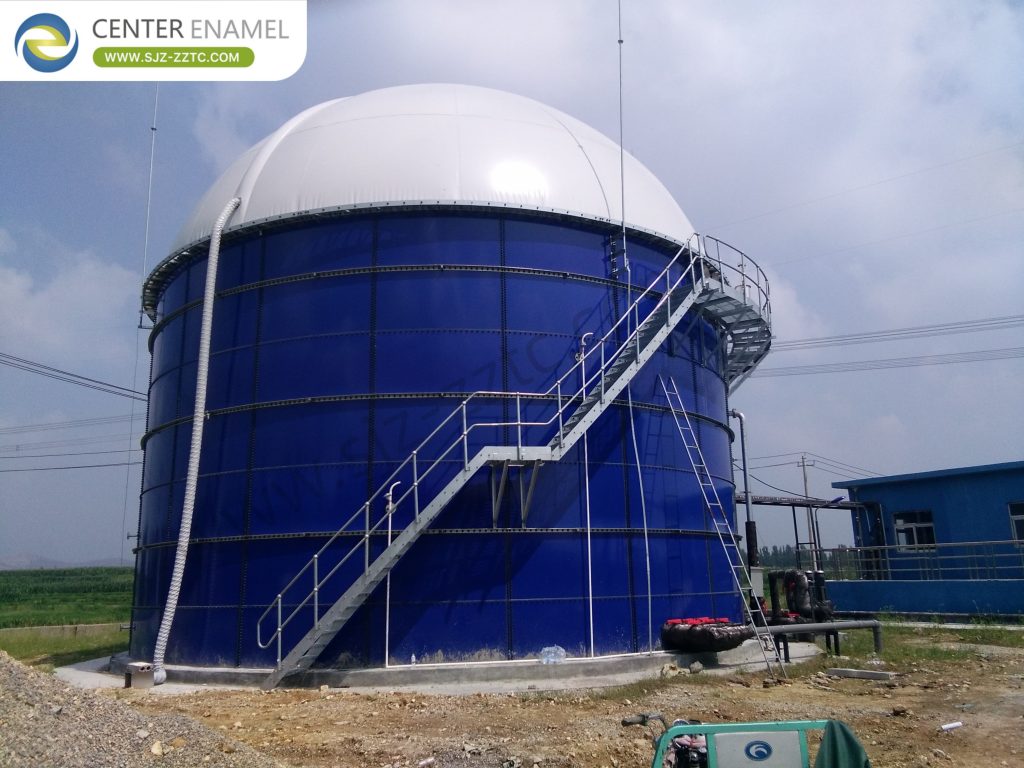
The Netherlands uses a management mechanism linking manure treatment with phosphate quotas. China has issued a series of environmental regulations, with the current legal system providing comprehensive regulation of pollution from large-scale livestock operations. These converging requirements mean that any biogas plant project design must now satisfy nutrient recovery targets, pathogen control standards, and verifiable environmental performance-not simply waste disposal.
Full-Process Factory Standardization for GFS Tanks: Consistent Quality Concrete Cannot Deliver
GFS tanks are fully factory-prefabricated to standardized specifications, with finished product quality stability far exceeding cast-in-place concrete tanks. All concrete tank processes are completed in the open air, with rebar tying, concrete pouring, and curing heavily influenced by worker skill, temperature, and rainfall. Wall thickness, density, and strength vary significantly between batches, with hidden defects like honeycombing, voids, and insufficient wall thickness common-quality cannot be uniformly controlled. Center Enamel's GFS tank steel panels, seals, and reinforcement components are all mass-produced in automated factories.
Steel stamping, high-temperature enameling, and dimensional cutting are all controlled by CNC equipment, with each panel's parameters and enamel thickness strictly following unified national standards. All components are uniformly packaged and transported to site, with assembly strictly following standardized construction drawings. Full-process quality inspection from raw materials to finished components ensures highly consistent product performance parameters, completely eliminating the uncontrollable quality risks of on-site concrete construction, with every tank delivering stable, consistent performance. This manufacturing reliability directly supports the long-term performance assumptions built into any biogas plant project design.
USR Process Definition: Purpose-Built Anaerobic Technology for High-Solids Wastewater
USR, or Upflow Solids Reactor, is an upflow anaerobic process modified for high-suspended-solids, high-solids organic wastewater, specifically designed to solve problems of clogging, sludge washout, and uneven reaction common in traditional anaerobic processes for high-solids wastewater. The process eliminates complex three-phase separators, simplifies internal structure, and relies on upflow hydraulics to promote thorough mixing of solid materials and anaerobic sludge. No strict granular sludge formation conditions are required-flocculent sludge can operate stably. The key feature is high solids tolerance and impurity resistance, with very high influent suspended solids tolerance. It is a dedicated high-efficiency anaerobic process for livestock manure, agricultural organic waste, and high-solids livestock wastewater, specifically developed for agricultural and environmental applications. In practical biogas plant project design, the USR Process is often selected when feedstock solids content would overwhelm conventional reactor configurations.
Livestock Wastewater Sources: Understanding What Enters the System
Livestock wastewater is the core agricultural pollution wastewater from large-scale poultry, livestock, and aquaculture operations, generated primarily during farming operations and facility cleaning. Poultry and livestock wastewater is the main component, including wash water from pig, cattle, and poultry housing, manure and urine seepage, and facility washdown-rich in livestock metabolic residues. Aquaculture wastewater comes from periodic pond water exchange and pond cleaning, with feed residues and metabolic waste as pollutants. Wastewater is primarily generated in peri-urban and rural farming areas. Small-scale farmers lack adequate collection facilities, with wastewater discharged directly to land and water. Large-scale farms have collection systems for centralized treatment, with water production varying with production cycles and cleaning frequency. Accurate characterization of these sources is the first step in any responsible biogas plant project design.
Bangladesh Large-Scale Poultry Farm Manure Resource Recovery Project
This benchmark project illustrates the performance achievable when sound biogas plant project design meets proven USR and CSTR technology. Targeting local poultry farm manure resource recovery with a daily treatment capacity of 47 tons, influent COD, BOD, and SS concentrations reach as high as 50,000 mg/L, 25,000 mg/L, and 50,000 mg/L respectively. After CSTR + UASB anaerobic treatment, all three parameters are reduced to below 200 mg/L, 100 mg/L, and 100 mg/L-effluent compliant with local environmental discharge standards. The project produces approximately 4,900 m³ of biogas daily; each cubic meter of biogas can generate 2 kWh of electricity, yielding daily power generation of 9,800 kWh-simultaneously achieving pollutant reduction and clean energy recovery. This is a benchmark project for livestock waste recycling in Southeast Asia.
Table 1: Bangladesh Poultry Farm Manure Resource Recovery Project Data
| Parameter | Influent Concentration | Effluent Concentration | Performance |
| COD | 50,000 mg/L | < 200 mg/L | >99.6% removal |
| BOD | 25,000 mg/L | < 100 mg/L | >99.6% removal |
| SS | 50,000 mg/L | < 100 mg/L | >99.8% removal |
| Daily Treatment Capacity | 47 tons | - | - |
| Biogas Production | - | ~4,900 m³/day | - |
| Power Generation | - | 9,800 kWh/day | 2 kWh per m³ biogas |
Center Enamel R&D Team: National-Level Expertise Behind Every Design
Center Enamel has built a full-chain professional team covering R&D, design, marketing, installation, and after-sales. The R&D team is led by national-level materials technology experts, specializing in enamel frit and tank anti-corrosion core technologies. External senior environmental engineering and mechanical structure engineers are retained to strengthen R&D capabilities, focusing on anti-corrosion coating formulations, specialty corrosion-resistant tanks, and anaerobic supporting integrated equipment-continuously breaking through industry technological barriers. The team operates through proprietary laboratories with external university research collaboration-conducting year-round new material and new process durability pilot testing and long-term corrosion simulation testing. Specialized enamel formulations are iteratively developed for extreme conditions such as high-salinity wastewater, strong acid and alkali POME, and high-organic livestock manure-providing core technical support for the company's annual new invention and utility patents and building a proprietary material technology barrier. This research depth is what allows Center Enamel to tailor biogas plant project design to feedstocks that would corrode ordinary equipment.
Center Enamel Innovative Material Technology: 200+ Formulations and 30-Year Service Life
Center Enamel has independently developed over 200 anti-corrosion enamel formulations, with proprietary double-sided double-layer enameling technology-GFS tank anti-corrosion service life exceeds 30 years-far surpassing concrete and ordinary equipment-suitable for global high-corrosion wastewater and biogas fermentation conditions. This extended service life materially improves the lifetime economics of any biogas plant project design, reducing replacement cycles and long-term maintenance expenditure while ensuring the USR Process operates within a structurally sound and chemically resistant vessel.
Table 2: Center Enamel Material Technology and R&D Capabilities
| Dimension | Detail | Project Benefit |
| Enamel Formulations | 200+ independently developed anti-corrosion formulations | Feedstock-specific corrosion resistance |
| Enameling Technology | Proprietary double-sided, double-layer enameling | Extended tank service life |
| Service Life | GFS tank anti-corrosion life exceeds 30 years | Lower lifecycle cost |
| R&D Leadership | National-level materials technology experts | Authoritative technical direction |
| External Expertise | Senior environmental and mechanical engineers | Integrated anaerobic equipment design |
| Laboratory Capability | Proprietary labs with university collaboration | Continuous material iteration |
| Testing Programs | Durability pilot testing, long-term corrosion simulation | Verified performance under extreme conditions |
| Target Conditions | High-salinity wastewater, strong acid/alkali POME, high-organic livestock manure | Broad application coverage |
| IP Output | Annual new invention and utility patents | Proprietary technology barrier |
Ready to develop a biogas plant project design built on the right reactor technology and proven corrosion-resistant materials? Contact Center Enamel today for a tailored engineering proposal and technical consultation.
With 200+ proprietary enamel formulations and a national-level R&D team behind every project, Center Enamel is prepared to support your biogas initiative from concept through commissioning-reach out now to begin the conversation.
Frequently Asked Questions
Q1: What defines a successful biogas plant project design for livestock manure?
It must match feedstock solids content to the right reactor, satisfy nutrient and pathogen regulations, size biogas recovery for realistic energy use, and select corrosion-resistant tanks for a 30-year service life.
Q2: Why choose the USR Process over conventional anaerobic reactors?
The USR Process tolerates high suspended solids without clogging, eliminates complex three-phase separators, operates with flocculent sludge, and requires far less maintenance-ideal for high-solids agricultural wastewater.
Q3: How does Center Enamel's material technology support biogas plant project design?
With 200+ enamel formulations, double-layer enameling, and 30-year anti-corrosion life, Center Enamel ensures reactor vessels withstand aggressive biogas and manure conditions throughout the project lifecycle.