
Complete USR Process Turnkey Solution for Palm Oil Wastewater Treatment Projects
The competitive landscape shows divergence, with leading companies building integrated service capabilities through technical integration and capital operations, and industry concentration gradually increasing. Chinese companies continue to consolidate their advantages in mid-tier equipment exports. International giants target high-end customers and complex industrial wastewater markets, while local players occupy the mid-to-low end and industrial park centralized treatment markets with service responsiveness and cost advantages. In the anaerobic process segment, UASB, EGSB, and IC anaerobic reactors, with advantages of high loading rates, small footprints, and stable operation, are widely used in high-concentration organic wastewater pretreatment in food processing, pharmaceutical fermentation, alcohol brewing, chemical, and other industries. These reactors use steel tank shells, and their corrosion resistance and gas-tightness directly determine long-term operational stability. The application value of glass-fused-to-steel tanks in such scenarios is increasingly prominent.
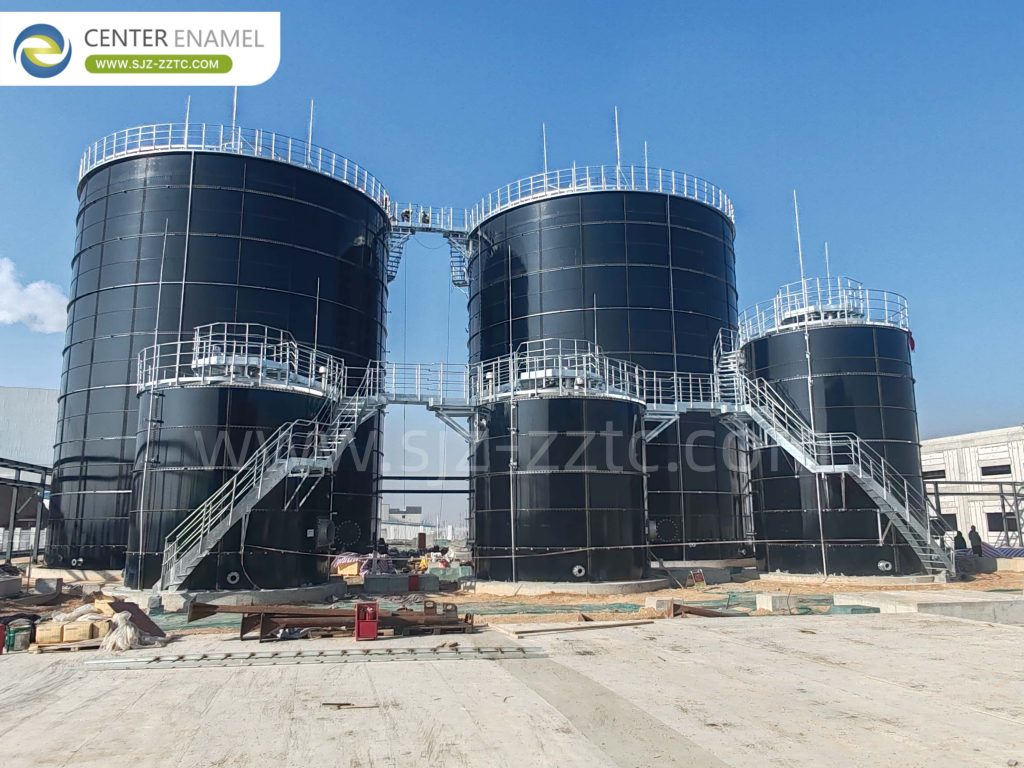
Among these anaerobic options, the USR process has emerged as a particularly effective choice for high-solids wastewater-and its performance depends heavily on the supporting equipment selected.
USR Supporting Equipment
Core equipment is the GFS Tank with no complex media or precision three-phase separators, featuring a rugged clog-resistant structure. Bottom large-diameter anti-clogging distribution system suitable for high-solids wastewater, preventing pipe clogging. Supporting equipment includes influent lift pumps, simple pretreatment screens, and equalization tanks for impurity removal and water quality balancing. Simple top gas collection devices and biogas conveying/desulfurization equipment for biogas resource recovery. Temperature, level, and pH online monitoring equipment. Bottom large-diameter sludge discharge pipes and pumps for rapid removal of high-concentration residual sludge, suitable for high-solids conditions. The complete system has extremely low failure rates, outstanding wear and clog resistance, and is far easier to maintain than conventional anaerobic processes.
With the right equipment configuration established, the next question is how these components integrate into a standardized treatment train for real-world applications.
Palm Oil Mill Effluent Standardized Treatment Solutions
Core treatment uses a mature train of "oil separation/cooling pretreatment + CSTR/USR anaerobic digestion + aerobic treatment + advanced treatment"-perfectly suited for POME's high-concentration, high-oil, high-temperature, low-pH characteristics. Pretreatment: Raw POME first enters oil separation tanks/oil separators to remove free and dispersed oil-recovered palm oil can be sold as a resource, significantly reducing organic load. Cooling towers/heat exchangers reduce temperature from 60-80°C to 35-38°C for mesophilic anaerobic digestion. Lime/NaOH addition adjusts pH from 4.0-5.0 to 6.8-7.2 for optimal anaerobic conditions. Screens and sedimentation tanks remove fruit shell fibers, fruit pulp residues, and other large suspended solids to prevent distribution system and pipe clogging.
Main anaerobic treatment: Center Enamel CSTR or USR anaerobic reactors with GFS Tanks as core reaction equipment, suited to POME's high-concentration, high-oil, high-suspended-solids conditions. CSTR mechanical mixing addresses oil floating layers, suspended solids sedimentation, and surface crusting-the three major challenges-ensuring thorough material-microbe contact. The USR Process simplifies internal structure with anti-clogging, high-solids tolerance-suited for high-suspended-solids POME. Single GFS Tank anaerobic effective volume 3,000-10,000 m³, with multiple tanks configurable for different mill capacities. Anaerobic digestion HRT 20-30 days, COD removal 80-90%, BOD removal 85-92%, with simultaneous large-volume biogas production.
Aerobic treatment: Anaerobic effluent still has COD 3,000-10,000 mg/L-requiring aerobic polishing. A/O, A²O, or SBR processes further degrade residual organics and remove nitrogen/phosphorus, reducing COD to 200-500 mg/L and BOD to 50-100 mg/L. Advanced treatment: Depending on discharge standards or reuse requirements, BAF, coagulation/sedimentation, sand filtration, or constructed wetlands reduce COD to below 100 mg/L and ammonia to below 10 mg/L for irrigation reuse or surface discharge compliance.
Biogas utilization: POME anaerobic digestion produces exceptionally high biogas yields-8-15 m³ biogas per m³ wastewater-after desulfurization and dehydration, biogas can be used for CHP, meeting 30-50% of mill electricity demand, with waste heat used for digester heating and FFB sterilization preheating-achieving energy self-sufficiency. Delivering this entire train as a single Turnkey Solution is what makes a Palm Oil Wastewater Treatment Project both technically reliable and commercially viable.
Ghana Municipal Domestic Wastewater Treatment Project
Completed installation in 2021, treating 1,800 m³/day of municipal wastewater using UBF anaerobic + A²/O nitrogen/phosphorus removal mature processes. Equipped with multiple Center Enamel GFS Tanks including 1 UBF anaerobic reactor, 1 secondary clarifier, and 2 internal/external double-layer A²/O biological tanks. Influent has high COD, BOD, suspended solids, and nitrogen/phosphorus concentrations-after full treatment, effluent parameters are significantly reduced with pH stable at 6.5-9.0, fully meeting local environmental discharge standards. Corrosion-resistant, conveniently assembled GFS Tanks efficiently solve urban domestic wastewater pollution while balancing treatment effectiveness and O&M economics-a mature municipal wastewater case in Africa.
This project illustrates how the same core tank technology supports diverse applications-and how a complete product matrix enables true one-stop delivery.
Full-Category Complete Product Matrix of Center Enamel
Center Enamel has built a complete product matrix of "core storage tanks + supporting covers + specialty pressure vessels + complete environmental engineering services"-the only company globally to achieve integrated enamel frit R&D, self-manufacturing, and GFS Tank application.
① Core: Proprietary GFS Tanks - Using proprietary double-sided hot-rolled double-layer enamel anti-corrosion technology-resistant to strong acids/alkalis, high salinity, and microbial corrosion-modular quick assembly-suitable for all strong-corrosion conditions in wastewater, biogas, and chemical applications.
② Supporting: Fusion Bonded Epoxy Tanks - Produced on China's first intelligent standardized production line-primarily for drinking water, fire water, and neutral medium storage.
③ Sealing: Aluminum Dome Covers - Proprietary high-strength aluminum alloy self-supporting structure-meeting international waterproof and load-bearing standards-suitable for tank sealing and biogas collection.
④ Other Tanks: Carbon Steel Tanks, Stainless Steel Tanks, Composting Tanks, Various Non-Standard Pressure Vessels.
⑤ Engineering Services: Environmental EPC General Contracting, Anaerobic Process Section Subcontracting-one-stop coverage across food waste, leachate, municipal wastewater, livestock biogas, petrochemical/metallurgical, and seawater desalination industries-customizable tank volume, corrosion protection grade, and complete process solutions with integrated equipment manufacturing and engineering construction.
A product matrix of this scope only delivers value when backed by internationally recognized credentials.
Comprehensive International Authoritative Certifications
Center Enamel holds CE, NSF, WRAS, ISO9001, BSCI, ASME, and other global certifications-fully clearing EU, North American, Southeast Asian, and African project tendering barriers-providing critical hard credential advantages for large overseas project bidding. These certifications give clients confidence that a Turnkey Solution from Center Enamel meets the regulatory requirements of their specific region.
Certifications and core products are complemented by carefully engineered roof solutions for different operating conditions.
Aluminum Alloy Trough Deck Roof Solution
Aluminum Alloy Trough Deck Roof is a cost-effective economical tank cover solution for clean water and wastewater storage scenarios, primarily designed for drinking water, production wastewater, and firewater reserve tanks, balancing practicality and cost advantages. The main body is integrally formed from anti-corrosion aluminum alloy plates, paired with aluminum support trusses. Its lightweight design imposes less load on the tank foundation, reducing civil construction investment. A naturally formed dense oxide protective layer on the surface resists rain and mild wastewater corrosion, withstands outdoor sun and rain exposure, and effectively blocks wind, rain, insects, fallen leaves, and odor volatilization, protecting water quality by preventing dust and debris from falling in and causing secondary contamination.
The flat roof structure is neat and orderly, allowing installation of maintenance walkways, guardrails, vents, and level monitoring ports on top, facilitating daily inspection and equipment maintenance. The simple sealing structure enables straightforward installation with short construction timelines, and virtually eliminates the need for anti-corrosion painting maintenance, resulting in extremely low operational costs. It is suitable for various small, medium, and large atmospheric pressure water storage tanks, and has been widely implemented in waterworks clear water tanks, industrial circulating water tanks, park firewater tanks, and domestic wastewater temporary storage facilities. It is highly compatible with water storage applications that do not require biogas collection or high-pressure sealing.
Facing challenges with palm oil wastewater or other industrial wastewater treatment? Contact us - our team will provide professional, efficient, and tailored solutions to meet your specific requirements.
Frequently Asked Questions
Q1: Why does the USR Process suit palm oil wastewater treatment?
The USR Process tolerates high suspended solids, oil, and impurities without clogging. Its anti-clogging distribution system and simplified structure ensure stable operation, fast start-up, and low maintenance for high-solids POME.
Q2: What does Center Enamel's Turnkey Solution include?
Our Turnkey Solution covers oil separation, cooling, pH adjustment, USR/CSTR anaerobic digestion, aerobic polishing, advanced treatment, biogas utilization, and GFS Tank supply-from design to commissioning.
Q3: What biogas benefits can a Palm Oil Wastewater Treatment Project expect?
POME generates 8-15 m³ biogas per m³ wastewater, meeting 30-50% of mill electricity demand. With CHP and waste heat recovery, projects can achieve energy self-sufficiency and strong ROI.