
Reliable USR Process with Advanced GFS Tanks for Complex Industrial Wastewater Treatment Project Applications
The competitive landscape shows divergence, with leading companies building integrated service capabilities through technical integration and capital operations, and industry concentration gradually increasing. Chinese companies continue to consolidate their advantages in mid-tier equipment exports. International giants target high-end customers and complex industrial wastewater markets, while local players occupy the mid- to low-end and industrial park centralized treatment markets with service responsiveness and cost advantages. In the anaerobic process segment, UASB, EGSB, and IC anaerobic reactors, with advantages of high loading rates, small footprints, and stable operation, are widely used in high-concentration organic wastewater pretreatment in food processing, pharmaceutical fermentation, alcohol brewing, chemical, and other industries. These reactors use steel tank shells, and their corrosion resistance and gas-tightness directly determine long-term operational stability. The application value of glass-fused-to-steel tanks in such scenarios is increasingly prominent.
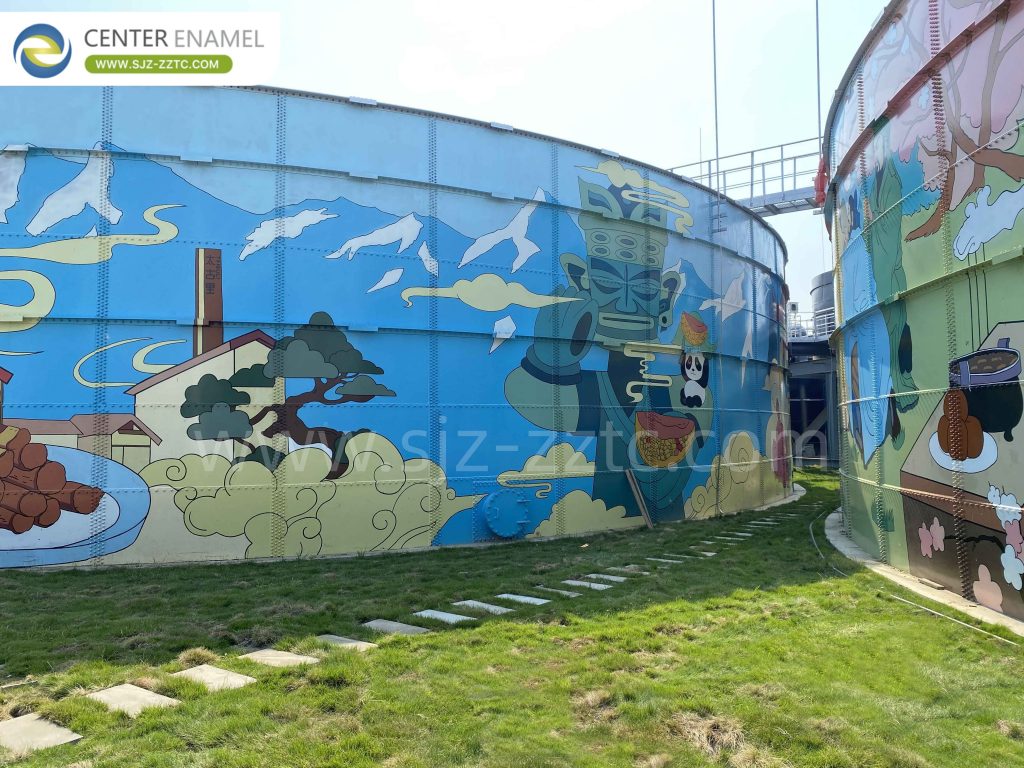
This market divergence creates a clear opportunity for suppliers who can combine process expertise with material durability. The USR Process represents one such advantage-specifically engineered for high-solids streams that defeat conventional reactors. When paired with corrosion-resistant GFS Tanks, it forms the backbone of a dependable Industrial Wastewater Treatment Project across food, agricultural, and chemical sectors.
GFS Tanks: Adaptable to Complex Operating Conditions Across All Industries
Center Enamel has independently developed over 200 specialized enamel frit formulations and supporting patents, capable of customizing anti-corrosion enamel based on customer storage media, with adaptability comprehensively superior to concrete tanks. Concrete tanks use a single material, only suitable for neutral clean water storage. When storing corrosive materials such as livestock manure, palm oil mill effluent, chemical wastewater, food waste digestate, high-salinity wastewater, etc., additional anti-corrosion linings must be applied. These linings are prone to failure, preventing long-term stable operation and cannot adapt to alternating high/low concentration storage conditions.
GFS Tanks can be specifically formulated with specialized enamels resistant to strong acids, strong alkalis, high organic content, and high salinity. A single tank can switch between multiple wastewater and fermentation feedstock storage requirements. They are universally applicable across biogas anaerobic digestion, municipal wastewater, livestock farming, food processing, and industrial water treatment scenarios, eliminating the need to rebuild tanks for media changes, perfectly meeting the needs of diversified, multi-condition environmental protection projects. This adaptability is what enables a single Industrial Wastewater Treatment Project to accommodate changing feedstock profiles without replacing core containment infrastructure.
USR Supporting Equipment: Built for Clog Resistance and Low Maintenance
Core equipment is the GFS tank with no complex media or precision three-phase separators, featuring a rugged clog-resistant structure. Bottom large-diameter anti-clogging distribution system suitable for high-solids wastewater, preventing pipe clogging. Supporting equipment includes influent lift pumps, simple pretreatment screens, and equalization tanks for impurity removal and water quality balancing. Simple top gas collection devices and biogas conveying/desulfurization equipment for biogas resource recovery. Temperature, level, and pH online monitoring equipment. Bottom large-diameter sludge discharge pipes and pumps for rapid removal of high-concentration residual sludge, suitable for high-solids conditions. The complete system has extremely low failure rates, outstanding wear and clog resistance, and is far easier to maintain than conventional anaerobic processes.
This equipment philosophy-simplicity, robustness, and tolerance for harsh conditions-is precisely what makes the USR Process viable for feeds that would quickly disable conventional anaerobic systems. The same design principles extend naturally into palm oil effluent applications, where GFS Tanks and clog-resistant internals are essential for any successful Industrial Wastewater Treatment Project.
Standardized Treatment Solutions for Palm Oil Mill Effluent
Core treatment uses a mature train of "oil separation/cooling pretreatment + CSTR/USR anaerobic digestion + aerobic treatment + advanced treatment"-perfectly suited for POME's high-concentration, high-oil, high-temperature, low-pH characteristics. Pretreatment: Raw POME first enters oil separation tanks/oil separators to remove free and dispersed oil-recovered palm oil can be sold as a resource, significantly reducing organic load. Cooling towers/heat exchangers reduce temperature from 60-80°C to 35-38°C for mesophilic anaerobic digestion.
Lime/NaOH addition adjusts pH from 4.0-5.0 to 6.8-7.2 for optimal anaerobic conditions. Screens and sedimentation tanks remove fruit shell fibers, fruit pulp residues, and other large suspended solids to prevent distribution system and pipe clogging. Main anaerobic treatment: Center Enamel CSTR or USR anaerobic reactors with GFS Tanks as core reaction equipment, suited to POME's high-concentration, high-oil, high-suspended-solids conditions. CSTR mechanical mixing addresses oil floating layers, suspended solids sedimentation, and surface crusting-the three major challenges-ensuring thorough material-microbe contact.
USR simplifies internal structure with anti-clogging, high-solids tolerance-suited for high-suspended-solids POME. Single GFS anaerobic tank effective volume 3,000-10,000 m³, with multiple tanks configurable for different mill capacities. Anaerobic digestion HRT 20-30 days, COD removal 80-90%, BOD removal 85-92%, with simultaneous large-volume biogas production. Aerobic treatment: Anaerobic effluent still has COD 3,000-10,000 mg/L-requiring aerobic polishing. A/O, A²O, or SBR processes further degrade residual organics and remove nitrogen/phosphorus, reducing COD to 200-500 mg/L and BOD to 50-100 mg/L.
Advanced treatment: Depending on discharge standards or reuse requirements, BAF, coagulation/sedimentation, sand filtration, or constructed wetlands reduce COD to below 100 mg/L and ammonia to below 10 mg/L for irrigation reuse or surface discharge compliance. Biogas utilization: POME anaerobic digestion produces exceptionally high biogas yields-8-15 m³ biogas per m³ wastewater-after desulfurization and dehydration, biogas can be used for CHP, meeting 30-50% of mill electricity demand, with waste heat used for digester heating and FFB sterilization preheating-achieving energy self-sufficiency.
This complete treatment train demonstrates how the USR Process integrates with downstream aerobic and advanced stages within a single Industrial Wastewater Treatment Project. It also confirms that GFS Tanks are not merely containment vessels but performance-critical components that determine the long-term stability of the entire anaerobic system.
Global Integrated Standardized Service System
Leveraging regional sales centers in China and overseas local agent networks, Center Enamel has established a complete after-sales service loop covering all markets. The system provides four core service pillars: 24/7 rapid response mechanism, on-site domestic/overseas installation services, full-project-cycle after-sales support, and long-term warranty protection-forming a complete service chain from preliminary site survey, mid-term construction management, to long-term inspection and maintenance. The entire system is uniformly adapted to both domestic and international project service standards, coordinating personnel scheduling, material support, and on-site coordination for simultaneous projects across multiple regions-significantly reducing customer multi-party coordination costs and ensuring efficient domestic and overseas project delivery.
This service infrastructure ensures that every USR Process installation and GFS Tanks deployment is supported from initial design through decades of operation-a critical requirement for any large-scale Industrial Wastewater Treatment Project operating across multiple regulatory jurisdictions.
Comprehensive International Authoritative Certifications
Center Enamel holds CE, NSF, WRAS, ISO9001, BSCI, ASME, and other global certifications-fully clearing EU, North American, Southeast Asian, and African project tendering barriers-providing critical hard credential advantages for large overseas project bidding.
These certifications are often mandatory prerequisites for participating in international tenders, making them essential credentials for any Industrial Wastewater Treatment Project requiring regulatory compliance across multiple regions.
Aluminum Alloy Trough Deck Roof: Economical Cover for Non-Pressurized Storage
Aluminum Alloy Trough Deck Roof is a cost-effective economical tank cover solution for clean water and wastewater storage scenarios, primarily designed for drinking water, production wastewater, and firewater reserve tanks, balancing practicality and cost advantages. The main body is integrally formed from anti-corrosion aluminum alloy plates, paired with aluminum support trusses. Its lightweight design imposes less load on the tank foundation, reducing civil construction investment.
A naturally formed dense oxide protective layer on the surface resists rain and mild wastewater corrosion, withstands outdoor sun and rain exposure, and effectively blocks wind, rain, insects, fallen leaves, and odor volatilization, protecting water quality by preventing dust and debris from falling in and causing secondary contamination. The flat roof structure is neat and orderly, allowing installation of maintenance walkways, guardrails, vents, and level monitoring ports on top, facilitating daily inspection and equipment maintenance.
The simple sealing structure enables straightforward installation with short construction timelines, and virtually eliminates the need for anti-corrosion painting maintenance, resulting in extremely low operational costs. It is suitable for various small, medium, and large atmospheric pressure water storage tanks, and has been widely implemented in waterworks clear water tanks, industrial circulating water tanks, park firewater tanks, and domestic wastewater temporary storage facilities. It is highly compatible with water storage applications that do not require biogas collection or high-pressure sealing.
For anaerobic USR Process reactors and biogas-producing Industrial Wastewater Treatment Project applications, gas-tight GFS Tanks roofs remain the correct specification-while the Aluminum Alloy Trough Deck Roof serves the complementary non-pressurized storage needs within the same facility.
Looking for a reliable partner for your Industrial Wastewater Treatment Project? Get in touch with Center Enamel today for a free consultation and a tailored USR Process + GFS Tanks solution. Our team is ready to support you-reach out now.
FAQ
What is the USR Process and why is it suited to Industrial Wastewater Treatment Project applications?
The USR Process is an upflow anaerobic reactor designed for high-solids wastewater. It eliminates three-phase separators, tolerates high suspended solids, and resists clogging-ideal for livestock, agricultural, and food processing streams.
Why specify GFS Tanks for USR Process reactors instead of concrete or steel?
GFS Tanks resist pH 1-14 corrosion, install faster, and last 30+ years. Concrete cracks and requires coatings that fail in high-sulfide environments; ordinary steel corrodes rapidly.
How does Center Enamel support complete Industrial Wastewater Treatment Project delivery?
We provide integrated design, USR/CSTR anaerobic systems, GFS Tanks manufacturing, installation, commissioning, and operator training-with CE, NSF, and ISO certifications for global tendering.