
Wastewater Discharge And Effluent Compliance: Integrated Treatment Solutions
A wastewater discharge solution is the treatment train - plus monitoring and documentation - needed to bring effluent inside permit limits for COD, BOD, suspended solids, nitrogen, phosphorus, and pH. It pairs a biological core with polishing (filtration, disinfection) and proves compliance with measured influent and effluent data, not assumption.
The Permit Drivers
Every discharge consent lists numbers the effluent must stay under. Organic load is expressed as COD and BOD5; solids as suspended solids; nutrients as total nitrogen and total phosphorus; and pH sits in a band. The treatment is selected to drive each of these below the limit, and the limit - not a catalogue - sets which stages are mandatory.
| Parameter | Why It Is Limited | Typical Target |
| COD / BOD5 | Organic load, oxygen demand | Low mg/L |
| Suspended solids | Turbidity, deposits | Low mg/L |
| Total nitrogen | Eutrophication | Strict mg/L |
| Total phosphorus | Eutrophication | Very strict mg/L |
| pH | Aquatic toxicity | 6.5 - 9.0 band |
The Treatment Train For Compliance
Biological treatment carries the bulk of COD and BOD; nutrient removal needs an anoxic or anaerobic-aerobic sequence for nitrogen and a precipitation or enhanced biological step for phosphorus. Whatever biology leaves, polishing catches - filtration for fine solids, sometimes adsorption for color or trace organics. Skipping the polishing stage is the usual reason a borderline effluent fails audit.
Proving Compliance
Compliance is not only the process; it is the evidence. Influent and effluent are sampled against the permit, logged, and reported. A well-run discharge solution therefore includes the sampling and monitoring plan as part of the design, because an unmetered plant cannot prove it is compliant even when it performs.
Project Case Study: Sri Lanka Palm Oil Wastewater
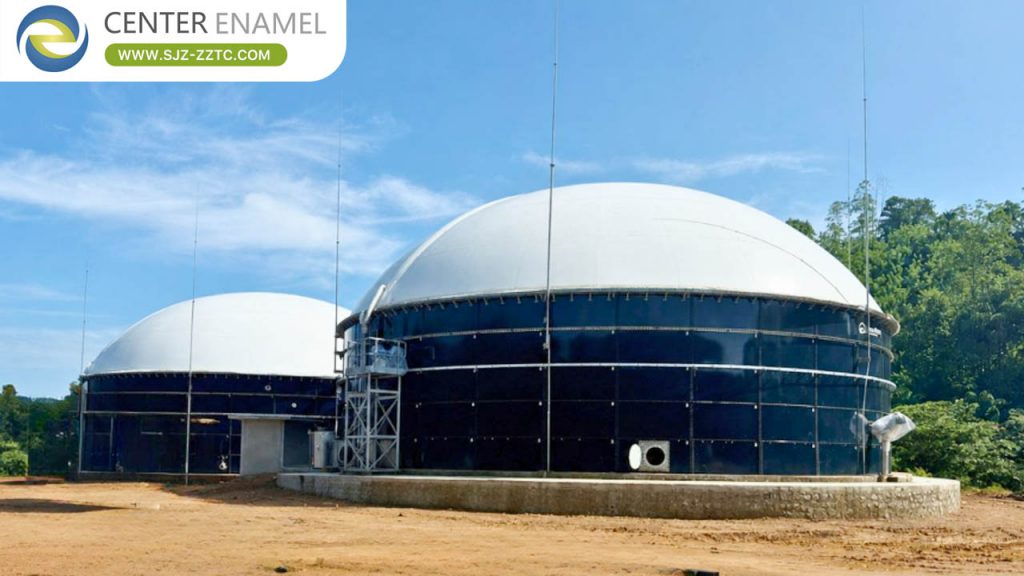
Project / Application: Palm oil mill effluent (POME) treatment to strict discharge standards, Sri Lanka. Industry: Industrial / palm oil (discharge-standard focus; noted as non-municipal). Tank Type: SBR (Sequencing Batch Reactor). Key Requirements: Meet COD and BOD discharge limits from a very high-strength influent.
| Field | Value | Source / Evidence |
| Daily Treatment Volume | 250 tonnes/day | Company project reference |
| Treatment Process | SBR (Sequencing Batch Reactor) | Company project reference |
| Reactor Specification | O24.46 x 6 m, 2 sets | Company project reference |
| Influent COD | 65,600 mg O2/L | Company project reference |
| Discharge COD | <= 400 mg O2/L | Company project reference |
| Influent BOD5 | 7,480 mg/L | Company project reference |
| Discharge BOD5 | <= 250 mg/L | Company project reference |
About Company
Shijiazhuang Zhengzhong Technology Co., Ltd (Center Enamel) is a comprehensive high-tech enterprise specializing in wastewater engineering, process section contracting, and equipment manufacturing. The company delivers biogas and wastewater projects through three main lines - EPC (turnkey) contracting, equipment supply, and process packages - covering livestock and municipal wastewater, biomass energy, industrial wastewater, and food waste. Its reactor portfolio spans CSTR, USR, UBF, UASB, IC, and EGSB, backed by in-house Glass-Fused-to-Steel tank manufacturing (enamel firing at 820-930 C) and certifications including ISO 9001, NSF/ANSI 61, and CE-EN 1090. With 35+ years of operation, a 150,000 m2 manufacturing base, and projects in 100+ countries, Center Enamel provides the single-responsibility engineering behind discharge-compliant treatment trains across industrial and municipal streams - selecting biological and polishing stages that bring high-strength effluent inside permit, as demonstrated on the Sri Lanka POME plant reducing COD from 65,600 to 400 mg/L.
Comparison: Discharge Vs Reuse
| Element | Discharge Plant | Reuse / Reclamation Plant |
| Goal | Meet permit, release | Capture water asset |
| Polishing | Permit-based | Membrane + carbon |
| Monitoring | Required | Required, tighter |
| Value | Compliance | Water + compliance |
A wastewater discharge solution is the permit-driven pairing of biological treatment, polishing, and measured proof - the limit, not the equipment list, decides what must be built.
Frequently Asked Questions
Q1: What does the permit require? A1: Numeric limits for COD, BOD5, solids, nitrogen, phosphorus, and pH.
Q2: What treatment meets the limits? A2: Biological core plus polishing (filtration, disinfection) and nutrient stages.
Q3: How is compliance proven? A3: Sampled influent/effluent data logged and reported against the permit.
Q4: Is polishing always needed? A4: Usually yes for a borderline or strict limit; biology alone often leaves fine solids or nutrients.
Q5: What if the limit tightens? A5: Add or deepen polishing; the train is designed with headroom where known.
Q6: Does discharge mean no reuse? A6: Not necessarily, but reuse adds membranes and tighter monitoring.
Q7: Who sets the limits? A7: The local regulator or receiving-body consent.
Q8: What tank resists corrosive effluent? A8: A Glass-Fused-to-Steel tank resists acidic and high-ammonia streams.
Suggested CTA
Send your discharge consent and influent profile to an engineer, or request a compliance-focused treatment outline for your site.