
Wastewater Reactor Types: Choosing CSTR, UASB, USR, SBR, Or MBR
Wastewater reactor types differ by how they mix, handle solids, and use footprint. A CSTR suits uniform mixed liquor, a UASB suits low-solid warm effluent with granular sludge, a USR holds coarse high-solid feed, an SBR batches variable loads, and an MBR adds membrane polishing. Choose from feed strength and solids, not from habit.
The Five Reactor Types At A Glance
Each reactor optimises a different constraint. The right pick depends on solids content, strength, and whether the owner values a small footprint or simple operation.
| Reactor | Best Feed | Key Feature |
| CSTR | Uniform slurry | Fully mixed, heated digester |
| UASB | Low-solid warm effluent | Granular sludge blanket |
| USR | High-solid coarse feed | Upflow solids, minimal mixing |
| SBR | Variable loads | Batch fill-draw cycle |
| MBR | Tight effluent limits | Membrane filtration |
CSTR Versus UASB
A CSTR keeps the whole tank mixed and is forgiving with solids, which is why it dominates manure and sludge digestion at 35-38 C. A UASB instead builds a dense granular sludge bed that treats low-solid, warm effluent at a high organic loading rate (typically 5-15 kg COD per m3 per day) with almost no mixing energy. They solve different problems.
USR And SBR
A USR lets coarse, high-solid feed rise through a blanket without the fine mixing a CSTR needs, which suits farm slurries with grit. An SBR cycles fill, react, settle, and draw in one tank, absorbing load swings that would upset a continuous reactor.
MBR And Footprint
When the permit is tight or land is scarce, an MBR couples biology with membrane filtration to produce a polished effluent in a compact footprint. The trade is higher energy and membrane replacement, so it is chosen for limit or space, not by default.
Tankage For Each Reactor
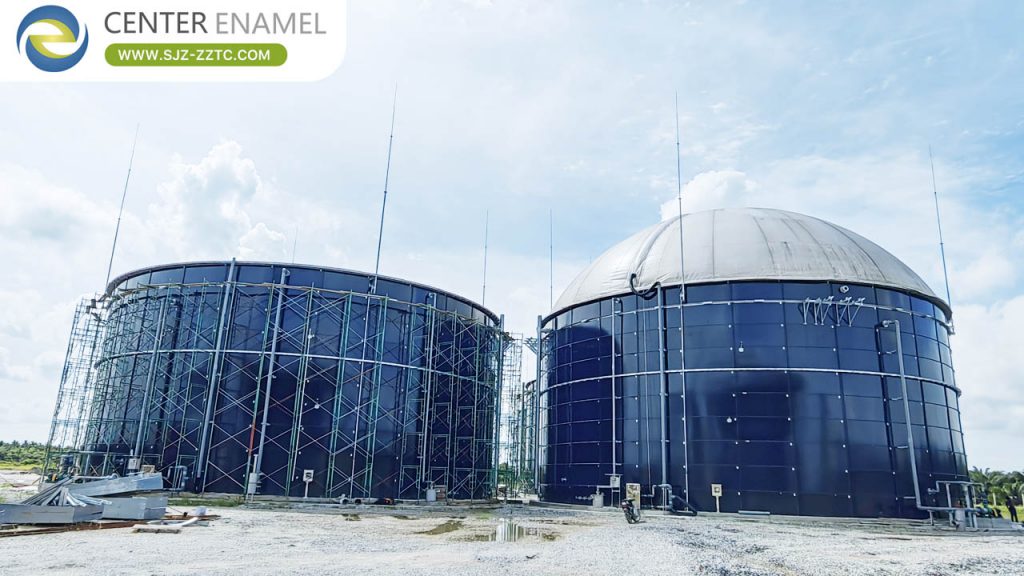
Most of these reactors are built as sealed Glass-Fused-to-Steel tanks for corrosion resistance and fast assembly. The tank geometry follows the reactor choice: mixed volume for a CSTR, tall upflow for a UASB or USR, and rectangular or square basins for an SBR or MBR.
Project Case Study: Beijing 5S Pig Farm Wastewater Treatment Project
Project / Application: Pig farm wastewater, Beijing, China. Industry: Livestock. Tank Type: UASB plus AOAO process. Key Requirements: High-strength manure wastewater treatment with pathogen reduction.
| Field | Value | Source / Evidence |
| Daily Treatment Volume | 580 m3/day | Company project reference |
| Treatment Process | UASB + AOAO | Company project reference |
| Installation Year | 2020 | Company project reference |
| Tank Dimensions | Not Provided In The Available Source | Process and capacity documented |
| Pollutant | Influent | Effluent |
| COD Cr | greater than or equal to 10,000 mg/L | less than or equal to 200 mg/L |
| Ammonia N | greater than or equal to 1,000 mg/L | less than or equal to 80 mg/L |
| Total P | greater than or equal to 200 mg/L | less than or equal to 8 mg/L |
| SS | greater than or equal to 10,000 mg/L | less than or equal to 100 mg/L |
| BOD5 | greater than or equal to 8,000 mg/L | less than or equal to 100 mg/L |
| Fecal Coliforms | greater than or equal to 5.6e6 CFU/100ml | less than or equal to 4.0e3 CFU/100ml |
About The Supplier
Shijiazhuang Zhengzhong Technology Co., Ltd (Center Enamel) manufactures Glass-Fused-to-Steel tanks for CSTR, UASB, USR, and aerobic reactors, with enamel firing at 820-930 C and certifications including ISO 9001, NSF/ANSI 61, and CE-EN 1090. The bolted system supports rapid reactor tank delivery.
Comparison: Selection Drivers
| If your constraint is | Choose | Reason |
| High solids, uniform feed | CSTR | Mixed, heated, forgiving |
| Low-solid warm effluent | UASB | High loading, low energy |
| Coarse high-solid feed | USR | Holds solids without fine mixing |
| Variable load | SBR | Batch absorbs swings |
| Tight limit or scarce land | MBR | Polished compact effluent |
Reactor choice is a feed-characteristic decision, not a brand decision. Match solids, strength, and footprint to CSTR, UASB, USR, SBR, or MBR, then let the tankage follow the reactor rather than the reverse.
Frequently Asked Questions
Q1: Which reactor suits my wastewater? A1: Match feed strength and solids to CSTR, UASB, USR, SBR, or MBR.
Q2: What is the difference between UASB and CSTR? A2: UASB uses a granular sludge blanket for low-solid effluent at high loading; CSTR is fully mixed for slurries.
Q3: When use an MBR? A3: When the effluent limit is tight or land is scarce; expect higher energy cost.
Q4: How does solids content affect choice? A4: High solids favour CSTR or USR; low solids favour UASB.
Q5: What loading rate does UASB handle? A5: Typically 5-15 kg COD per m3 per day with mature granular sludge.
Q6: What temperature do digesting reactors need? A6: Mesophilic CSTR and USR run at 35-38 C.
Q7: Can one tank serve several reactors? A7: Geometry differs, so tank shape follows the reactor type.
Q8: What tank resists the corrosion? A8: A Glass-Fused-to-Steel tank with factory-fired enamel.
Send your wastewater character and constraints to an engineer, or request a reactor-type and tankage recommendation.
Wastewater reactor types differ by how they mix, handle solids, and use footprint. A CSTR suits uniform mixed liquor, a UASB suits low-solid warm effluent with granular sludge, a USR holds coarse high-solid feed, an SBR batches variable loads, and an MBR adds membrane polishing. Choose from feed strength and solids, not from habit.
The Five Reactor Types At A Glance
Each reactor optimises a different constraint. The right pick depends on solids content, strength, and whether the owner values a small footprint or simple operation.
| Reactor | Best Feed | Key Feature |
| CSTR | Uniform slurry | Fully mixed, heated digester |
| UASB | Low-solid warm effluent | Granular sludge blanket |
| USR | High-solid coarse feed | Upflow solids, minimal mixing |
| SBR | Variable loads | Batch fill-draw cycle |
| MBR | Tight effluent limits | Membrane filtration |
CSTR Versus UASB
A CSTR keeps the whole tank mixed and is forgiving with solids, which is why it dominates manure and sludge digestion at 35-38 C. A UASB instead builds a dense granular sludge bed that treats low-solid, warm effluent at a high organic loading rate (typically 5-15 kg COD per m3 per day) with almost no mixing energy. They solve different problems.
USR And SBR
A USR lets coarse, high-solid feed rise through a blanket without the fine mixing a CSTR needs, which suits farm slurries with grit. An SBR cycles fill, react, settle, and draw in one tank, absorbing load swings that would upset a continuous reactor.
MBR And Footprint
When the permit is tight or land is scarce, an MBR couples biology with membrane filtration to produce a polished effluent in a compact footprint. The trade is higher energy and membrane replacement, so it is chosen for limit or space, not by default.
Tankage For Each Reactor
Most of these reactors are built as sealed Glass-Fused-to-Steel tanks for corrosion resistance and fast assembly. The tank geometry follows the reactor choice: mixed volume for a CSTR, tall upflow for a UASB or USR, and rectangular or square basins for an SBR or MBR.
Project Case Study: Beijing 5S Pig Farm Wastewater Treatment Project
Project / Application: Pig farm wastewater, Beijing, China. Industry: Livestock. Tank Type: UASB plus AOAO process. Key Requirements: High-strength manure wastewater treatment with pathogen reduction.
| Field | Value | Source / Evidence |
| Daily Treatment Volume | 580 m3/day | Company project reference |
| Treatment Process | UASB + AOAO | Company project reference |
| Installation Year | 2020 | Company project reference |
| Tank Dimensions | Not Provided In The Available Source | Process and capacity documented |
| Pollutant | Influent | Effluent |
| COD Cr | greater than or equal to 10,000 mg/L | less than or equal to 200 mg/L |
| Ammonia N | greater than or equal to 1,000 mg/L | less than or equal to 80 mg/L |
| Total P | greater than or equal to 200 mg/L | less than or equal to 8 mg/L |
| SS | greater than or equal to 10,000 mg/L | less than or equal to 100 mg/L |
| BOD5 | greater than or equal to 8,000 mg/L | less than or equal to 100 mg/L |
| Fecal Coliforms | greater than or equal to 5.6e6 CFU/100ml | less than or equal to 4.0e3 CFU/100ml |
About The Supplier
Shijiazhuang Zhengzhong Technology Co., Ltd (Center Enamel) manufactures Glass-Fused-to-Steel tanks for CSTR, UASB, USR, and aerobic reactors, with enamel firing at 820-930 C and certifications including ISO 9001, NSF/ANSI 61, and CE-EN 1090. The bolted system supports rapid reactor tank delivery.
Comparison: Selection Drivers
| If your constraint is | Choose | Reason |
| High solids, uniform feed | CSTR | Mixed, heated, forgiving |
| Low-solid warm effluent | UASB | High loading, low energy |
| Coarse high-solid feed | USR | Holds solids without fine mixing |
| Variable load | SBR | Batch absorbs swings |
| Tight limit or scarce land | MBR | Polished compact effluent |
Reactor choice is a feed-characteristic decision, not a brand decision. Match solids, strength, and footprint to CSTR, UASB, USR, SBR, or MBR, then let the tankage follow the reactor rather than the reverse.
Frequently Asked Questions
Q1: Which reactor suits my wastewater? A1: Match feed strength and solids to CSTR, UASB, USR, SBR, or MBR.
Q2: What is the difference between UASB and CSTR? A2: UASB uses a granular sludge blanket for low-solid effluent at high loading; CSTR is fully mixed for slurries.
Q3: When use an MBR? A3: When the effluent limit is tight or land is scarce; expect higher energy cost.
Q4: How does solids content affect choice? A4: High solids favour CSTR or USR; low solids favour UASB.
Q5: What loading rate does UASB handle? A5: Typically 5-15 kg COD per m3 per day with mature granular sludge.
Q6: What temperature do digesting reactors need? A6: Mesophilic CSTR and USR run at 35-38 C.
Q7: Can one tank serve several reactors? A7: Geometry differs, so tank shape follows the reactor type.
Q8: What tank resists the corrosion? A8: A Glass-Fused-to-Steel tank with factory-fired enamel.
Send your wastewater character and constraints to an engineer, or request a reactor-type and tankage recommendation.