
Wastewater Tanks: A Complete Guide to Selection, Features, and Types
Wastewater tanks are the backbone of any effective treatment system, whether municipal or industrial. From raw sewage holding to biological aeration and sludge storage, the vessel you choose directly impacts operational reliability, maintenance costs, and regulatory compliance. This guide breaks down the essential characteristics, material demands, and the most common tank varieties-including the increasingly popular GFS tanks-to help you make an informed decision.
What Are Wastewater Tanks and Why Do They Matter?
A wastewater tank is a watertight containment structure designed to hold, treat, or process effluent and sludge before discharge or further treatment. Unlike simple storage vessels, wastewater tanks must withstand chemically aggressive environments, fluctuating organic loads, and often continuous immersion. The Nebraska Department of Environment and Energy defines such tanks broadly as structures used for aeration, dilution, disinfection, equalization, mixing, sedimentation, storage, or chemical addition. Given this diversity of roles, a “one-size-fits-all” approach rarely works. The correct tank must align with the specific stage of the treatment train-whether it sits at the headworks holding raw influent or at the tail end storing digested biosolids.
Key Features and Performance Requirements
Choosing a wastewater tank involves balancing structural integrity with long-term corrosion resistance. Because wastewater contains dissolved sulfides, organic acids, and abrasive solids, ordinary carbon steel without protection will degrade rapidly. Consequently, premium tanks feature factory-applied coatings or linings engineered for immersion service.
Corrosion Resistance Is Non-Negotiable. The internal environment of a wastewater tank can swing from acidic to alkaline depending on the industrial contributions to the sewer. Tanks must resist undercutting and blistering. Glass-fused-to-steel technology, for instance, creates an inert barrier that handles pH ranges from 3 to 11 in standard formulations, with special coatings extending to pH 1–14.
Structural and Hydraulic Design. Tanks must be watertight and structurally sound against hydrostatic pressure, wind, and seismic loads. For bolted tanks, standards such as ISO 28765:2022 specify design criteria for cylindrical, vertically walled tanks with flat bottoms, covering diameters up to 100 meters and wall heights up to 50 meters. Additionally, the tank geometry must support the process-whether that means a conical bottom for sludge draw-off, baffles for mixing, or sufficient freeboard for foam control.
Installation and Lifecycle Factors. Field-erected bolted tanks offer significant logistical advantages over welded or concrete alternatives. They can be shipped in compact bundles and assembled on-site without heavy welding equipment, reducing downtime and accommodating sites with tight access. A quality wastewater tank should deliver a service life exceeding 30 years with minimal maintenance, as is often claimed for vitreous enamel-coated systems.
Table 1: Comparison of Wastewater Tank Material Characteristics
| Material / System | Corrosion Resistance | Installation Method | Typical Service Life | Best Suited For |
| Epoxy-Coated Carbon Steel | Moderate (depends on coating integrity) | Bolted or welded | 15–25 years | Equalization, non-aggressive holding |
| Glass-Fused-to-Steel (GFS) | Excellent (pH 3–11 standard) | Bolted | 30+ years | Aggressive wastewater, biogas, leachate |
| Concrete | Good (but susceptible to H2S attack) | Cast-in-place | 20–50 years | Large municipal plants, below-grade |
| Stainless Steel | Superior | Welded | 30+ years | High-chloride or specialty industrial streams |
Common Types of Wastewater Tanks
The treatment train dictates the tank type. While the names vary by region and process design, several core categories appear in most municipal and industrial facilities.
Septic and Holding Tanks. These are the simplest forms, used for primary settling and anaerobic digestion of solids in decentralized systems or as emergency storage. They are typically watertight and constructed from concrete, fiberglass, or plastic. Holding tanks, by contrast, merely store wastewater until it can be hauled away for proper disposal.
Equalization Tanks. Flow and load equalization is critical for downstream biological processes. By dampening peak flows and organic surges, these tanks prevent shock loading to aeration basins and clarifiers. A well-designed equalization tank requires mixing-either mechanical or diffused air-to prevent solids from settling and going septic.
Aeration and Biological Reactor Tanks. These are the heart of secondary treatment. In activated sludge systems, aeration tanks provide the oxygen and mixing necessary for microorganisms to consume organic matter. The design must account for diffuser layout, depth (often 9–15 feet for diffused systems), and the intense corrosive environment created by continuous aeration.
Clarifiers and Settling Tanks. Gravity separation tanks, whether primary or final, rely on quiescent conditions to allow solids to settle. The tank geometry-particularly the weir loading and sludge collection mechanism-determines efficiency. Final clarifiers following activated sludge are especially sensitive because the biological floc is lighter and more buoyant, requiring careful hydraulic design to avoid solids carryover.
GFS Tanks: The Premium Choice for Demanding Applications
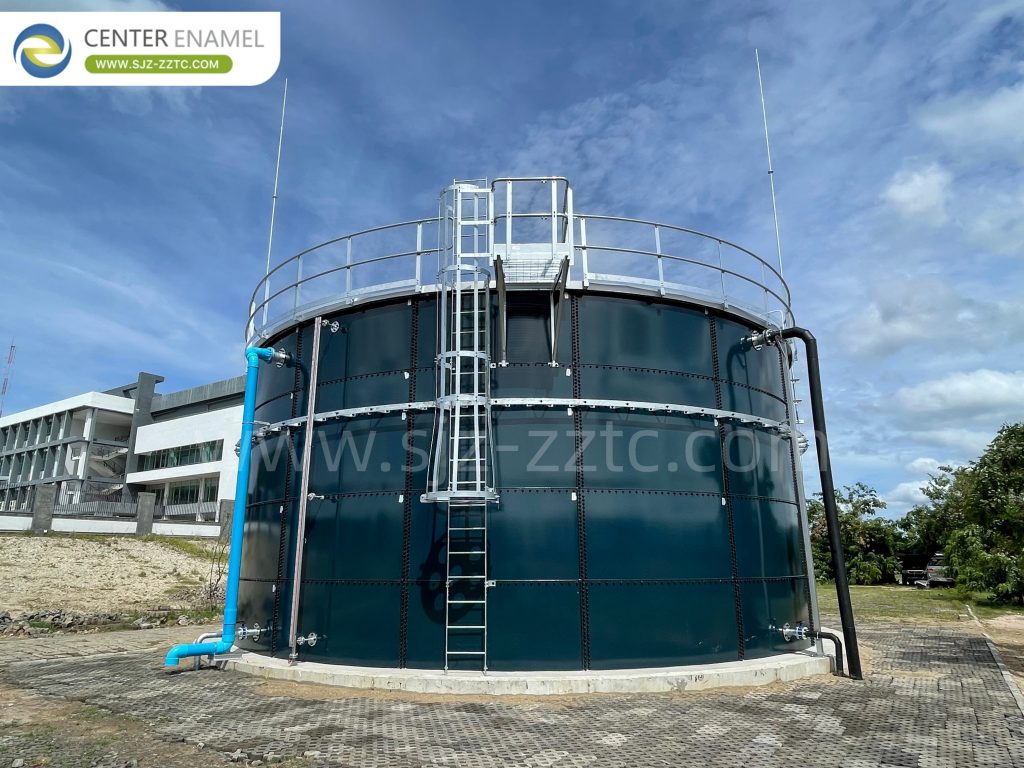
Among modern tank technologies, GFS Tanks (Glass-Fused-to-Steel) have emerged as a leading solution for wastewater and sludge storage. The manufacturing process fuses silica glass onto steel panels at temperatures exceeding 800–900°C, creating a molecular bond that combines the mechanical strength of steel with the chemical inertness of glass.
Why GFS Tanks Excel in Wastewater. The enamel surface is smooth, non-porous, and resistant to bacteria adhesion, which inhibits biofilm formation and simplifies cleaning. Unlike painted coatings that can chip and undercut, the glass layer is fused to the steel, meaning it will not peel or blister under normal immersion conditions. This makes GFS tanks particularly suitable for aggressive streams such as landfill leachate, industrial effluent with high sulfate content, and anaerobic digestion sludge.
Modular Bolted Construction. GFS tanks are assembled on-site using bolted steel panels, self-locking screws, and sealant. This allows for rapid erection even in remote locations, and the tanks can be expanded, relocated, or disassembled if facility needs change. Standard panel sizes are typically 2.4m by 1.2m, with steel thicknesses ranging from 3mm to 12mm depending on tank diameter and height. The bolted design also eliminates the need for hot work welding on-site, improving safety and reducing weather-related delays.
Compliance and Standards. Reputable GFS tank suppliers design to recognized international standards, including AWWA D103, EN 15282, and ISO 28765. The latter explicitly covers the design of vitreous enamel-coated bolted cylindrical steel tanks for water and effluent storage, specifying minimum shell thickness (1.5mm) and temperature limits (−50°C to +100°C).
Table 2: Typical GFS Tank Specifications for Wastewater Service
| Parameter | Standard Range | Notes |
| Coating Thickness | 0.25–0.40 mm (double-sided) | Two coats fired at high temperature |
| Steel Panel Thickness | 3–12 mm | Selected based on hydrostatic load |
| pH Resistance | 3–11 (standard); 1–14 (special) | Confirm with supplier for extreme streams |
| Service Life | 30+ years | With minimal maintenance |
| Installation Time | Days to weeks (vs. months for concrete) | Dependent on tank size and site access |
Material Selection and Corrosion Protection
Beyond GFS, engineers have several options for wastewater service. Epoxy-coated carbon steel offers a cost-effective middle ground for less aggressive streams, but the coating is thinner and more susceptible to mechanical damage during installation or cleaning. Stainless steel-particularly grades like 304 or 316-provides excellent corrosion resistance but at a significantly higher capital cost, often limiting its use to specific high-chloride or high-temperature zones.
For concrete tanks, the primary concern is microbially induced corrosion (MIC) caused by hydrogen sulfide gas in the headspace. Above the water line, concrete must be coated with a protective barrier-typically a bitumastic or epoxy coating-to prevent acid attack from sulfur-oxidizing bacteria. This adds a maintenance burden that factory-coated steel tanks avoid.
Installation, Maintenance, and Operational Best Practices
Proper installation is as critical as material selection. Bolted tanks require a level, load-bearing foundation, typically a concrete ring wall or a compacted granular pad. The base must accommodate the tank’s weight when full and provide a seal against groundwater infiltration. During assembly, torque specifications for bolts must be followed precisely, and holiday testing (spark testing) of the enamel coating is recommended to detect any pinholes or defects before filling.
Once in service, routine inspections should focus on the waterline and the headspace-the two zones most susceptible to corrosion. For GFS tanks, the glass surface can be visually inspected for chips; minor damage can often be repaired with a compatible enamel patch kit. Unlike painted tanks, there is no need for periodic recoating, which reduces long-term labor costs and eliminates the need to take tanks offline for repainting every few years.
FAQ
Q1: What is the primary advantage of GFS tanks over concrete for wastewater?
GFS tanks offer faster installation, superior resistance to hydrogen sulfide corrosion, and the ability to be expanded or relocated. Concrete tanks are prone to MIC attack above the waterline and require protective coatings that need periodic maintenance.
Q2: Can GFS tanks handle industrial wastewater with extreme pH?
Standard GFS coatings handle pH 3–11, which covers most municipal and food-processing waste. For extreme alkaline or acidic industrial streams (pH 1–14), special enamel formulations are available and should be specified during procurement.
Q3: How long does a bolted wastewater tank last?
A well-maintained GFS bolted tank can exceed 30 years of service life. The key factors are proper foundation design, correct bolt torque during installation, and prompt repair of any mechanical damage to the glass coating.
Ready to specify the right wastewater tank for your project? Our engineering team can help you evaluate your process requirements and select a GFS or bolted steel solution that meets your site conditions and budget. Contact us today for a technical consultation and a tailored quote-we will respond within one business day with preliminary sizing and material recommendations.