
Wastewater Treatment Project Basics: Process Selection for Industrial Flows
An industrial wastewater treatment project begins by measuring strength (COD, BOD, TSS, salinity, toxicity) and load (daily and peak flow), then matches those numbers to anaerobic, aerobic, or hybrid process trains - not the other way around. Municipal and industrial streams differ so much that copying a municipal design onto a factory effluent usually fails.
1. Characterize Before You Design
Industrial effluent varies by sector: palm oil POME is very high COD, pharmaceutical streams can be saline, and food waste is variable. The design must capture the actual inlet range, not a single textbook number, or the reactor will be under- or oversized. Profiling also flags inhibitors (salt, ammonia, shock loads) that dictate pre-treatment.
2. Anaerobic, Aerobic, or Hybrid
Anaerobic trains (UASB, EGSB, anaerobic reactors) suit high-COD streams because they cut organics to biogas with low energy and sludge. Aerobic (activated sludge, SBR, MBR) polishes and removes nutrients. Many industrial projects pair both: anaerobic first for bulk COD, aerobic second for the limit. The split is set by the COD and the discharge target.
3. Tankage and Footprint
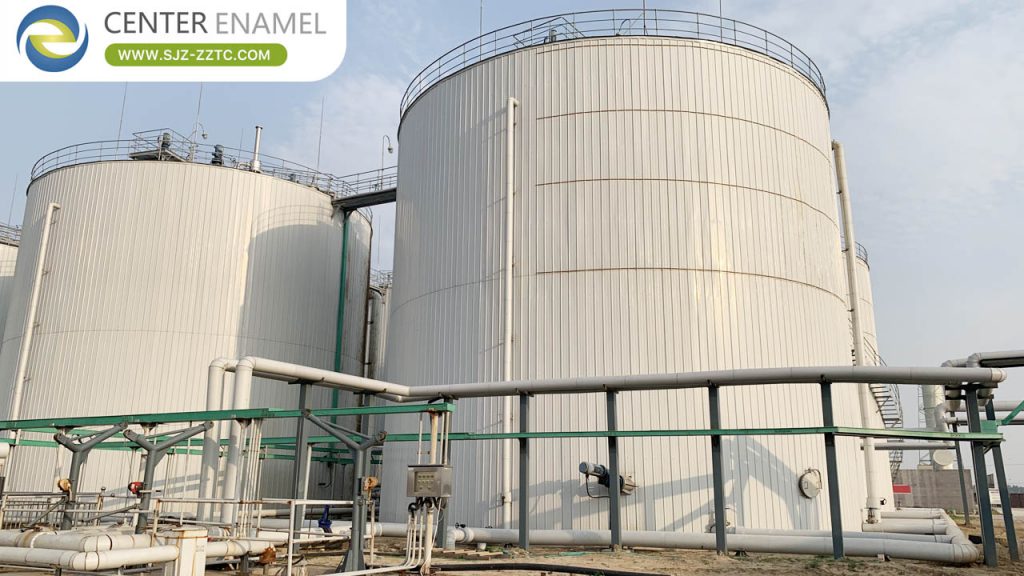
Bolted GFS tanks give the project a corrosion-resistant shell for anaerobic and aerobic stages alike, from 200 m3 to 60,000 m3, fused at 820-930 C and built to ISO 28765 and AWWA D103. Their flat-pack assembly suits remote industrial sites where concrete pouring is slow or costly.
Comparison: Process Trains
| Driver | Anaerobic | Aerobic | Hybrid |
| Best COD range | High | Low-Medium | Full range |
| Energy | Net producer | Net consumer | Balanced |
| Sludge | Low | Higher | Moderate |
| Use | Bulk COD cut | Polish/N-removal | Full train |
Project Case Study
Indonesia Biogas Project - Dumai (Dumai, Indonesia, 2009). A palm oil wastewater treatment plant delivered with 3 GFS tanks (19.86 m diameter x 8.4 m) for an anaerobic treatment train, installed by a 7-person team in 40 days - an example of an industrial wastewater project scoped and deployed on a remote site.
| Project | Indonesia Biogas Project - Dumai |
| Location | Dumai, Indonesia |
| Industry | Palm Oil |
| Application | Palm Oil Wastewater Treatment Plant |
| Product | 3 GFS tanks, 19.86 m dia x 8.4 m |
| Deployment | 7 engineers, 40 days installation |
| Status | Delivered November 2009 |
About Shijiazhuang Zhengzhong Technology Co., Ltd (Center Enamel)
Shijiazhuang Zhengzhong Technology Co., Ltd (Center Enamel) manufactures the GFS tankage that carries these industrial trains: enamel fused at 820-930 C forms an inert barrier against corrosive process liquors, engineered to ISO 28765 and AWWA D103, shipped flat-pack for fast overseas assembly. That is the shell an industrial wastewater project is built into.
Start an industrial wastewater project with measured strength and load, then let the numbers pick the train. Pair anaerobic and aerobic where the COD and limit demand it. Send your inlet profile and we will recommend the process and tankage.
Frequently Asked Questions (FAQ)
Q1: How do you select a wastewater process?
A: Characterize strength and load first, then match anaerobic, aerobic, or hybrid to the COD and discharge target.
Q2: Is anaerobic or aerobic better for industry?
A: Anaerobic for high COD with energy recovery; aerobic for polishing and nutrient removal; hybrid for the full train.
Q3: What is an ETP?
A: An Effluent Treatment Plant that conditions industrial discharge to meet limits before release or reuse.
Q4: Why is industrial flow different from municipal?
A: Industrial streams vary widely in COD, salinity, and toxicity, needing site-specific design.
Q5: What tank capacity is available?
A: GFS tanks from 200 m3 to 60,000 m3 per unit.
Q6: What standards apply?
A: GFS tanks are built to ISO 28765 and AWWA D103.
Suggested CTA
Send your inlet COD, flow, and discharge limit. We will recommend the process train and configure the GFS tankage.