
How Can a Wastewater Treatment Solutions Provider Help Pharmaceutical Plants Handle High-Strength Effluent?
The core challenges of industrial wastewater treatment center on the "three highs"-high difficulty, high cost, and high energy consumption.
Wastewater from new energy, chemical, and pharmaceutical industries is complex in composition with numerous characteristic pollutants, and traditional treatment processes are difficult to remove effectively. Chinese companies have significant price advantages in the mid- to low-end equipment segment. The industry also faces continuous technological upgrade pressure from increasingly stringent emission standards, as well as new requirements for digitalization and low-carbon transformation on operational refinement management capabilities.
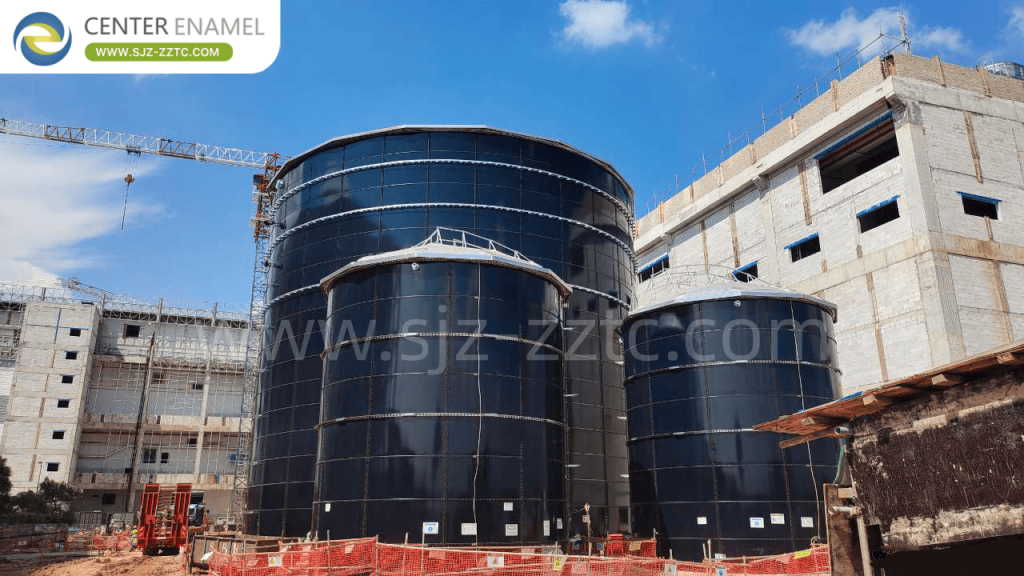
Meeting these demands requires more than equipment supply-it requires a Wastewater Treatment Solutions Provider that can integrate process design, durable hardware, and long-term service into one accountable package.
GFS Tanks Engineered for Harsh Environments
GFS tanks can undergo customized wind and seismic design based on project site climate and geological conditions, with environmental adaptability far superior to concrete tanks.
Concrete tanks are cast-in-place monolithic structures, with seismic and wind resistance entirely dependent on on-site construction quality. In remote areas, typhoon-prone zones, and earthquake belts, construction quality is difficult to control. Under strong earthquakes or typhoons, concrete tanks are prone to cracking and base settlement damage, with subsequent reinforcement costs equivalent to rebuilding.
GFS tanks undergo collection of local seismic intensity, maximum wind pressure, and foundation bearing capacity data before construction, with customized thickened steel panels, stiffening ribs, and anchored base components-all factory-prefabricated to standardized specifications. The bolted panel structure has excellent stress distribution capability, making it less prone to overall fracture under seismic and typhoon impacts, and minor foundation settlement will not cause through-cracking. Structural parameters can be flexibly adjusted for mountainous, coastal typhoon-zone, and high-seismic-zone projects, providing long-term protection against extreme natural climate damage.
Inside the IC Reaction Process
Pretreated high-strength organic wastewater enters the lower main reaction zone from the bottom, mixing with recirculated sludge-water mixture and rising rapidly. Anaerobic microorganisms efficiently degrade organic matter, producing large volumes of biogas.
The gas-lift action of biogas carries the mixed liquor upward to the top gas-liquid separator where biogas is collected. Degassed sludge-water mixture returns by gravity through downcomers to the reactor bottom, creating autonomous internal circulation that repeatedly enhances pollutant degradation.
After multiple circulation cycles, the wastewater enters the upper polishing zone for further reaction and sludge-water separation. Remaining trace organics are fully degraded, sludge settles back to the lower reaction zone, treated effluent overflows from the top, and aged sludge is periodically discharged-fully autonomous circulation, efficient continuous operation. This is Anaerobic Digestion at its most refined, and it is the technical core that a capable Wastewater Treatment Solutions Provider must master.
What Makes Pharmaceutical Wastewater So Difficult
Pharmaceutical wastewater exhibits complex composition, large fluctuations, high pollution load, and very poor biodegradability.
COD ranges widely-fermentation type 5,000–30,000 mg/L, chemical synthesis peaking over 100,000 mg/L, with BOD/COD generally below 0.2. Water contains unreacted raw materials, drug intermediates, organic solvents, mycelium, and high concentrations of salts, with some wastewater salinity reaching tens of thousands of mg/L.
Color is high, yellow-brown to dark black, with nitrogen and phosphorus pollutants severely exceeding limits, readily causing eutrophication. Water quality and quantity have no stable pattern, with alternating high/low concentration discharges-extremely high treatment difficulty. These conditions explain why conventional Anaerobic Digestion alone is rarely sufficient and why combined trains are standard practice.
Performance Data Summary
Table 1: Pharmaceutical Wastewater Quality Characteristics
| Parameter | Fermentation Type | Chemical Synthesis Type |
| COD range | 5,000–30,000 mg/L | Over 100,000 mg/L |
| BOD/COD ratio | Generally below 0.2 | Generally below 0.2 |
| Salinity | Up to tens of thousands mg/L | Up to tens of thousands mg/L |
| Color | Yellow-brown to dark black | Yellow-brown to dark black |
| N & P | Severely exceeding limits | Severely exceeding limits |
| Discharge pattern | Alternating high/low concentration | Alternating high/low concentration |
Table 2: Center Enamel Global Track Record
| Metric | Detail |
| First overseas GFS tank installation | 2009, Niger, Africa |
| First GFS tank export to US | 2015, passed strict US acceptance standards |
| Regions covered | Southeast Asia, Africa, the Americas |
| Applications | Livestock biogas, POME, municipal wastewater, drinking water |
| Special site experience | Mountainous, coastal salt spray, tropical heat, EU/US standards |
More Than a Decade of Global Installation Experience
Center Enamel offers unmatched global practical experience among domestic peers-over a decade covering multiple regions and all industry sectors.
In 2009, Center Enamel completed the first overseas GFS tank installation-sending a team to Niger, Africa for drinking water storage tank installation. In 2015, it broke industry ground with China's first GFS tank export and installation to the US-passing strict US acceptance standards.
All installed projects have operated stably for many years, covering livestock biogas, POME, municipal wastewater, and drinking water storage applications. Construction has covered Southeast Asia, Africa, the Americas, and other regions-accumulating specialized solutions for complex sites including mountainous terrain, coastal salt spray, tropical high temperatures, and high-standard European/American facility conditions-maturely addressing global special construction requirements.
Full-Industry-Chain Integrated Delivery
Center Enamel is the only company globally integrating proprietary enamel frit R&D, self-manufactured tanks, and EPC general contracting-full-process self-control from solution design, equipment production, cross-border logistics, overseas construction, to post-construction O&M-significantly reducing client coordination and time costs.
For clients seeking a single Wastewater Treatment Solutions Provider, this means one contract, one point of accountability, and no gaps between design intent and installed reality.
Aluminum Geodesic Dome Roof for Tank Covers
Aluminum Geodesic Dome Roof independently developed by Center Enamel is manufactured using high-strength aluminum alloy plates through integral stamping. It features a triangular grid spherical self-supporting structure, enabling large-span full coverage without internal support columns.
Made of aluminum alloy, the roof offers excellent weather resistance and corrosion resistance, capable of long-term protection against acid rain, salt spray, and UV radiation, suitable for various extreme outdoor climate conditions. The structural design complies with international AWWA D108 standards, with aluminum plate thickness, rib cross-sections, and joint connections all verified by finite element stress analysis, ensuring wind and snow load resistance that meets building code requirements across different global regions.
The weight of the Aluminum Geodesic Dome Roof is only one-third to one-half of a steel roof with the same span, significantly reducing the load on the tank top and allowing direct installation without tank wall reinforcement. The roof provides superior overall sealing performance, with double sealing between panels using specialized sealant strips and mechanical interlocking, enabling both airtight gas storage and enclosed odor control, suitable for biogas collection and storage, wastewater tank odor control, and drinking water contamination prevention.
The support-column-free design does not interfere with the installation and operation of internal equipment such as mixers and water distributors. The aluminum material does not support microbial growth, requiring no anti-corrosion maintenance over long-term use, resulting in low total life-cycle costs.
Frequently Asked Questions
1. What does a Wastewater Treatment Solutions Provider do?
It integrates process design, equipment manufacturing, installation, and O&M-delivering a complete, accountable treatment system rather than isolated components.
2. Why is Anaerobic Digestion essential for pharmaceutical wastewater?
It removes high organic loads efficiently, produces biogas, and reduces downstream treatment burden-critical for COD levels above 5,000 mg/L.
3. What experience does Center Enamel bring globally?
Over 30,000 projects across 100+ countries, including the first Chinese GFS tank export to the US in 2015.
Let's Build Your Treatment System
Looking for a Wastewater Treatment Solutions Provider with proven Anaerobic Digestion expertise and global delivery experience? Contact Center Enamel to discuss your project requirements.
Send us your wastewater data and treatment goals-our team will respond with a tailored, compliant, and cost-effective system design.