
How Does a Wastewater Treatment Solutions Provider Leverage GFS Tanks to Meet Global Compliance Standards?
Global industrial wastewater treatment policies are escalating rapidly-from "compliance discharge" toward mandatory "resource recovery" and "zero liquid discharge." The EU, through its Circular Economy Action Plan, requires member states to increase industrial wastewater reuse rates and extends carbon footprint accounting to the full life cycle of wastewater treatment.
China continuously updates and tightens industrial water pollutant discharge standards, with increasingly stringent limits on total nitrogen, total phosphorus, and characteristic pollutants for industries such as chemicals, pharmaceuticals, and printing and dyeing. Some water-scarce regions and highly polluting industries are mandated to adopt zero or near-zero liquid discharge technologies. Germany has established a differentiated pretreatment technical standard system by industry, requiring industrial wastewater to meet specific quality requirements before discharge into municipal wastewater treatment plants, implementing strict source control.
These converging regulatory pressures mean that selecting the right Wastewater Treatment Solutions Provider is no longer simply a procurement decision-it is a strategic compliance and risk management decision. The provider must deliver not only treatment technology but also durable containment infrastructure, proven process integration, and the credentials to operate across multiple regulatory jurisdictions.
GFS Tanks Bolted Assembly: Flexible Infrastructure for Evolving Regulations
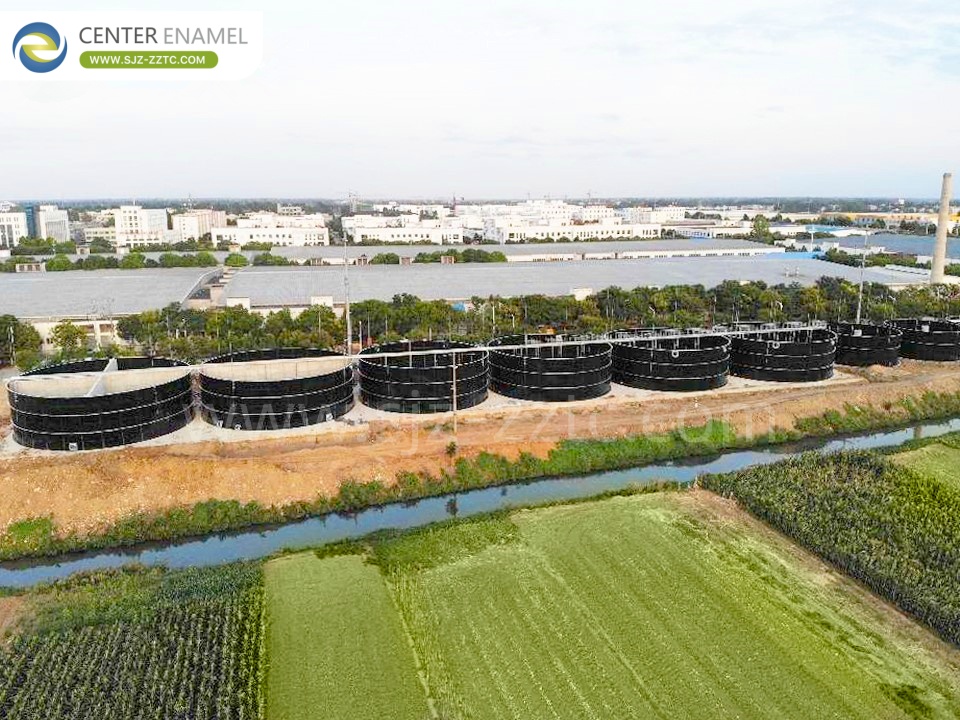
GFS tanks are assembled on-site from prefabricated panels, with short construction periods and support for expansion, relocation, and reuse-advantages distinctly different from immovable concrete tanks. This flexibility is particularly valuable in a regulatory environment where treatment requirements may tighten over time.
Concrete tank pouring requires formwork, rebar tying, pouring, and long curing periods, with a single tank construction taking months. Rain, snow, and low temperatures force work stoppages and delays. Once poured, they are permanent fixed structures that cannot be dismantled, expanded, or relocated-project relocation means complete abandonment.
GFS tank panels are all factory-prefabricated, transported to site, and directly assembled with simple procedures. Construction can proceed even in low-temperature, light-rain conditions, with installation time only one-third that of concrete tanks-making construction schedules highly controllable. For expansion, additional steel panels can be installed to increase volume; for plant relocation, tanks can be fully disassembled with panels transported to new sites for reassembly and reuse, significantly reducing material and construction costs. This makes GFS tanks ideally suited for short-term environmental projects, phased expansion projects, and relocated construction projects-all common scenarios as facilities adapt to evolving discharge standards.
| Feature | GFS Tanks | Concrete Tanks |
| Construction Time | 1/3 of concrete tanks | Months per tank |
| Weather Impact | Can proceed in low temp/light rain | Work stoppages in rain/snow/low temp |
| Expansion | Add panels to increase volume | Not expandable |
| Relocation | Fully disassemblable and reusable | Permanent, cannot relocate |
| Reuse | Panels transported and reassembled | Complete abandonment |
| Best For | Short-term, phased, relocated projects | Permanent fixed installations |
IC Process Advantages: Efficiency, Compactness, and Energy Savings
For a Wastewater Treatment Solutions Provider, the choice of biological process determines both treatment performance and long-term operating economics. The IC Process delivers top-tier treatment efficiency, with a footprint only one-third that of traditional anaerobic processes for the same treatment capacity-a significant compactness advantage for space-constrained facilities.
Its built-in gas-lift internal circulation requires no external recirculation equipment, providing autonomous forced mixing of sludge and water. Strong hydraulic mixing ensures thorough microbe-pollutant contact, greatly improving degradation efficiency and withstanding high water quality and hydraulic shock loads. The dual-zone configuration combines high-efficiency degradation with deep polishing for stable effluent quality. The process achieves a high degree of sludge granulation, strong activity, and very low washout. High automation, stable operation, low failure rates, large biogas production, and outstanding resource recovery benefits make the IC Process a compelling choice. Long-term energy and O&M costs are far lower than traditional anaerobic processes, making it suitable for large-flow, high-concentration industrial wastewater treatment.
Brewery Wastewater: Low Toxicity, High Treatability
Brewery wastewater stands out among industrial effluent streams for its exceptionally favorable treatment characteristics. It contains no chemical toxicity-it is purely natural organic wastewater with very low ecotoxicological risk and easy environmental restoration.
All pollutants are natural organics from grain fermentation-starches, sugars, alcohols, amino acids, and proteins-containing no heavy metals, bacteriostats, or persistent toxic organics. They do not inhibit biochemical bacteria and have no acute or chronic toxicity to soil, water, or plants. The core pollution is only high-concentration oxygen-demanding organics-direct discharge rapidly depletes dissolved oxygen, causing oxygen depletion, black-odor conditions, algal blooms, and channel siltation. Importantly, these pollutants have no bioaccumulation potential and are rapidly decomposed by microorganisms and natural water bodies-resulting in no long-term persistent ecological harm. This makes brewery wastewater an ideal candidate for anaerobic digestion and biogas recovery.
Core R&D Capabilities and Global Certifications
Technology R&D is the foundation of Center Enamel's competitive advantage as a Wastewater Treatment Solutions Provider. The company independently masters over 200 differentiated anti-corrosion enamel formulations, with full self-control over the enamel raw material chain, holding nearly 100 invention and utility patents. Products have passed NSF, WRAS, ASME, BSCI, CE, ISO9001, and other global certifications.
| Certification / Honor | Category |
| NSF | Product certification |
| WRAS | Product certification |
| ASME | Product certification |
| BSCI | Social compliance |
| CE | European conformity |
| ISO9001 | Quality management |
| National High-Tech Enterprise | Government honor |
| National Specialized "Little Giant" | Government honor |
| Hebei Manufacturing Single Champion | Government honor |
| Provincial Smart Factory | Government honor |
| Provincial Green Factory | Government honor |
The company maintains long-term collaborative research with multiple universities through joint materials laboratories-continuously iterating anti-corrosion coatings and large bolted tank structural design technologies. The proprietary material technology barrier creates an irreplaceable competitive advantage, with product performance comparable to high-end imported European/American storage equipment.
Installation and Construction Team: Proven Global Execution
The installation team has practical experience from over 10,000 GFS tank projects globally, strictly following standardized construction procedures-full control over project mobilization, civil coordination, tank assembly, piping, and commissioning schedules and quality.
The team is proficient in complete standardized installation processes for GFS tanks, dual-membrane gas storage covers, USR/CSTR/IC anaerobic reactors, and biogas desulfurization/piping systems-adaptable to large-scale farms, industrial parks, remote mountainous sites, coastal high-corrosion sites, and other complex locations-strictly implementing unified global safety construction standards. For large overseas cross-border projects, the team can be deployed as complete units for on-site construction, technical training, and local worker practical instruction-full control over construction details, air-tightness testing, and corrosion protection-ensuring timely and stable commissioning of global environmental projects through standardized delivery capability.
Aluminum Alloy Trough Deck Roof: Economical Cover for Water Storage
Complementing its tank and process offerings, Center Enamel provides the Aluminum Alloy Trough Deck Roof-a cost-effective economical tank cover solution for clean water and wastewater storage scenarios, primarily designed for drinking water, production wastewater, and firewater reserve tanks, balancing practicality and cost advantages.
The main body is integrally formed from anti-corrosion aluminum alloy plates, paired with aluminum support trusses. Its lightweight design imposes less load on the tank foundation, reducing civil construction investment. A naturally formed dense oxide protective layer on the surface resists rain and mild wastewater corrosion, withstands outdoor sun and rain exposure, and effectively blocks wind, rain, insects, fallen leaves, and odor volatilization-protecting water quality by preventing dust and debris from falling in and causing secondary contamination.
The flat roof structure is neat and orderly, allowing installation of maintenance walkways, guardrails, vents, and level monitoring ports on top, facilitating daily inspection and equipment maintenance. The simple sealing structure enables straightforward installation with short construction timelines, and virtually eliminates the need for anti-corrosion painting maintenance, resulting in extremely low operational costs. It is suitable for various small, medium, and large atmospheric pressure water storage tanks, and has been widely implemented in waterworks clear water tanks, industrial circulating water tanks, park firewater tanks, and domestic wastewater temporary storage facilities. It is highly compatible with water storage applications that do not require biogas collection or high-pressure sealing.
FAQ
Q1: How do global regulations affect wastewater treatment solutions? Regulations are shifting from compliance discharge to resource recovery and zero liquid discharge, requiring providers to deliver reusable, expandable, and compliant systems.
Q2: Why are GFS Tanks preferred by wastewater treatment solutions providers? GFS Tanks install in one-third the time of concrete, can be expanded or relocated, and resist corrosion-ideal for evolving regulatory requirements.
Q3: What certifications support Center Enamel's global projects? Center Enamel holds NSF, WRAS, ASME, BSCI, CE, and ISO9001 certifications, plus National High-Tech Enterprise and Provincial Green Factory honors.
Ready to meet tightening discharge standards with a proven Wastewater Treatment Solutions Provider? Contact Center Enamel today for a customized solution built on GFS Tanks and advanced IC Process technology.
Let our team help you navigate global compliance while maximizing resource recovery and operational efficiency. Reach out to Center Enamel and discover why over 10,000 projects worldwide rely on our integrated environmental expertise.