
How Do GFS Tanks and Wastewater Treatment Technologies Help Beverage Plants Solve Their Problems?
Wastewater treatment technology is usually sold as a process diagram-a reaction zone, a separator, an effluent line. The diagram only holds if the steel around it stays tight. In anaerobic work, corrosion resistance and gas-tightness decide whether a plant still performs in year ten, so the tank is part of the process. Center Enamel, Shijiazhuang Zhengzhong Technology Co., Ltd-builds both halves: glass-fused-to-steel tanks, reactor integration, roofs and on-site installation. What follows runs from market tiers to the reaction loop, the influent that stresses it, the factory behind the shell and the roof that closes it.
A Market Split Into Three Tiers
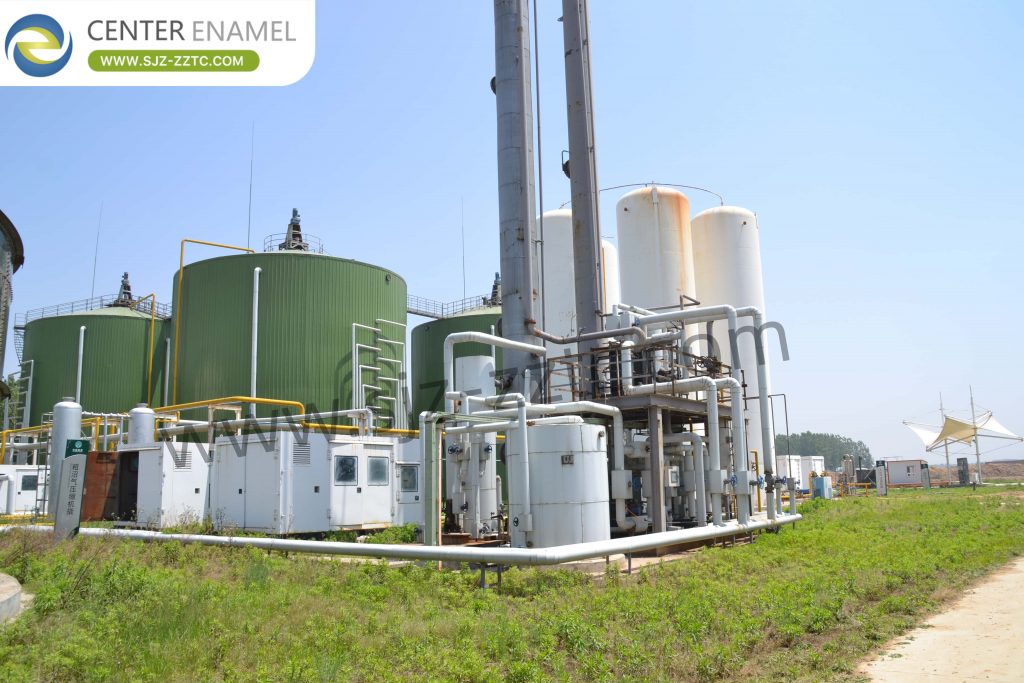
Competition has diverged, and concentration is rising as leaders assemble integrated capability through technical integration and capital operations. Chinese manufacturers consolidate their edge in mid-tier equipment exports; international giants chase high-end customers and complex industrial streams; local players hold the mid-to-low-end and park centralized treatment market on responsiveness and cost. Inside that field, UASB, EGSB and IC reactors carry high-strength organic pretreatment in food processing, pharmaceutical fermentation, alcohol brewing and chemicals, valued for high loading, small footprint and stable operation. All of them sit in a steel shell whose corrosion resistance and gas-tightness govern long-term stability.
| Tier | Who competes there | Basis of advantage |
| High end | International giants | Complex industrial streams, integrated service |
| Mid tier | Chinese equipment exporters | Standardized equipment, export volume |
| Mid-to-low end | Local players | Responsiveness, cost, park projects |
That is where glass-fused-to-steel tanks moved from an option to a default-and the case becomes clearer once the reaction itself is on the table.
Inside the IC Loop: Four Moves, No External Pumping
Pretreated high-strength wastewater enters the lower reaction zone from the bottom and mixes with recirculated sludge-water liquor, rising fast. Anaerobic microorganisms degrade the organics and generate large biogas volumes; the gas lift carries the mixed liquor upward to a top gas-liquid separator, where biogas is collected. Degassed liquor then returns by gravity through downcomers to the base, creating an autonomous internal circulation that repeatedly pushes pollutant degradation further. After several cycles the flow enters the upper polishing zone, where residual organics finish degrading and sludge separates; sludge settles back to the lower zone, treated effluent overflows from the top, and aged sludge is discharged periodically. No external recirculation pump, no interruption-which is exactly why the shell must hold pressure and stay sealed.
The streams this loop absorbs are rarely gentle, and beverage production shows the range vividly.
Beverage Load: The Numbers That Set the Design
Beverage effluent runs high in COD and sugar, low in suspended solids, slightly acidic and highly biodegradable-with pronounced swings. COD typically sits between 3,000 and 20,000 mg/L, while CIP cleaning wastewater can exceed 50,000 mg/L. Core pollutants are soluble sugars-sucrose, fructose, glucose-and BOD/COD of 0.5 to 0.65 puts these streams among the most degradable in industry. pH runs slightly acidic, juice at 3 to 4 and carbonated streams carrying phosphoric acid; temperatures sit at 20 to 40 °C. Quality alternates with cleaning cycles and product changeovers, so strong caustic and dilute filling water arrive on the same day.
| Parameter | Typical range | Design implication |
| COD | 3,000–20,000 mg/L (CIP peaks above 50,000) | Buffer volume, shock-load capacity |
| BOD/COD | 0.5–0.65 | High anaerobic conversion, strong biogas yield |
| Suspended solids | Low (pulp, tea residue, fiber) | Simple separation, low sludge output |
| pH | Slightly acidic; juice 3–4 | Acid-resistant coating and seals |
| Temperature | 20–40 °C | Mesophilic operation without pre-heating |
Acidic, sugar-rich and fluctuating influent is what makes coating quality a process decision rather than a purchasing detail.
Factory Panels Beat Cast-in-Place Concrete
GFS tanks are fully factory-prefabricated to standardized specifications, and finished-product stability far exceeds cast-in-place concrete. Concrete work happens in the open air, where rebar tying, pouring and curing depend on crew skill, temperature and rainfall; wall thickness, density and strength vary between batches, and honeycombing, voids and thin walls hide inside the finished structure. Center Enamel's steel panels, seals and reinforcement components are mass-produced in automated plants, with stamping, high-temperature enameling and dimensional cutting all under CNC control, each panel's parameters and enamel thickness held to unified national standards. Components ship in uniform packaging and assemble to standardized drawings, with inspection running from raw material to finished part-so every tank delivers consistent performance instead of site-dependent luck.
Consistent panels are what make wastewater treatment technology dependable at scale-and they need a base built to produce them in volume.
The Base Behind the Panels
The core intelligent manufacturing base sits in Hebei Province on more than 150,000 m², pairing a mature Phase I facility with a Phase II high-end environmental equipment park for stable dual-base capacity. On site: R&D offices, proprietary material laboratories and finished-product testing centers, quality systems meeting ISO, NSF and CE, plus green manufacturing certified as a Provincial Green Factory. Six marketing service centers support a nationwide production-sales network, while expressway links, major logistics hubs and full container capability move several large tank projects at once. With 500+ staff and parallel automated lines, output places the base among the global top tier of GFS tank manufacturers.
Scale alone does not make a tank fit a site-engineering does.
Design That Starts With the Site
The design team includes senior engineers registered in the Hebei Provincial Science and Technology Expert Database and works to European and American high-end safety standards. It delivers integrated design for livestock biogas, POME, municipal wastewater, hazardous waste storage and seawater desalination-tank structure, anti-corrosion and sealing, biogas piping, anaerobic integration. Before drawing, the team checks seismic zone, wind pressure, soil bearing capacity, water corrosivity and discharge limits, then thickens panels, reinforces anchorage or upgrades seals as needed. Packages are tailored to plant area, load, targets and budget.
One component is still chosen late, and it decides how the tank behaves in service: the roof.
The Roof Choice: FRP Where Air-Tightness Is Not Needed
The FRP roof is an economical cover for atmospheric tanks that need no air-tightness-drinking water, irrigation, firewater reserve and temporary wastewater holding. Flat and dome styles follow tank size and site appearance. The cover is molded integrally from resin and fiberglass: light, water-resistant, mildly acid- and alkali-resistant, and immune to rust and rot in humid conditions, which removes the anti-corrosion maintenance metal roofs need. The dome sheds water through its curvature, resisting ponding, dust, snow and wind; the flat version carries walkways, gauges and vents. It is fully insulated, free of galvanic corrosion, keeps drinking water quality intact and meets domestic storage standards. Modular low-weight parts hoist easily on site, cutting construction effort and cost.
| Roof style | Best for | Practical benefit |
| Dome FRP | Water storage in windy, snowy sites | Drainage, snow and wind resistance |
| Flat FRP | Tanks needing top access | Walkways, gauges, vents |
| Not suitable | Biogas collection, pressurized tanks | No air-tightness or pressure rating |
Used correctly, it suits rural tanks, park firewater, waterworks buffer tanks and small-to-medium wastewater storage-cost-effective conventional duty, and openly not the answer for anaerobic gas production.
FAQ
Why do GFS tanks matter in wastewater treatment technology?
Anaerobic reactors sit inside a steel shell whose corrosion resistance and gas-tightness determine long-term stability. Factory-fused enamel panels resist acidic, sugar-rich influent and hold gas in, so the process keeps performing instead of leaking, corroding or losing biogas. That is why the tank specification belongs in process design, not on a procurement list. A sealed shell also keeps oxygen out of the biogas path.
How does the IC process circulate without pumps?
Biogas gas-lift drives the loop: liquor rises to a top separator, biogas is collected, degassed liquor returns by gravity through downcomers, and the cycle repeats. Each pass sends organics through the reaction zone again, delivering high loading rates, a small footprint and steady effluent without external recirculation equipment, while aged sludge is discharged periodically to keep the bed active.
Which roof fits a GFS tank project?
FRP suits atmospheric tanks without air-tightness needs-drinking water, firewater, irrigation and temporary storage-in flat or dome style, at low cost and light weight. Biogas collection, odor containment or pressurized duty needs an air-tight cover instead, such as an aluminum geodesic dome, because FRP carries no pressure rating.
Tell us the stream, the site and the discharge limit, and our engineers will match tank, process and roof to all three. Want a second opinion on your current design? Send the Center Enamel team your drawings and get a buildability review.