
How Is Wastewater Treatment Technology Evolving to Meet Chemical Wastewater Regulations?
Industrial wastewater regulation is no longer a matter of meeting discharge limits at the pipe end. Across major economies, policy is shifting from "compliance discharge" toward mandatory resource recovery and zero liquid discharge, forcing plant operators to rethink both process design and containment strategy. For Chemical Wastewater-one of the heaviest pollution loads in industry-this regulatory tightening demands treatment technology that is corrosion-resistant, scalable, and capable of withstanding constant quality fluctuation. Center Enamel addresses this challenge through a combination of proprietary Glass-Fused-to-Steel containment and integrated environmental engineering services, delivering Wastewater Treatment Technology that keeps pace with both regulation and operational reality.
What Policy Pressures Are Reshaping Industrial Wastewater Treatment?
Global industrial wastewater treatment policies are escalating from "compliance discharge" to mandatory "resource recovery" and "zero liquid discharge." The EU, through its Circular Economy Action Plan, requires member states to increase industrial wastewater reuse rates and extends carbon footprint accounting to the full life cycle of wastewater treatment. China continuously updates and tightens industrial water pollutant discharge standards, with increasingly stringent limits on total nitrogen, total phosphorus, and characteristic pollutants for industries such as chemicals, pharmaceuticals, and printing and dyeing. Some water-scarce regions and highly polluting industries are mandated to adopt zero or near-zero liquid discharge technologies. Germany has established a differentiated pretreatment technical standard system by industry, requiring industrial wastewater to meet specific quality requirements before discharge into municipal wastewater treatment plants, implementing strict source control.
These policy shifts create a clear technical mandate: treatment systems must deliver higher removal efficiency, greater reliability, and longer service life under more aggressive chemical conditions. That mandate flows directly into equipment selection-particularly the tanks and covers that contain the most corrosive streams.
Why Does Bolted GFS Tank Assembly Outperform Concrete Construction?
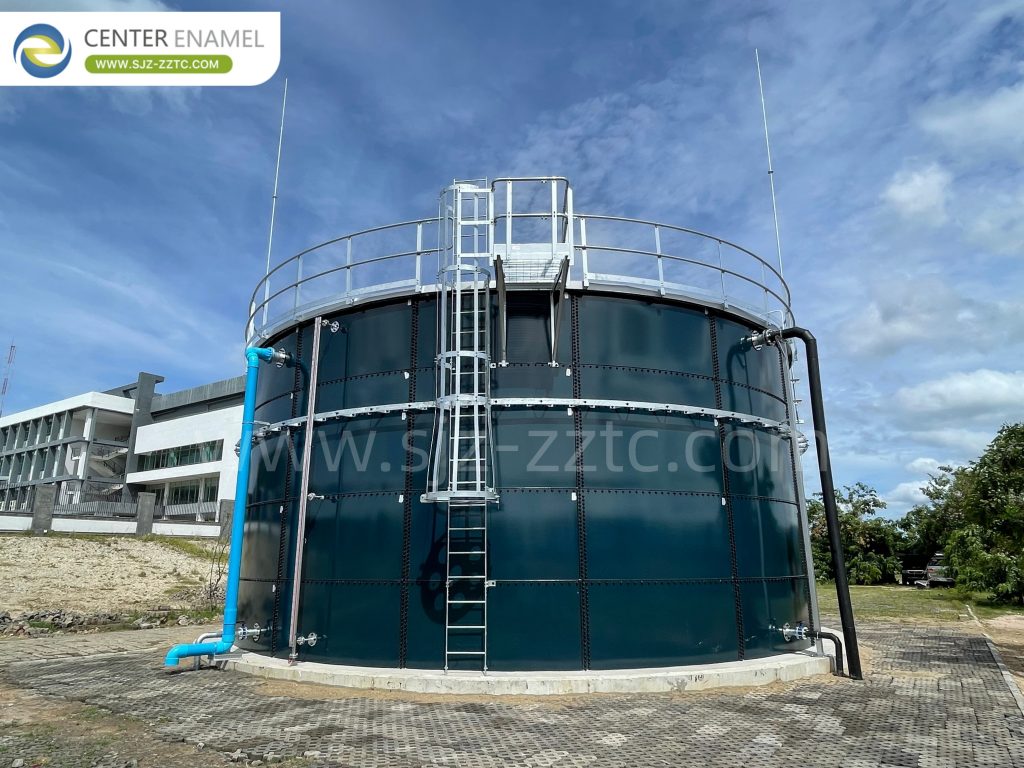
Meeting these tightened standards depends as much on how treatment infrastructure is built as on the process inside it. GFS tanks are assembled on-site from prefabricated panels, with short construction periods and support for expansion, relocation, and reuse-advantages distinctly different from immovable concrete tanks. Concrete tank pouring requires formwork, rebar tying, pouring, and long curing periods, with a single tank construction taking months. Rain, snow, and low temperatures force work stoppages and delays. Once poured, they are permanent fixed structures that cannot be dismantled, expanded, or relocated-project relocation means complete abandonment.
GFS tank panels are all factory-prefabricated, transported to site, and directly assembled with simple procedures. Construction can proceed even in low-temperature, light-rain conditions, with installation time only one-third that of concrete tanks-construction schedules are controllable. For expansion, additional steel panels can be installed to increase volume; for plant relocation, tanks can be fully disassembled with panels transported to new sites for reassembly and reuse, significantly reducing material and construction costs for new construction and reconstruction. This is ideally suited for short-term environmental projects, phased expansion projects, and relocated construction projects-a practical advantage when Chemical Wastewater treatment capacity must be scaled in step with production changes.
How Does the IC Process Handle Complex Chemical Wastewater Streams?
Chemical Wastewater originates from the entire production chain of petrochemicals, coal chemicals, fine chemicals, fertilizers and pesticides, and consumer chemicals. Petrochemical wastewater is primarily oily wastewater and alkaline residue, rich in hydrocarbons, phenols, and sulfides. Coal chemical wastewater is mainly coal gasification scrubber water, rich in ammonia nitrogen, cyanides, phenols, and heterocyclic compounds. Fine chemical wastewater has diverse compositions with various synthesis intermediates, residual raw materials, and byproducts, while pesticide wastewater contains organophosphorus and organochlorine pesticide residues. Wastewater generation is continuous, with significant fluctuations as product lines change; large petrochemical plants have high continuous discharge volumes, while small and medium-sized chemical plants have intermittent discharges with extremely unstable water quality.
This variability places a premium on anaerobic process robustness. The IC process-Internal Circulation Anaerobic Reactor-meets that need through a GFS tank with built-in gas-lift internal circulation system and upper/lower three-phase separators, the key components enabling autonomous circulation and high-rate degradation without external return pumps. Combined with corrosion-resistant GFS construction, this configuration allows chemical producers to treat high-strength streams reliably despite fluctuating influent quality.
What Does Center Enamel's Product Matrix Cover?
Center Enamel has built a complete product matrix of "core storage tanks + supporting covers + specialty pressure vessels + complete environmental engineering services"-the only company globally to achieve integrated enamel frit R&D, self-manufacturing, and GFS tank application.
| Category | Solution | Application |
| Core | Proprietary GFS Tanks | Strong-corrosion conditions in wastewater, biogas, and chemical applications |
| Supporting | Fusion Bonded Epoxy Tanks | Drinking water, fire water, neutral medium storage |
| Sealing | Aluminum Dome Covers | Tank sealing and biogas collection |
| Other Tanks | Carbon Steel, Stainless Steel, Composting Tanks, Non-Standard Pressure Vessels | Specialized industrial duty |
| Engineering Services | Environmental EPC Contracting, Anaerobic Process Subcontracting | Food waste, leachate, municipal wastewater, livestock biogas, petrochemical/metallurgical, seawater desalination |
The core GFS tank line uses proprietary double-sided hot-rolled double-layer enamel anti-corrosion technology-resistant to strong acids, alkalis, high salinity, and microbial corrosion-with modular quick assembly suited to all strong-corrosion conditions. Supporting Fusion Bonded Epoxy tanks are produced on China's first intelligent standardized production line, primarily for drinking water, fire water, and neutral medium storage. Aluminum Dome Covers use a proprietary high-strength aluminum alloy self-supporting structure meeting international waterproof and load-bearing standards.
How Is Global Service Delivery Structured?
Technology performance depends on execution quality. Leveraging regional sales centers in China and overseas local agent networks, Center Enamel has established a complete after-sales service loop covering all markets. The system provides four core service pillars: 24/7 rapid response mechanism, on-site domestic/overseas installation services, full-project-cycle after-sales support, and long-term warranty protection-forming a complete service chain from preliminary site survey, mid-term construction management, to long-term inspection and maintenance. The entire system is uniformly adapted to both domestic and international project service standards, coordinating personnel scheduling, material support, and on-site coordination for simultaneous projects across multiple regions-significantly reducing customer multi-party coordination costs and ensuring efficient domestic and overseas project delivery.
| Service Pillar | Scope |
| 24/7 Rapid Response | Continuous technical support across all time zones |
| On-Site Installation | Domestic and overseas installation services |
| Full-Cycle After-Sales | Preliminary survey through long-term maintenance |
| Long-Term Warranty | Extended protection and inspection programs |
Frequently Asked Questions
What makes GFS tanks suitable for Chemical Wastewater?
The proprietary double-sided enamel coating resists strong acids, alkalis, high salinity, and microbial corrosion, making GFS tanks reliable for aggressive chemical streams that degrade concrete or standard steel containment.
Can GFS tanks be expanded or relocated?
Yes. Panels are factory-prefabricated and bolted on-site, allowing additional panels for capacity expansion or full disassembly and reassembly at a new site-at a fraction of concrete construction cost.
Does Center Enamel provide full EPC services?
Center Enamel offers environmental EPC general contracting and anaerobic process subcontracting, covering food waste, leachate, municipal wastewater, livestock biogas, petrochemical/metallurgical, and seawater desalination applications.
Looking to align your Chemical Wastewater treatment strategy with tightening global discharge and reuse standards? Center Enamel's engineering team can assess your stream characteristics and recommend a containment and process configuration built for long-term compliance.
Reach out to Center Enamel to discuss your project requirements and receive a tailored technical proposal-our specialists are ready to support your next wastewater treatment initiative from concept through commissioning.