
How Advanced Wastewater Treatment Technology and IC Process Solve Industrial Pollution
The industrial wastewater treatment market has entered a phase of structural divergence. Leading companies are building integrated service capabilities through technical integration and capital operations, and industry concentration is gradually increasing. Chinese companies continue to consolidate their advantages in mid-tier equipment exports, while international giants target high-end customers and complex industrial wastewater markets. Local players occupy the mid- to low-end and industrial park centralized treatment markets with service responsiveness and cost advantages.
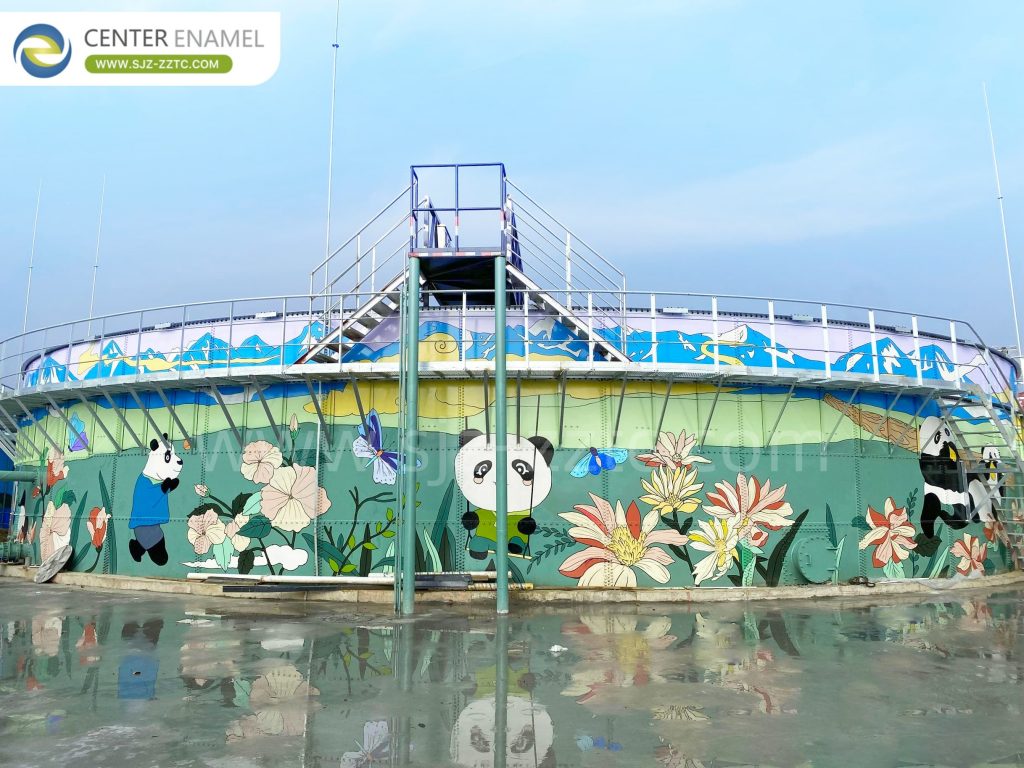
Within this competitive landscape, the anaerobic process segment has become a focal point of technological differentiation. UASB, EGSB, and IC anaerobic reactors-with advantages of high loading rates, small footprints, and stable operation-are widely used in high-concentration organic wastewater pretreatment in food processing, pharmaceutical fermentation, alcohol brewing, chemical, and other industries. These reactors use steel tank shells, and their corrosion resistance and gas-tightness directly determine long-term operational stability. The application value of glass-fused-to-steel tanks in such scenarios is increasingly prominent. Understanding why requires examining both the containment material and the process technology that together define modern Wastewater Treatment Technology.
GFS Tanks Adaptable to Complex Operating Conditions Across All Industries
Center Enamel has independently developed over 200 specialized enamel frit formulations and supporting patents, capable of customizing anti-corrosion enamel based on customer storage media, with adaptability comprehensively superior to concrete tanks. Concrete tanks use a single material, only suitable for neutral clean water storage. When storing corrosive materials such as livestock manure, palm oil mill effluent, chemical wastewater, food waste digestate, or high-salinity wastewater, additional anti-corrosion linings must be applied. These linings are prone to failure, preventing long-term stable operation and cannot adapt to alternating high/low concentration storage conditions.
GFS tanks solve this problem at the material level. They can be specifically formulated with specialized enamels resistant to strong acids, strong alkalis, high organic content, and high salinity. A single tank can switch between multiple wastewater and fermentation feedstock storage requirements. They are universally applicable across biogas anaerobic digestion, municipal wastewater, livestock farming, food processing, and industrial water treatment scenarios, eliminating the need to rebuild tanks for media changes and perfectly meeting the needs of diversified, multi-condition environmental protection projects.
IC Process Advantages: Compact, Efficient, and Energy-Saving
The IC Process represents the cutting edge of anaerobic Wastewater Treatment Technology, and its advantages are measurable. It delivers top-tier treatment efficiency with a footprint only one-third that of traditional anaerobic processes for the same treatment capacity-a significant compactness advantage for space-constrained industrial sites. The built-in gas-lift internal circulation requires no external recirculation equipment, with autonomous forced mixing of sludge and water. Strong hydraulic mixing ensures thorough micro-pollutant contact, greatly improving degradation efficiency and withstanding high water quality and hydraulic shock loads.
The dual-zone configuration combines high-efficiency degradation with deep polishing for stable effluent quality. The process achieves a high degree of sludge granulation, strong activity, and very low washout. High automation, stable operation, low failure rates, large biogas production, and outstanding resource recovery benefits further distinguish the IC Process. Long-term energy and O&M costs are far lower than traditional anaerobic processes, making it suitable for large-flow, high-concentration industrial wastewater treatment.
Pharmaceutical Wastewater: The Most Toxic and Persistent Category
Pharmaceutical wastewater is the most toxic and highest environmental risk category among the five wastewater types, with significant biological toxicity and environmental persistence. Residual antibiotics, bacteriostats, and chemical synthesis intermediates in the wastewater can inhibit microbial activity at microgram-level concentrations, disrupting biochemical system bacterial community structure and potentially causing system failure. Large quantities of persistent refractory organics discharged into natural waters cannot be rapidly decomposed, remaining in water and soil for extended periods, inhibiting aquatic organism reproduction and disrupting aquatic ecological balance. Heavy metal ions, high salts, and toxic organics form combined synergistic pollution, causing persistent surface and groundwater contamination with long-term ecological safety risks.
These characteristics explain why pharmaceutical wastewater demands both robust containment and a process resilient to shock loads and inhibitory compounds. The IC Process, housed within corrosion-resistant GFS tanks, provides exactly this combination-protecting the biological system from toxic upsets while ensuring the tank shell itself does not degrade under aggressive chemical exposure.
Proven Anaerobic Performance: Pakistan Biogas Demonstration Project
Center Enamel's anaerobic expertise is validated by real-world project delivery. The Pakistan Food Waste + Napier Grass Biogas Demonstration Project exemplifies the company's capability as general contractor. CSTR served as the core anaerobic process, using food waste and Napier grass as mixed fermentation feedstock. The system is equipped with a mechanical mixing system ensuring thorough mixing of feedstock and anaerobic microorganisms, achieving efficient organic degradation with stable daily biogas production of 100 m³. This is the local official demonstration project for validating gas production efficiency and long-term continuous operational stability. After successful pilot operation, multiple large-scale Napier grass biogas projects are planned locally to promote biomass clean energy and support regional low-carbon development.
| Project | Location | Process | Feedstock | Biogas Output | Key Features |
| Pakistan Food Waste + Napier Grass Biogas Demonstration Project | Pakistan | CSTR | Food waste + Napier grass (mixed fermentation) | 100 m³/day | Mechanical mixing system; official local demonstration project; validates gas production efficiency and long-term operational stability |
This project demonstrates that anaerobic treatment systems built on GFS tanks can operate stably over the long term-a critical validation for pharmaceutical applications where reliability is non-negotiable.
Installation and Construction Excellence
Behind every successful treatment system is disciplined execution. The Center Enamel installation team has practical experience from over 10,000 GFS tank projects globally, strictly following standardized construction procedures-full control over project mobilization, civil coordination, tank assembly, piping, and commissioning schedules and quality.
The team is proficient in complete standardized installation processes for GFS tanks, dual-membrane gas storage covers, USR/CSTR/IC anaerobic reactors, and biogas desulfurization/piping systems-adaptable to large-scale farms, industrial parks, remote mountainous sites, coastal high-corrosion sites, and other complex locations-strictly implementing unified global safety construction standards. For large overseas cross-border projects, the team can be deployed as complete units for on-site construction, technical training, and local worker practical instruction-full control over construction details, air-tightness testing, and corrosion protection-ensuring timely and stable commissioning of global environmental projects through standardized delivery capability.
| Capability | Coverage | Key Strengths |
| Global project experience | 30,000+ mature projects across 100+ countries | Southeast Asia, Africa, Europe, Americas |
| Installation scope | GFS tanks, dual-membrane gas storage covers, USR/CSTR/IC anaerobic reactors, biogas desulfurization/piping | Standardized global safety construction standards |
| Site adaptability | Large-scale farms, industrial parks, remote mountainous sites, coastal high-corrosion sites | Complex location expertise; cross-border deployment |
Global Benchmark Project Portfolio
Center Enamel's project portfolio covers over 100 countries across Southeast Asia, Africa, Europe, and the Americas-30,000+ mature projects-accumulating complete industry solutions across palm oil, livestock, municipal, brewing, and food waste biogas-rapidly matching customized solutions for different regional climates, water quality, and regulations. This track record demonstrates that advanced Wastewater Treatment Technology must be paired with proven delivery capability to deliver reliable long-term results.
Ready to upgrade your facility with proven Wastewater Treatment Technology and IC Process design? Contact us today for a solution engineered to your wastewater characteristics and site conditions.
Frequently Asked Questions
What makes the IC Process different from traditional anaerobic treatment?
The IC Process uses built-in gas-lift internal circulation with no external pumps, achieving a footprint one-third of traditional systems with superior shock load resistance.
Can GFS tanks handle pharmaceutical wastewater?
Yes. Custom enamel formulations resist high salinity, strong acids/alkalis, and toxic organics-ideal for the most corrosive pharmaceutical waste streams.
How many projects has Center Enamel delivered globally?
Over 30,000 projects across 100+ countries, covering palm oil, livestock, municipal, brewing, food waste biogas, and industrial wastewater applications.