
What a Biogas Project Involves: From Feedstock To Gas Recovery
A biogas project converts organic feedstock such as animal manure, food waste, and agro-industrial wastewater into renewable methane through anaerobic digestion. The gas is captured in dedicated storage, conditioned, and used for power generation, heat, or upgraded to biomethane for grid injection or vehicle fuel.
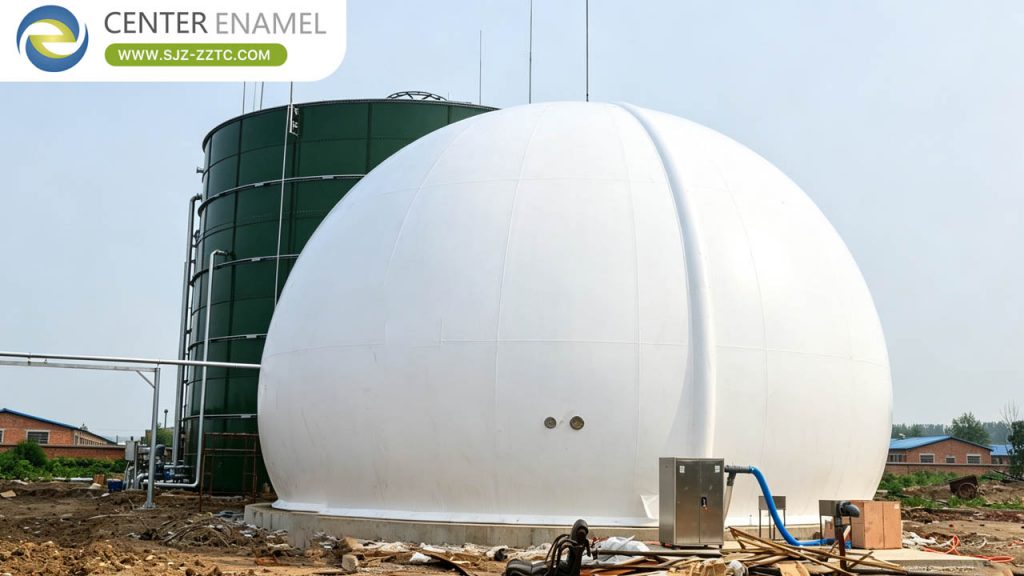
What Is A Biogas Project?
A biogas project is an integrated engineering system that recovers energy from organic waste. Unlike a single piece of equipment, it combines feedstock handling, a sealed anaerobic digester, gas collection, and a utilisation train. The objective is to stabilise waste while producing a usable fuel, so the design must balance biology, civil tankage, and gas equipment from day one.
Key Stages Of A Biogas Project
Most biogas projects follow the same sequence. Each stage carries its own engineering decisions and failure points.
| Stage | What Happens | Typical Equipment |
| Feedstock intake | Receive, screen, and homogenise organic feed | Receiving pit, mixer, screen |
| Anaerobic digestion | Microbes convert organics to biogas | CSTR, UASB, or USR digester |
| Gas handling | Dewater, desulphurise, store gas | Scrubber, gas holder, flare |
| Utilisation | Burn or upgrade the methane | CHP, boiler, biogas upgrading skid |
| Digestate | Stabilise and store residues | GFS storage tank, lagoon |
Choosing The Digester Technology
The digester type depends on feedstock solids and site constraints. A continuously stirred CSTR suits uniform manure slurries at 35-38 C. An upflow anaerobic sludge blanket (UASB) fits low-solid, warm effluents and builds dense granular sludge. An upflow solids reactor (USR) holds coarse high-solid feed without fine mixing. Selection drives the tank geometry, not the other way around.
Feedstock And Mass Balance
Gas yield tracks the volatile solids fed, not the total volume. Mature cattle manure typically returns 0.20-0.30 m3 of biogas per kg of volatile solids, with 55-65% methane. Co-digesting with energy crops or food waste shifts the carbon-to-nitrogen ratio toward 20-30:1 and lifts yield, but only when the extra feed is reliably available.
Project Case Study: Malaysia Biogas Project
Project / Application: Large-scale biogas from agro-industrial wastewater, Malaysia. Industry: Food / agro-industrial. Tank Type: Glass-Fused-to-Steel (GFS). Key Requirements: High-rate digestion of high-strength effluent with reliable daily gas output.
| Field | Value | Source / Evidence |
| Tank Type | GFS (Glass-Fused-to-Steel) | Company project reference |
| Tank Quantity | 5 Nos. | Company project reference |
| Dimensions Per Tank | Ø24.46 x 12 m | Company project reference |
| Volume Per Tank | 5,400 m3 | Calculated from supplied diameter and height |
| Total Effective Volume | 27,000 m3 (5 tanks) | Company project reference |
| Daily Biogas Production | 22,000 m3 total | Company project reference |
| Digestibility | approx 80% | Company project reference |
| Gas Yield Rate | 0.45 m3 / kg COD removed | Company project reference |
| Parameter | Inlet Water | Effluent |
| COD | >= 60,000 mg/L | >= 12,000 mg/L |
| BOD | <= 25,000 mg/L | <= 5,000 mg/L |
About The Supplier
Shijiazhuang Zhengzhong Technology Co., Ltd (Center Enamel) manufactures Glass-Fused-to-Steel tanks rated for anaerobic digestion service, with enamel firing at 820-930 C and certifications including ISO 9001, NSF/ANSI 61, and CE-EN 1090. The bolted design supports rapid overseas deployment and factory-controlled quality.
Comparison: Biogas Project Delivery Models
| Model | Best For | Main Risk |
| EPC single-responsibility | Owners wanting one accountable party | Higher upfront coordination |
| Equipment-supply only | Owners with local civil team | Interface gaps at tank-process boundary |
| Build-own-operate | Operators wanting guaranteed output | Long contract commitment |
A biogas project succeeds when feedstock, digester type, tankage, and gas utilisation are designed as one system. Start from the mass balance and the daily gas target, then size the tanks and process around that reality.
Frequently Asked Questions
Q1: What are the main stages of a biogas project? A1: Feedstock intake, anaerobic digestion, gas handling and storage, utilisation (CHP or upgrading), and digestate management.
Q2: How much tankage does a biogas project need? A2: It scales with daily feed and hydraulic retention time; a high-rate digester for 22,000 m3/day biogas used five 5,400 m3 GFS tanks in one referenced project.
Q3: What feedstock works best for biogas? A3: Manure, food waste, and agro-industrial effluents with high volatile solids and a balanced C:N near 20-30:1.
Q4: How is biogas stored and used? A4: Gas is held in a dedicated holder or double-membrane roof, then burned in a CHP unit, used for heat, or upgraded to biomethane.
Q5: Is a biogas project profitable? A5: It depends on feedstock cost, gas off-take price, and digestate value; the digester alone does not guarantee a return.
Q6: What temperature does a digester need? A6: Mesophilic digestion typically runs at 35-38 C, with heated and insulated tanks in cold climates.
Q7: How long does commissioning take? A7: Bolted GFS tankage can be installed in weeks; biological start-up and gas stabilisation add several weeks depending on inoculum.
Q8: Can biogas be vehicle fuel? A8: Yes, after upgrading to biomethane (CO2 and H2S removal) it meets vehicle-grade specifications.
Discuss your feedstock and gas target with an engineer, or request a tankage and process scope for your biogas project.