
What About The Leftover Digestate: Managing Anaerobic Digestion Byproducts
The leftover digestate is the nutrient-rich slurry or fibre remaining after anaerobic digestion has taken the biogas out of the feed. It is managed by separating the liquid fraction from the solid fraction, then returning the liquid to land as fertilizer within a nitrogen and phosphorus budget and composting or bedding the solid. The separation and storage equipment that sit after the digester, not the digester itself, decide how much of the feed's nutrients are recovered safely.
What Digestate Actually Is
Digestion moves the volatile solids into biogas but leaves most of the nitrogen, phosphorus, and the bulk fibre behind. The liquid fraction carries the dissolved nutrients; the solid fraction carries the indigestible fibre and a share of the nutrients. Treating digestate as waste ignores that it is the nutrient loop closing on the same farm that supplied the feed.
| Fraction | What It Contains | Typical End Use |
| Liquid digestate | Dissolved N, P, potassium | Land application as fertiliser |
| Solid fibre | Fibre, bound N and P | Compost, bedding, or dry product |
| Separated water | Dilute nutrients | Recirculation or irrigation |
How It Is Separated And Stored
A screw press or centrifuge splits the stream at the digester outlet. The liquid goes to agitated storage so it can be spread when crops need it; the solid drops to a curing pad or composting bay. Without separation, the whole stream is too wet to handle and too bulky to move far, which is the usual reason digestate becomes a liability instead of an asset.
A Boundary Condition
Digestate is not a free fertilizer; it is a nutrient load that must be balanced against the land area and the crop uptake. Over-application causes nitrate leaching and odour, and winter storage in cold regions needs enough tank volume to hold the months when spreading is banned. Size the storage from the spreading ban length, not from convenience.
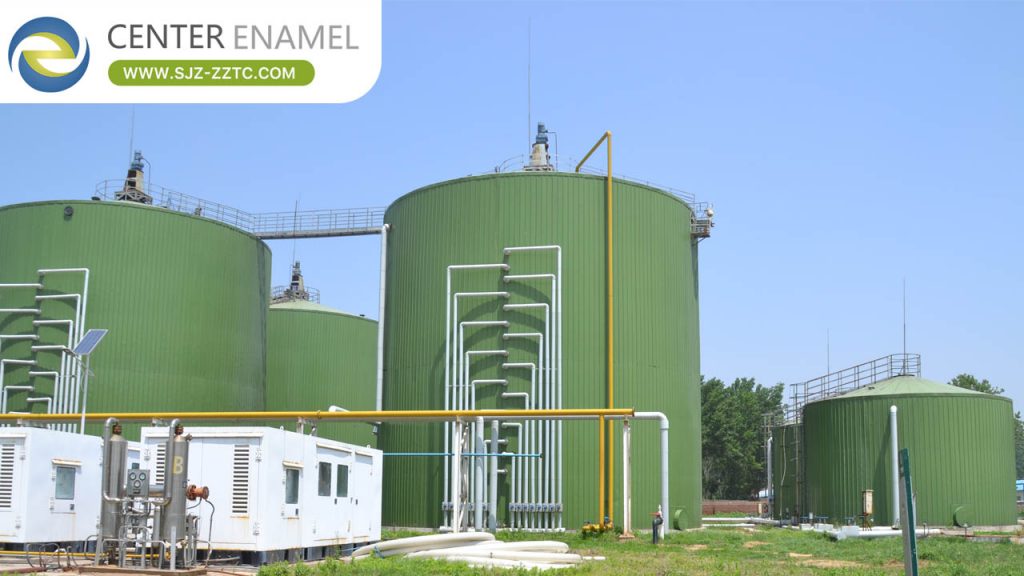
Project Case Study: Zhenyuan Group Biogas Project In Henan
Project / Application: Vehicle-grade methane from farm manure and washing wastewater, Xinzheng, Henan, China. Industry: Biogas and agriculture. Tank Type: CSTR (Continuous Stirred-Tank Reactor). Key Requirements: Recover energy and keep the nutrient loop on the farm.
| Field | Value | Source / Evidence |
| Handling Capacity | 650 T/D (manure + washing wastewater) | Company project reference |
| Treatment Type | Medium Temperature Anaerobic Fermentation | Company project reference |
| Reactor Type | CSTR (Continuous Stirred-Tank Reactor) | Company project reference |
| Primary Reactors | 3 sets, O15.29 x 15 m | Company project reference |
| Secondary Reactor | 1 set, O5.22 x 6 m | Company project reference |
| Annual Methane Production | 3,000,000 m3 (vehicle-grade) | Company project reference |
| Installation Year | 2013 | Company project reference |
About The Supplier
Shijiazhuang Zhengzhong Technology Co., Ltd (Center Enamel) builds the Glass-Fused-to-Steel digester and separation tanks that sit at the front and the back of this nutrient loop, with enamel firing at 820-930 C and certifications including ISO 9001, NSF/ANSI 61, and CE-EN 1090. The Henan reference shows a two-stage CSTR handling 650 T/D of manure and washing wastewater, where the digestate is the residual of a plant designed to return both energy and nutrients to the farm.
Comparison: Digestate End-Use Options
| Option | Best When | Trade-off |
| Direct land application | Cropland nearby | Needs spreading-ban storage |
| Composting the solid | Fibre-heavy feed | Extra pad and curing time |
| Recirculation | On-site process water | Dilutes but does not remove N |
| Drying or pelletising | Off-farm sale | Highest capital and energy |
The leftover digestate is the second product of any digester, after the biogas. Separate it, store it for the spreading window, and balance it against the land, and the residue becomes the nutrient loop instead of a disposal cost.
Frequently Asked Questions
Q1: What is digestate? A1: The nutrient-rich liquid and fibre left after anaerobic digestion has removed the biogas.
Q2: How is digestate separated? A2: A screw press or centrifuge splits liquid from solid at the digester outlet.
Q3: Where do the nutrients go? A3: The liquid is spread as fertiliser; the solid is composted, bedded, or dried.
Q4: Can digestate be sold? A4: The solid can be composted or pelletised for off-farm sale where transport and markets allow.
Q5: What is the main risk? A5: Over-application causes leaching and odour; storage must cover the spreading ban.
Q6: Is digestate the same as sludge? A6: No; digestate comes from anaerobic digestion of organics, sludge from wastewater settling.
Q7: What tank holds digestate? A7: A Glass-Fused-to-Steel tank resists the corrosive, high-ammonia liquid.
Q8: Does separation improve value? A8: Yes; separating lets the liquid be spread and the solid be handled separately.
Suggested CTA
Describe your feed volume and available land to an engineer, or request a digestate separation and storage scope with your digester.