
What Are the Characteristics of Paper Industry Wastewater?
The pulp and paper industry is one of the most resource-intensive and polluting sectors worldwide, generating enormous volumes of wastewater that present significant environmental challenges. Understanding the characteristics of paper industry wastewater is essential for developing effective treatment strategies that meet increasingly stringent discharge standards.
Paper mill effluent is notoriously complex, containing a mixture of organic compounds, inorganic chemicals, suspended solids, and process residues. As global environmental regulations tighten, the industry faces mounting pressure to implement advanced treatment solutions that go beyond traditional clarification methods.
In this comprehensive guide, we will examine the key characteristics of paper industry wastewater, explore its environmental impact, and demonstrate why advanced containment solutions-particularly Glass-Fused-to-Steel (GFS) tanks from Center Enamel-are essential for effective treatment.
High Organic Load: COD and BOD Levels
One of the defining characteristics of paper industry wastewater is its exceptionally high organic load, measured through Chemical Oxygen Demand (COD) and Biochemical Oxygen Demand (BOD). These parameters indicate the amount of oxygen required to break down organic matter in the water.
Studies of wood-based paper mill effluents show that wastewater from primary clarifier outlets typically contains COD levels ranging from 900 to 1,100 mg/L and BOD levels from 300 to 450 mg/L. These figures far exceed permissible discharge limits in most jurisdictions.
The high organic load primarily stems from lignin, cellulose, and hemicellulose released during pulping and bleaching processes. Lignin is particularly problematic because it is resistant to biological degradation, making paper wastewater one of the most challenging industrial effluents to treat.
Secondary treatment can reduce COD by approximately threefold and BOD by up to tenfold, but significant organic residues often remain. This necessitates advanced treatment stages, including anaerobic digestion, to achieve compliance.
Suspended Solids and Abrasive Fibers
Paper industry wastewater contains high concentrations of suspended solids, including wood fibers, mineral fillers, and ash. Total Suspended Solids (TSS) in primary clarifier effluent typically ranges from 230 to 300 mg/L, which can be reduced by about 90% through secondary treatment.
These suspended solids present unique challenges for treatment infrastructure. The abrasive nature of wood fibers and mineral particles causes continuous mechanical wear on tank linings and equipment. This abrasion, combined with chemical corrosion, demands robust containment systems that can withstand both physical and chemical degradation.
The high solids content also increases wastewater viscosity, making pumping and mixing difficult. Tanks must be structurally robust enough to support heavy mixing and scraping equipment required for effective primary clarification.
Extreme pH Fluctuations
Paper manufacturing processes use a wide range of chemicals, including caustic soda for pulping, chlorine compounds for bleaching, and various acids for pH adjustment. As a result, paper mill effluent exhibits wide and rapid pH swings-ranging from highly acidic to strongly alkaline.
This chemical volatility creates severe challenges for wastewater treatment infrastructure. Tanks must be engineered with coatings that offer broad-spectrum chemical resistance to maintain integrity across the entire pH spectrum. Standard GFS coatings can withstand pH levels from 3 to 11, while specialized coatings can handle pH 1 to 14.
High Total Dissolved Solids (TDS)
While secondary treatment effectively removes suspended solids and reduces organic loads, it has little impact on dissolved solids. Studies show that TDS levels in paper mill effluent typically remain between 1,860 and 2,150 mg/L even after secondary treatment.
These high dissolved solids include salts, inorganic chemicals, and residual processing compounds. Elevated TDS poses risks to receiving water quality and can cause ecological damage, including increased salinity and toxicity to aquatic organisms.
Reducing TDS requires advanced treatment technologies beyond conventional clarification, such as reverse osmosis or membrane filtration. However, these technologies depend on reliable upstream treatment to protect sensitive membranes from fouling.
Color and Lignin Compounds
Paper industry wastewater is characterized by its dark, intense color, which results from the presence of lignin and its derivatives. These complex organic compounds are difficult to degrade biologically and can persist in the environment.
The dark color of pulp mill effluent is not merely an aesthetic issue-it reduces light penetration in receiving waters, disrupting aquatic ecosystems by inhibiting photosynthesis. Additionally, lignin compounds can react with chlorine during disinfection to form toxic chlorinated organics.
Treatment of colored wastewater often requires advanced oxidation processes, coagulation, or activated carbon adsorption to achieve acceptable color removal.
Chemical Oxygen Demand and Bleaching Residues
Beyond lignin, paper mill effluent contains residual bleaching chemicals, including chlorine, chlorine dioxide, hydrogen peroxide, and ozone. These oxidizing agents contribute to the chemical oxygen demand and can be toxic to aquatic life.
The specific composition of wastewater varies significantly based on the pulping method (mechanical, chemical, or semi-chemical) and the raw materials used (wood types, recycled paper content). This variability makes consistent biological treatment difficult and requires flexible treatment systems that can accommodate changing influent characteristics.
Furthermore, recent research has identified microplastics as an emerging concern in paper mill wastewater. Studies of German paper mills found microplastic concentrations ranging from 10⁶ to 10⁸ particles per cubic meter in untreated wastewater, with removal rates exceeding 99% through mechanical and activated sludge treatment.
The Importance of Robust Containment Infrastructure
Given the demanding characteristics of paper industry wastewater-high organic loads, abrasive solids, extreme pH fluctuations, and corrosive chemicals-the choice of containment infrastructure is critical to treatment success. Conventional concrete tanks, while common, present significant limitations.
Concrete tanks are porous and prone to cracking, allowing corrosive gases to attack embedded rebar. They also require long curing times and cannot be easily expanded or relocated. These limitations make concrete an increasingly unpopular choice for modern paper wastewater treatment facilities.
GFS Tanks: The Ideal Solution for Paper Wastewater
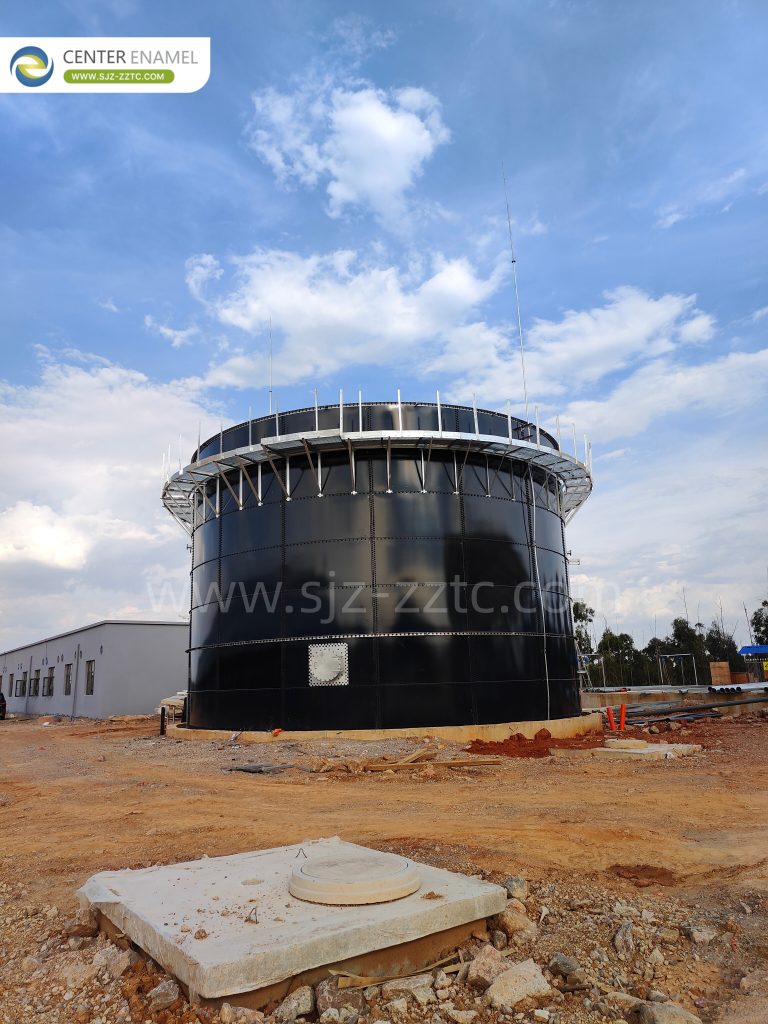
Glass-Fused-to-Steel (GFS) tanks have emerged as the preferred containment solution for paper industry wastewater treatment. By fusing high-tech glass enamel to steel plates at temperatures exceeding 820°C, GFS creates a material that combines the structural strength of steel with the chemical inertness of glass.
Superior Corrosion Resistance
GFS tanks offer unparalleled resistance to organic acids, hydrogen sulfide, and the extreme pH fluctuations characteristic of paper mill effluent. The inert glass surface withstands highly abrasive fibers, bleaching agents, and fluctuating pH levels that would rapidly degrade concrete or carbon steel.
Standard GFS coatings offer acid and alkali resistance across pH 3 to 11, with specialized coatings available for pH 1 to 14 applications. The coating hardness measures 6.0 on the Mohs scale, providing excellent abrasion resistance against the continuous wear caused by high solids content.
Rapid Installation and Flexibility
GFS tanks utilize a modular, bolted design that allows for rapid on-site assembly without extensive field welding. Construction time is approximately one-fifth that of traditional welded tanks, significantly reducing project timelines.
The bolted construction also provides flexibility-tanks can be easily expanded, dismantled, or relocated to accommodate changing production needs. This scalability is particularly valuable for paper mills facing evolving market conditions.
Long Service Life and Low Maintenance
GFS tanks offer a service life exceeding 30 years with minimal maintenance requirements. The non-porous, glossy surface is easy to clean and resists biological growth, while the glass coating eliminates the need for annual corrosion protection treatments required for carbon steel tanks.
This extended lifespan, combined with low maintenance costs, makes GFS tanks highly cost-effective over the lifecycle of a wastewater treatment facility.
Center Enamel: Professional Wastewater Treatment Solutions
Shijiazhuang Zhengzhong Technology Co., Ltd., operating under the brand Center Enamel, is a global leader in the design and manufacture of advanced containment solutions. With over 30 years of experience and a project footprint extending to more than 100 countries, Center Enamel provides turnkey EPC solutions for paper industry wastewater treatment.
Proven Track Record in Paper Wastewater
Center Enamel has successfully completed multiple papermaking wastewater treatment projects for leading industry enterprises. In China alone, Center Enamel has implemented projects in Sichuan, Guangdong, Hebei, Chongqing, Jiangsu, and Guangxi provinces.
One notable project in Guangxi involved supplying two GFS tanks measuring 15.28 meters in diameter and 25.65 meters in height, with a total volume of 14,648 cubic meters. These tanks are fully operational and demonstrate the effectiveness of GFS technology in handling the demanding conditions of paper mill effluent.
Comprehensive Product Portfolio
Beyond GFS tanks, Center Enamel offers a complete range of wastewater treatment infrastructure:
Fusion Bonded Epoxy (FBE) Tanks: Engineered for primary clarification and sludge holding, providing excellent abrasion resistance against high solids content
Stainless Steel Bolted Tanks (SS304/SS316L): Ideal for high-temperature and chemically volatile streams
Aluminum Dome Roofs: Maintenance-free, corrosion-resistant covers that provide odor control and prevent rainwater ingress
Double Membrane Roof Systems: For advanced biogas capture where anaerobic digestion is employed
Integrated Anaerobic Digestion Capabilities
Center Enamel specializes in high-efficiency anaerobic digestion systems, including Internal Circulation (IC) reactors and Completely Stirred Tank Reactors (CSTR). These technologies maximize biogas recovery from high-strength organic wastewater, turning treatment costs into energy revenue.
Conclusion
Paper industry wastewater is characterized by high organic loads, abrasive suspended solids, extreme pH fluctuations, and dissolved solids that present significant treatment challenges. Traditional containment solutions like concrete struggle to withstand these demanding conditions.
Glass-Fused-to-Steel (GFS) tanks offer the superior corrosion resistance, abrasion resistance, and structural integrity required for reliable paper wastewater treatment. With over 30 years of expertise and proven success across numerous paper industry projects, Center Enamel is a trusted partner in delivering comprehensive wastewater treatment solutions-from individual tanks to integrated EPC systems.
Frequently Asked Questions
What makes papermaking wastewater so difficult to treat compared to other industrial effluents?
Papermaking wastewater is challenging due to its combination of high Chemical Oxygen Demand (900–1,100 mg/L) from lignin and cellulose, abrasive suspended solids (230–300 mg/L TSS), extreme pH fluctuations from pulping chemicals, and elevated dissolved solids that persist even after secondary treatment.
Why are Glass-Fused-to-Steel (GFS) tanks preferred over concrete for paper mill wastewater treatment?
GFS tanks combine steel strength with glass corrosion resistance, offering superior protection against acidic and alkaline conditions (pH 3–11). Unlike porous concrete that cracks and allows gas attack on rebar, GFS provides an inert, non-porous barrier. GFS tanks also install rapidly (1/5 the time of concrete), allow future expansion, and require no annual corrosion maintenance.
What types of wastewater treatment solutions does Center Enamel provide for the paper industry?
Center Enamel offers comprehensive EPC solutions including Glass-Fused-to-Steel tanks, Fusion Bonded Epoxy tanks for high-abrasion applications, stainless steel tanks for volatile streams, Aluminum Dome Roofs for odor control, and anaerobic digestion systems (CSTR, IC reactors) for biogas recovery. With projects completed across multiple provinces in China and over 100 countries worldwide, Center Enamel is a proven partner for paper wastewater treatment.