
What Are the Examples of Slaughterhouse Waste? Turning Waste into Energy
Every day, slaughterhouses around the world process thousands of animals to meet global demand for meat. But along with meat production comes a significant challenge: slaughterhouse waste. What exactly constitutes this waste, and why is it such an environmental concern? More importantly, how can this waste be transformed from a costly liability into a valuable energy asset?
This article explores the most common examples of slaughterhouse waste, explains how modern biogas technology converts these materials into renewable energy, and introduces Center Enamel's proven solutions for slaughterhouse wastewater treatment projects worldwide.
What Are the Examples of Slaughterhouse Waste?
Slaughterhouse waste falls into two main categories: solid waste and liquid wastewater. Both contain extremely high levels of organic matter that can pollute waterways if left untreated.
Liquid Waste Components
The liquid portion of slaughterhouse waste includes:
Blood – During slaughter and processing, significant volumes of blood enter the wastewater stream. Blood contains very high concentrations of organic solids and nitrogen, giving it an extremely high Biochemical Oxygen Demand (BOD) – approximately 250,000 mg/L. Even a small loss of blood into wastewater dramatically increases treatment costs.
Washing Water – Large volumes of water are used to clean carcasses, equipment, and facility floors. This water picks up blood, fat, tissue fragments, and other organic residues.
Urine and Fecal Matter – Animals held in lairage (resting areas) before slaughter produce urine and feces that are flushed into the wastewater system.
Solid Waste Components
Solid slaughterhouse waste includes:
| Waste Type | Description |
| Paunch contents | Stomach contents of ruminant animals (cattle, sheep, goats)-can be 80kg or more per animal |
| Fat trimmings | Excess fat removed from carcasses during processing |
| Meat trimmings | Small tissue pieces from cutting and deboning operations |
| Hair, feathers, bristles | Animal coverings removed during processing |
| Hooves and horns | Hard keratinous materials |
| Bones | Skeletal remains |
| Condemned organs | Organs deemed unfit for human consumption |
By-Product Composition by Animal Type
The composition of slaughterhouse waste varies significantly by animal species and tissue type:
| Animal Source | Waste Fraction | Protein (%) | Lipids/Fat (%) |
| Pork | Blood | 83 | 0.28 |
| Pork | Fat | 0 | 100 |
| Cattle | Soft offal | 26.5 | 58.4 |
| Poultry | Feathers | 80 | 3 |
This high organic content-rich in proteins, lipids, and suspended solids – makes slaughterhouse waste both a pollution threat and a valuable feedstock for biogas production.
Why Slaughterhouse Waste Is a Major Environmental Challenge
Slaughterhouse effluents are considered one of the most concentrated and compositionally complex industrial waste streams. When discharged untreated, they cause:
Oxygen depletion in rivers and streams-organic matter consumes dissolved oxygen, killing aquatic life
Nutrient pollution – excess nitrogen and phosphorus cause algal blooms and eutrophication
Soil contamination – land application can lead to groundwater pollution
Odor problems – decomposition of organic waste generates unpleasant smells
Regulatory penalties – most countries have strict limits on slaughterhouse effluent discharge
Traditional waste management methods like landfilling, incineration, and composting have significant limitations-they are energy-intensive, produce greenhouse gases, or fail to fully capture the energy potential of the waste.
The Solution: Converting Slaughterhouse Waste to Biogas
Anaerobic digestion offers a scientifically proven, cost-effective alternative. This natural biological process uses microorganisms to break down organic matter in an oxygen-free environment, producing biogas (primarily methane and carbon dioxide) and a nutrient-rich digestate.
Advantages of Biogas Conversion
Energy Generation – The captured biogas can be used to produce heat, steam, or electricity, reducing reliance on fossil fuels and lowering energy bills.
Waste Reduction – Anaerobic digestion significantly reduces the volume and organic load of slaughterhouse waste, making final disposal easier and cheaper.
Odor Control – The enclosed digestion process eliminates the foul odors associated with decomposing organic waste.
Fertilizer Production – The remaining digestate is rich in nitrogen, phosphorus, and potassium-an excellent organic fertilizer for agricultural use.
Greenhouse Gas Reduction – Capturing methane prevents it from escaping into the atmosphere, where it is 25 times more potent than carbon dioxide as a greenhouse gas.
Regulatory Compliance – Proper treatment ensures compliance with environmental discharge regulations.
The Technology: CSTR for Slaughterhouse Wastewater Treatment
Among the various anaerobic reactor configurations available, the Continuous Stirred-Tank Reactor (CSTR) is particularly well-suited for slaughterhouse wastewater due to its ability to handle high suspended solids and high lipid concentrations.
How CSTR Works
The CSTR is equipped with a mechanical stirring device (mixers, paddles, agitator shaft) that continuously mixes the reactor contents. This complete mixing action:
Prevents solids from settling at the bottom
Prevents fats and oils from forming a floating scum layer
Ensures maximum contact between microorganisms and organic matter
Maintains uniform temperature and pH throughout the reactor
The reactor operates at a constant temperature-typically mesophilic (35-37°C) or thermophilic (50-55°C) – with continuous or semi-continuous feeding.
Performance Results
Research demonstrates the effectiveness of CSTR systems for slaughterhouse wastewater:
| Parameter | Typical Performance |
| COD removal | Up to 91.7% |
| Biogas yield | 0.32-0.41 L/g COD removed |
| Methane content | Up to 61% |
Adding trace elements (Fe, Ni, Co, Mn, Mo) can further enhance process stability and biogas production, allowing higher organic loading rates without system failure.
GFS Tanks and Double Membrane Roofs for Biogas Projects
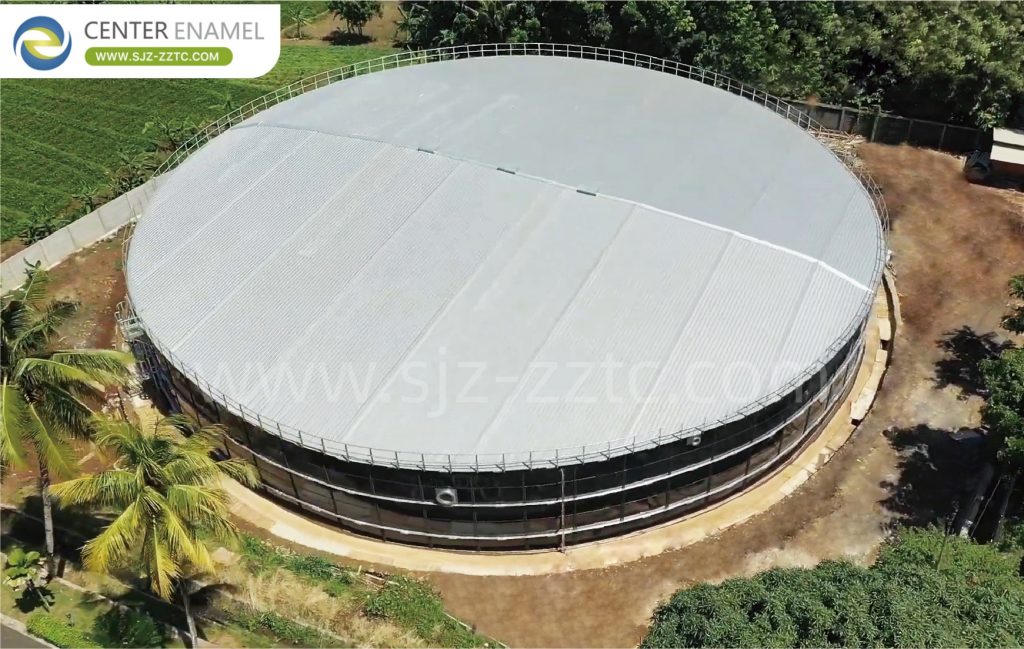
For reliable, long-term biogas storage, Glass-Fused-to-Steel (GFS) tanks combined with Double Membrane Roofs are the industry standard.
GFS Tanks
GFS tanks are manufactured by fusing enamel coating to steel at temperatures exceeding 800°C, creating a hard, inert, and exceptionally smooth surface. This provides:
Superior corrosion resistance – essential for the acidic environment of anaerobic digesters
Long service life – decades of maintenance-free operation
Rapid installation – bolted design eliminates welding and extended construction timelines
Global compliance – manufactured to ISO 9001, NSF/ANSI 61, and AWWA D103 standards
Double Membrane Roofs
The double membrane roof serves as an integrated gas holder, storing biogas directly above the digestion tank. Advantages include:
Cost optimization – lower cost than rigid steel roofs
Space efficiency – no need for separate ground-mounted gas holders
Weather resistance – outer membrane protects against sun, rain, and wind
Constant pressure – inner membrane maintains stable gas pressure for downstream equipment
Center Enamel: Global Expertise in Biogas Solutions
With over 36 years of experience and a presence in more than 100 countries, Center Enamel is Asia's largest manufacturer of GFS tanks and a trusted partner for biogas projects worldwide.
Complete EPC Services
Center Enamel acts as a one-stop EPC (Engineering, Procurement, and Construction) provider, offering:
Initial site assessment and feasibility studies
Custom engineering design based on waste composition
Equipment manufacturing (GFS tanks, covers, accessories)
Transportation and logistics
On-site installation supervision
Commissioning and staff training
Certifications and Standards
ISO 9001 (Quality Management)
NSF/ANSI 61 (Drinking Water Components)
AWWA D103-09 (Factory-Coated Bolted Steel Tanks)
CE/EN1090 (European Construction Products)
EN28765 (Glass-Fused-to-Steel Tanks)
Conclusion
Slaughterhouse waste-including blood, fat, paunch contents, hair, and fecal matter-represents a major environmental challenge due to its high organic load. However, modern anaerobic digestion technology using CSTR reactors transforms this waste from a pollution problem into a valuable energy resource.
The benefits are clear:
Renewable energy – Biogas for heat, electricity, or vehicle fuel
Waste reduction – Lower disposal costs and regulatory compliance
Fertilizer production – Nutrient-rich digestate for agriculture
Carbon reduction – Methane capture supports climate goals
With proven global experience, Center Enamel delivers reliable GFS tanks, double membrane roofs, and complete EPC biogas solutions for slaughterhouses worldwide. From France to Sweden and beyond, Center Enamel's technology is helping meat processors turn waste into wealth.
Frequently Asked Questions (FAQs)
1. What is the most problematic component of slaughterhouse wastewater?
Blood is typically the most problematic due to its extremely high BOD (up to 250,000 mg/L) and nitrogen content. Even small blood losses significantly increase treatment costs. Fat and grease are also challenging as they can clog pipes and inhibit anaerobic bacteria if not properly managed.
2. How much biogas can be produced from slaughterhouse waste?
Biogas yield depends on waste composition, but typical systems achieve 0.32-0.41 liters of biogas per gram of COD removed, with methane content up to 61%. A medium-sized slaughterhouse can generate enough biogas to cover a substantial portion of its energy needs for heating and electricity.
3. What pre-treatment is required before anaerobic digestion?
Slaughterhouse waste requires screening to remove large solids, crushing to reduce particle size, and sand/grit removal to protect mechanical equipment. Homogenization tanks equalize flow and load fluctuations before the wastewater enters the CSTR reactor. Proper pre-treatment is essential for stable system operation.