
What Center Enamel Delivers for Industrial Wastewater Treatment - Comprehensive Anaerobic Technologies
Global industrial wastewater treatment policies are escalating from "compliance discharge" to mandatory "resource recovery" and "zero liquid discharge." The EU, through its Circular Economy Action Plan, requires member states to increase industrial wastewater reuse rates and extends carbon footprint accounting to the full life cycle of wastewater treatment.
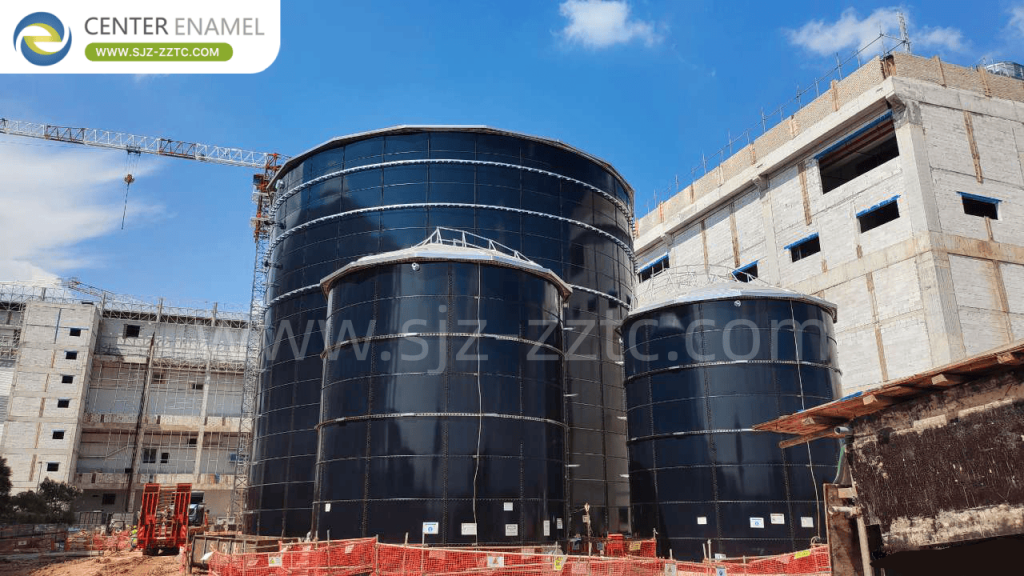
China continuously updates and tightens industrial water pollutant discharge standards, with increasingly stringent limits on total nitrogen, total phosphorus, and characteristic pollutants for industries such as chemicals, pharmaceuticals, and printing and dyeing. Some water-scarce regions and highly polluting industries are mandated to adopt zero or near-zero liquid discharge technologies. Germany has established a differentiated pretreatment technical standard system by industry, requiring industrial wastewater to meet specific quality requirements before discharge into municipal wastewater treatment plants, implementing strict source control.
Meeting these tightening standards while recovering resources requires process technology designed for difficult streams-and this is where Anaerobic Technologies become essential rather than optional.
What the USR Process Is and How It Works
At the core of our offering is a process built for the hardest wastewater streams. USR, or Upflow Solids Reactor, is an upflow anaerobic process modified for high-suspended-solids, high-solids organic wastewater, specifically designed to solve problems of clogging, sludge washout, and uneven reaction common in traditional anaerobic processes for high-solids wastewater.
The USR Process eliminates complex three-phase separators, simplifies internal structure, and relies on upflow hydraulics to promote thorough mixing of solid materials and anaerobic sludge. No strict granular sludge formation conditions are required-flocculent sludge can operate stably. The key feature is high solids tolerance and impurity resistance, with very high influent suspended solids tolerance. It is a dedicated high-efficiency anaerobic process for livestock manure, agricultural organic waste, and high-solids livestock wastewater, specifically developed for agricultural and environmental applications.
Where Food Waste Wastewater Comes From
Understanding the feedstock is essential before selecting any process. Food waste wastewater originates from the resource recovery process of kitchen waste from catering services, canteens, and food processing and distribution-a typical high-concentration organic wastewater in urban solid waste resource recovery.
Major sources include food waste pretreatment sorting wastewater from bag breaking, crushing, and sorting operations; oil separation wastewater from three-phase oil extraction; anaerobic digestion digestate, the residual liquid after food waste anaerobic digestion; and equipment and vehicle wash water. Food waste consists primarily of food residues, rich in animal and vegetable oils, starches, proteins, cellulose, salts, and seasoning residues. After pretreatment crushing and sorting, organics are solubilized forming high-concentration wastewater. Large and medium-sized cities' centralized food waste treatment facilities handle hundreds of tons daily with large continuous wastewater production; smaller facilities produce less volume but with higher concentrations-oil and salt accumulation issues are prominent. These characteristics make food waste an ideal candidate for Anaerobic Technologies that convert pollutants into energy.
Three Decades of Environmental Equipment Expertise
Delivering these technologies reliably requires deep engineering roots. Center Enamel has been deeply engaged in the environmental bolted storage equipment field for over 30 years. Starting with proprietary enamel anti-corrosion material technology, the company has gradually completed the full-industry-chain upgrade from a single tank manufacturer to a comprehensive environmental EPC service provider.
Throughout its 30+ year history, the company has been recognized as a National High-Tech Enterprise, National Specialized and Sophisticated "Little Giant," Manufacturing Single Champion, and Provincial Green Factory. It has successfully delivered over 30,000 environmental projects globally, establishing itself as a leading enterprise in the global GFS tank storage industry. The company has fully integrated the entire chain from enamel frit R&D, intelligent environmental equipment manufacturing, to EPC project contracting-every business breakthrough has been achieved through proprietary core anti-corrosion technology.
Company Milestones and Credentials
| Dimension | Achievement |
| Industry Experience | 30+ years |
| Total Projects Delivered | 30,000+ |
| Enterprise Honors | National High-Tech Enterprise, National "Little Giant" |
| Manufacturing Recognition | Manufacturing Single Champion |
| Factory Standards | Provincial Green Factory |
| Core Technology | Proprietary enamel anti-corrosion materials |
Construction Team Manpower Reserve
Behind every installation stands a trained workforce. Center Enamel has established its own domestic and international certified construction teams, with regular practical training on GFS tank installation and overseas construction standards for various countries. Domestically, regional construction teams cover multiple zones, capable of simultaneously deploying multiple teams for large tank farm projects. Internationally, cross-border professional installation teams are equipped to various country construction standards-sufficient manpower reserves ensure uninterrupted construction delivery for remote African sites, high-standard European and American facilities, and other projects.
Inside the R&D Team Driving Innovation
Process performance depends on material science. Center Enamel has built a full-chain professional team covering R&D, design, marketing, installation, and after-sales. The R&D team is led by national-level materials technology experts, specializing in enamel frit and tank anti-corrosion core technologies. External senior environmental engineering and mechanical structure engineers are retained to strengthen R&D capabilities, focusing on anti-corrosion coating formulations, specialty corrosion-resistant tanks, and anaerobic supporting integrated equipment-continuously breaking through industry technological barriers.
The team operates through proprietary laboratories with external university research collaboration-conducting year-round new material and new process durability pilot testing and long-term corrosion simulation testing. Specialized enamel formulations are iteratively developed for extreme conditions such as high-salinity wastewater, strong acid and alkali POME, and high-organic livestock manure-providing core technical support for the company's annual new invention and utility patents-building a proprietary material technology barrier.
Innovative Material Technology Behind Every Tank
These R&D efforts translate directly into product longevity. Center Enamel has independently developed over 200 anti-corrosion enamel formulations, with proprietary double-sided double-layer enameling technology. GFS tank anti-corrosion service life exceeds 30 years-far surpassing concrete and ordinary equipment-suitable for global high-corrosion wastewater and biogas fermentation conditions, and forming the durable hardware foundation for all our Anaerobic Technologies.
Facing industrial wastewater that conventional processes cannot handle? Send us your water quality data today and our engineers will recommend the right process configuration for your site.
From first consultation to final commissioning, reach out to Center Enamel for a solution backed by 30+ years of enamel expertise and 30,000+ global installations.
FAQ
What is the USR Process used for?
The USR Process treats high-solids organic wastewater like livestock manure, slaughterhouse waste, and straw leachate. It eliminates three-phase separators and operates stably with flocculent sludge.
Why are Anaerobic Technologies important for industrial wastewater?
Anaerobic Technologies convert organic pollutants into biogas for energy recovery, reduce sludge production, and handle high-strength streams that aerobic treatment cannot economically manage.
How long do Center Enamel GFS tanks last?
With 200+ proprietary enamel formulations and double-sided double-layer enameling, GFS tanks exceed 30 years of anti-corrosion service life-even in high-salinity and high-organic conditions.