
What Defines a WWTP?
A WWTP (Wastewater Treatment Plant) is defined by its function: an integrated system of physical, biological, and sometimes chemical unit processes that removes pollutants from used water to a regulated discharge or reuse limit. What sets one plant apart from another is the treatment level it must reach — driven by the limit — and the unit processes chained to get there.
The Core Definition
At minimum a WWTP receives wastewater, separates solids, biologically oxidizes dissolved organics, settles the biomass, and discharges clarified water. Sludge from settling is thickened, stabilized, and dewatered rather than dumped. The plant is defined by this full chain, not by any single tank.
Main Components
Preliminary (screening, grit removal) protects equipment; primary (sedimentation) drops settleable solids; secondary (activated sludge, UBF, trickling filter) removes dissolved BOD/COD; tertiary (filtration, nutrient removal) meets tight limits; and the sludge line stabilizes and dewaters residues. Storage and equalization tanks buffer flow swings.
| Stage | Unit process | Removes |
| Preliminary | Screen, grit chamber | Rags, sand, debris |
| Primary | Sedimentation | Settleable TSS, some BOD |
| Secondary | Activated sludge / UBF | Dissolved BOD/COD |
| Tertiary | Filter, N/P removal | Nutrients, fine SS |
| Sludge line | Thickening, dewatering | Residual solids |
Treatment Levels
Primary plants cut TSS and a fraction of BOD; secondary plants add biological treatment for 85–95% BOD removal; tertiary plants add nutrient and pathogen control. The required level is set by the discharge permit, not by preference.
Municipal vs Industrial WWTP
A municipal WWTP handles domestic sewage with relatively stable composition; an industrial WWTP (ETP) must manage variable, often high-strength or toxic streams and is scoped to that specific load. Municipal plants emphasize nutrient removal; industrial plants emphasize the particular pollutant (COD, salts, heavy metals).
Technical Considerations
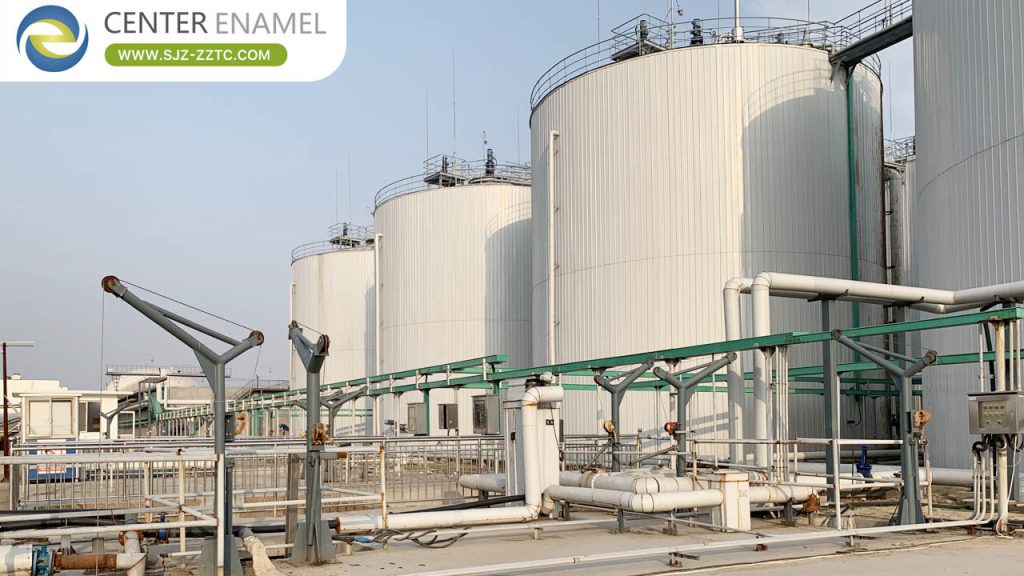
Tankage dominates the footprint: equalization, reactors, clarifiers, and sludge holds. Bolted GFS tanks (glass fused at 820–930°C) resist the corrosive, H₂S-rich liquors found across the plant and scale from 200 m³ to 60,000 m³. Coatings and roofs are selected per duty.
Project Case Study
Domestic Sewage Treatment Project in Ghana. A municipal WWTP with 1,800 m³/day capacity combining UBF (Upflow Blanket Filter) and A²/O (Anaerobic-Anoxic-Oxic) processes across 4 reactor sets (UBF Ø11.46 × 9.6 m, secondary sedimentation Ø14.52 × 4.8 m, 2 A²/O Ø20.64 × 6.6 m), delivering COD 1,000 → 100 mg/L, BOD 500 → 25 mg/L, ammonia 30 → 10 mg/L.
| Project | Domestic Sewage Treatment Project in Ghana |
| Location | Ghana |
| Industry | Municipal / Domestic Sewage |
| Application | Municipal WWTP (UBF + A²/O) |
| Product | 4 reactor sets (GFS) |
| Capacity | 1,800 m³/day |
| Output | COD 1,000→100 mg/L |
| Status | Delivered 2021 |
About Center Enamel
Center Enamel demonstrates international project experience in municipal and industrial WWTP tankage, with delivered projects across Asia and Africa including the Ghana municipal sewage plant above. The company supplies bolted GFS tanks engineered for the corrosive, mixed-duty environment of a WWTP — from equalization to sludge — and supports overseas logistics and installation.
Advantages and Limitations
A well-defined WWTP protects receiving waters and enables reuse. Limits: nutrient and trace-pollutant limits raise complexity and cost; and tank corrosion must be designed for up front. GFS tankage addresses the corrosion and speed-of-deployment needs of both municipal and industrial plants.
A WWTP is defined by its pollutant-removal chain — preliminary, primary, secondary, tertiary, and sludge treatment — sized to a discharge limit. Municipal and industrial plants share the chain but differ in load and target pollutant. Send your flow and limit and we will scope the right tankage and train.
Frequently Asked Questions (FAQ)
Q1: What defines a WWTP?
A: An integrated system of unit processes that removes pollutants from used water to a discharge or reuse limit.
Q2: What are the main WWTP components?
A: Screening, sedimentation, biological secondary treatment, tertiary polish, and a sludge stabilization/dewatering line.
Q3: What is the difference between municipal and industrial WWTP?
A: Municipal treats stable domestic sewage; industrial (ETP) handles variable, high-strength or toxic loads scoped to the pollutant.
Q4: What tank capacity is available?
A: Center Enamel supplies GFS WWTP tanks from 200 m³ to 60,000 m³, corrosion-rated for H₂S liquors.
Q5: What standards apply to WWTP tanks?
A: Relevant tank standards include AWWA D103, ISO 28765, and EN 1090 where applicable to the product.
Q6: What project experience exists?
A: Delivered municipal sewage and palm-oil/pharma wastewater plants in Ghana, Indonesia, and China.
Share your wastewater flow, composition, and discharge limit. We will define the treatment level, recommend the train, and quote GFS tankage for your WWTP.