
What Do New Food Waste Collection Requirements Mean?
New food waste collection requirements mean that households and businesses must separate food and other organic waste from general trash so it can be recycled instead of landfilled or burned. The practical effect is a growing, reliable stream of high-strength feedstock—food waste is 0.35–0.60 m³/kg VS biogas-yielding material—that anaerobic digestion (AD) converts into renewable biogas (55–65% CH₄) and a fertilizer-grade digestate.
Why Separate Food Waste
Landfilled food waste rots and emits methane uncontrolled; separated collection captures that carbon as energy. Many jurisdictions now mandate source separation, curb-side organics bins, and bans on food waste in landfills—creating a steady AD feed supply and a clear project pipeline for biogas developers.
How Collected Food Waste Is Treated
After collection and contamination screening, food waste is fed to an AD reactor (typically CSTR at mesophilic 35–38°C). Co-digestion with manure or energy crops balances the C:N ratio toward 20–30:1 and lifts gas yield. The output biogas fuels CHP at 35–45% electrical / 80–90% total efficiency; the digestate is spread as fertilizer.
| Step | What happens | Output |
| Collection | source-separated organics | clean feedstock |
| Pre-treatment | screen + grind | pumpable slurry |
| AD (CSTR) | 35–38°C, 15–30 d HRT | biogas 55–65% CH₄ |
| CHP / use | power + heat | energy |
| Digestate | nutrient recovery | fertilizer |
What an AD Plant Needs
A food-waste AD plant needs receiving/hopper, pre-treatment, a sealed heated digester, gas storage, and digestate tanks. Because feed is variable and corrosive, bolted Glass-Fused-to-Steel (GFS) digester and storage tanks (glass fused at 820–930°C) are preferred for fast, modular, leak-tight construction.
Technical Considerations
Screen plastics and grit before digestion; control ammonia if protein-rich feed is used; keep mesophilic 35–38°C; size digestate storage for land-application gaps. CSTR residence is ~15–30 days; co-digestion improves the C:N balance and gas stability.
How to Scope a Food-Waste AD Project
Estimate daily tonnage from collection coverage, set digester volume by HRT and VS load, and specify corrosion-resistant tankage. A tonnage + collection-area sheet lets suppliers quote digester and storage tanks quickly.
Project Case Study
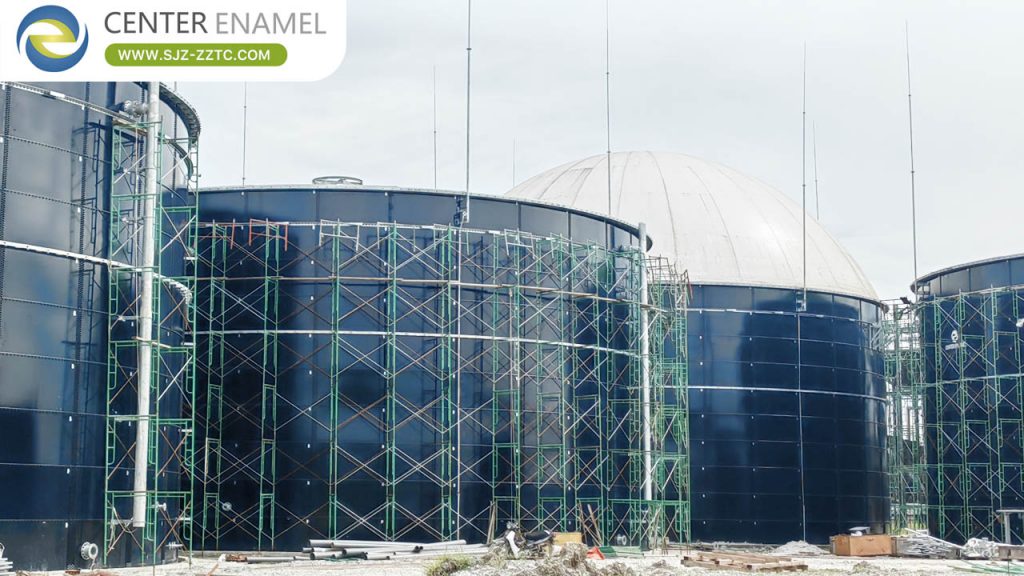
Pakistan Biogas Project. A CSTR waste-to-energy plant delivered with Center Enamel that converts food waste and napier grass (Pennisetum purpureum) into renewable biogas at 100 m³/day—a direct example of separated organic waste becoming energy via AD.
| Project | Pakistan Biogas Project |
| Location | Pakistan |
| Industry | Waste-to-Energy / Biogas |
| Application | Food waste + napier grass digestion |
| Product | CSTR anaerobic digester (GFS) |
| Capacity | 100 m³/day biogas |
| Material | Glass-Fused-to-Steel (GFS) |
| Standards | ISO 28765, AWWA D103 |
| Status | Delivered reference project |
About Center Enamel
Center Enamel demonstrates its manufacturing capability through bolted Glass-Fused-to-Steel tanks produced on controlled enamel-firing lines (glass fused to steel at 820–930°C). For food-waste AD plants the company supplies digester, receiving, and digestate storage tanks from 20 m³ to 60,000 m³, manufactured under ISO 9001 with ISO 28765 / AWWA D103 design and CE/EN 1090 marking—tankage built to survive the warm, corrosive, gas-bearing digester environment.
Advantages and Limitations
Mandatory collection turns food waste from a liability into a steady AD feed, yielding biogas and fertilizer. Limits: contamination screening is essential, ammonia can inhibit at high protein loads, and digestate management needs planning. GFS tanks give fast, leak-tight, corrosion-resistant builds.
Comparison: Food Waste Routes
| Route | Energy | Nutrient | Note |
| Anaerobic digestion | biogas CHP | digestate | best for energy |
| Composting | low | compost | dry residue |
| Landfill | lost (CH₄ leak) | lost | worst option |
New food waste collection rules create a reliable, high-yield AD feedstock. Anaerobic digestion at 35–38°C converts separated food waste into biogas (55–65% CH₄) and fertilizer; specify sealed, corrosion-resistant GFS digester and storage tanks for a fast, compliant build.
Frequently Asked Questions (FAQ)
Q1: What do new food waste collection requirements mean?
A: Mandatory source separation of food/organics so it is recycled—mainly via anaerobic digestion into biogas and fertilizer—instead of landfilled.
Q2: Why separate food waste?
A: Landfilled food waste emits uncontrolled methane; separation captures that carbon as energy and cuts landfill burden.
Q3: How is collected food waste treated?
A: Screened, pre-treated, then fed to a CSTR digester at 35–38°C; biogas (55–65% CH₄) fuels CHP and digestate is fertilizer.
Q4: What does an AD plant need?
A: Receiving, pre-treatment, sealed heated digester, gas storage, and digestate tanks—GFS resists the corrosive duty.
Q5: What standards apply to tanks?
A: GFS tanks to ISO 28765 / AWWA D103, ISO 9001, CE/EN 1090.
Q6: What capacity is available?
A: GFS tanks from 20 m³ to 60,000 m³ for AD and digestate duty.
Share your collection coverage and daily tonnage. We will size CSTR digester and storage tanks, recommend GFS specifications, and confirm standards for your food-waste AD project.