
What Does a Sewage Project Involve?
A sewage project is the engineered system that collects, treats, and safely discharges municipal wastewater—typically through three stages: primary clarification, biological treatment (often activated sludge, SBR, or A²/O), and tertiary polishing. For a B2B buyer the project is defined by design flow, influent load, discharge standard, and the tank package (equalization, reactors, sedimentation, and sludge holding) that must survive continuous wet, corrosive duty.
Primary Treatment
Raw sewage first passes screens and grit removal, then primary clarifiers where settleable solids drop out. This removes roughly 50–60% of suspended solids and 25–35% of BOD before biology, lowering the load on downstream reactors and protecting them from shock.
Secondary (Biological) Treatment
The biological stage is the heart of a sewage project. Activated sludge, SBR (Sequencing Batch Reactor), and A²/O (Anaerobic-Anoxic-Oxic) all use microbes to oxidize BOD and, in the A²/O case, remove nitrogen and phosphorus. For a 1,800 m³/day municipal plant, a UBF (Upflow Blanket Filter) plus A²/O train can take COD from 1,000 mg/L down to 100 mg/L and BOD from 500 to 25 mg/L.
| Stage | Typical removal | Key tank | Note |
| Primary | 50–60% SS | clarifier | protects biology |
| Secondary (A²/O) | COD 1,000→100 mg/L | A²/O reactors | N & P removal |
| Tertiary | polish + disinfect | filter / contact | meets discharge |
Tertiary and Sludge Handling
Tertiary polishing (filtration, disinfection) meets strict discharge limits, while generated sludge is thickened, stabilized, and stored before disposal or reuse. Sludge holding and digestion tanks must be sealed and corrosion-resistant because they hold putrescible, gas-bearing material.
Technical Considerations
Specify tankage for continuous immersion, H₂S corrosion, and thermal cycling; bolted Glass-Fused-to-Steel (GFS) tanks suit modular, relocatable sewage plants. Confirm design flow with peak factors, confirm discharge standard (e.g. COD ≤100 mg/L), and plan equalization to absorb diurnal variation. Standard bolted GFS ranges 200–60,000 m³.
How to Scope a Sewage Project
Work in this order: (1) confirm average and peak daily flow; (2) fix influent concentrations and discharge limit; (3) pick the biological process by load and nutrient rules; (4) size equalization, reactor, and sedimentation tanks; (5) specify corrosion-resistant tank material and standards. A clear flow-and-standard sheet lets suppliers quote a tank package fast.
Project Case Study
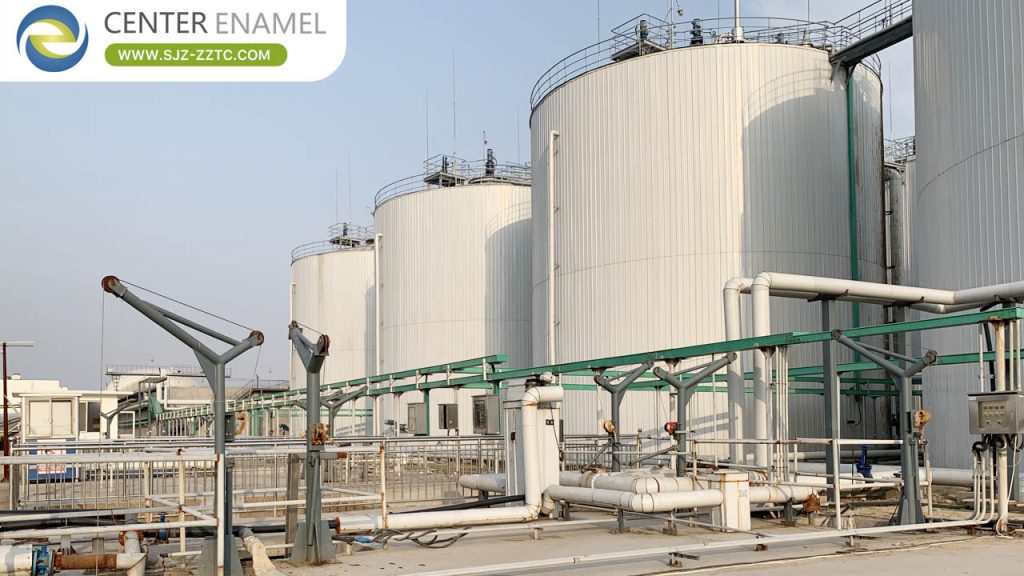
Domestic Sewage Treatment Project in Ghana. A 1,800 m³/day municipal plant combining UBF + A²/O + sedimentation, delivered with Center Enamel GFS tankage. It is a documented international sewage project: COD reduced from 1,000 to 100 mg/L, BOD from 500 to 25 mg/L, ammonia-N from 30 to 10 mg/L, and total phosphorus from 10 to 2 mg/L.
| Project | Domestic Sewage Treatment Project in Ghana |
| Location | Ghana |
| Industry | Municipal / Domestic Sewage |
| Application | Municipal domestic sewage treatment |
| Product | UBF + A²/O + sedimentation tanks |
| Capacity | 1,800 m³/day |
| Quantity | 1 UBF + 1 sedimentation + 2 A²/O |
| Material | Glass-Fused-to-Steel (GFS) |
| Standards | ISO 28765, AWWA D103 |
| Status | Delivered 2021 |
About Center Enamel
Center Enamel demonstrates its international project experience through delivered tank packages on four continents, including the Ghana municipal sewage plant above and biogas and wastewater projects across Asia and the Middle East. The company supplies bolted GFS tanks engineered for continuous wet, corrosive duty, manufactured under ISO 9001 with ISO 28765 / AWWA D103 design and CE/EN 1090 structural marking—tankage proven on real overseas EPC and municipal works.
Advantages and Limitations
A well-scoped sewage project gives reliable, permit-compliant discharge and recoverable water. Limits: biological stages need skilled operation and consistent power; cold climates slow nitrification; and sludge handling adds cost. Modular GFS tanks reduce civil works and speed deployment.
Comparison of Biological Processes
| Process | N/P removal | Footprint | Best when |
| Activated sludge | N partial | large | high flow |
| SBR | N/P good | medium | variable flow |
| A²/O | N + P | medium | strict discharge |
| UBF + A²/O | N + P | compact | municipal + industrial mix |
Conclusion
A sewage project is defined by flow, load, discharge standard, and a corrosion-resistant tank package spanning primary, biological (activated sludge / SBR / A²/O), and tertiary stages. Scope process by nutrient rules, then size and specify tanks by duty and standard.
Frequently Asked Questions (FAQ)
Q1: What does a sewage project involve?
A: Collection, primary clarification, biological treatment (activated sludge / SBR / A²/O), tertiary polishing, and sludge handling—built around a corrosion-resistant tank package.
Q2: Which biological process is best?
A: A²/O or UBF + A²/O when nitrogen and phosphorus removal is required; SBR suits variable flow; activated sludge suits large, steady plants.
Q3: What standards apply to tanks?
A: Bolted GFS sewage tanks are typically designed to ISO 28765 and AWWA D103, with ISO 9001 quality and CE/EN 1090 structural marking.
Q4: How are tanks selected?
A: By duty (immersion, H₂S corrosion), capacity (200–60,000 m³ GFS), process role, and transport/installation constraints.
Q5: What capacity is available?
A: Center Enamel supplies GFS tanks from 200 m³ to 60,000 m³, modular for municipal and industrial sewage.
Q6: What project experience exists?
A: Delivered municipal sewage, biogas, and industrial WWTP tank packages across Ghana, China, Indonesia, and the Middle East.
Send your design flow, influent concentrations, and discharge standard. We will recommend a biological process, size the GFS tank package, and confirm standards and delivery for your sewage project.