
What Does An Industrial Wastewater Solution Include?
An industrial wastewater solution is a scoped sequence of unit operations - pre-treatment, primary separation, biological treatment (aerobic or anaerobic), physical-chemical polishing, sludge handling, and a controls and compliance layer - built around the specific pollutant profile, flow, and discharge or reuse target of the plant. It is not a single device; it is the integration of those stages, sized and selected for the stream, that decides whether the effluent meets permit.
The Stages A Solution Must Cover
A complete solution starts with pre-treatment that protects later stages: screening, grit removal, equalization, oil and grease separation, and pH correction. Primary clarification removes settleable solids. The biological core - the heart of the system - oxidizes or converts dissolved organics, often with anaerobic, aerobic, or hybrid trains. Physical-chemical polishing catches what biology leaves, and sludge handling closes the solids loop. Each stage exists because the stream demands it, not by default.
| Stage | What It Does | Typical Unit |
| Pre-treatment | Protect downstream, remove gross solids/oil | Screen, grit, equalization, DAF |
| Primary | Settleable solids removal | Clarifier, separator |
| Biological | Dissolved COD / nutrient conversion | CSTR, UASB, SBR, MBR, A2/O |
| Polishing | Final COD, metals, color | Coagulation, filtration, carbon |
| Sludge | Concentrate, stabilize, dewater | Thickener, digester, press |
Why Scope Matters More Than Equipment
Buying a reactor without scoping the equalization and sludge path is the usual reason industrial plants underperform. A high-salinity or variable-load stream needs a different biological envelope than a steady municipal one. The solution is therefore defined by a mass balance - what enters, what must leave, and what the permit allows - before any tank is specified.
A Boundary Condition
Reuse and zero-liquid-discharge change the scope entirely: they add membranes, evaporators, and a salt balance that a simple discharge plant does not need. State the discharge limit or reuse target first; it sets which stages are mandatory and which are optional.
Project Case Study: Jiangdong Pharmaceutical Wastewater Treatment
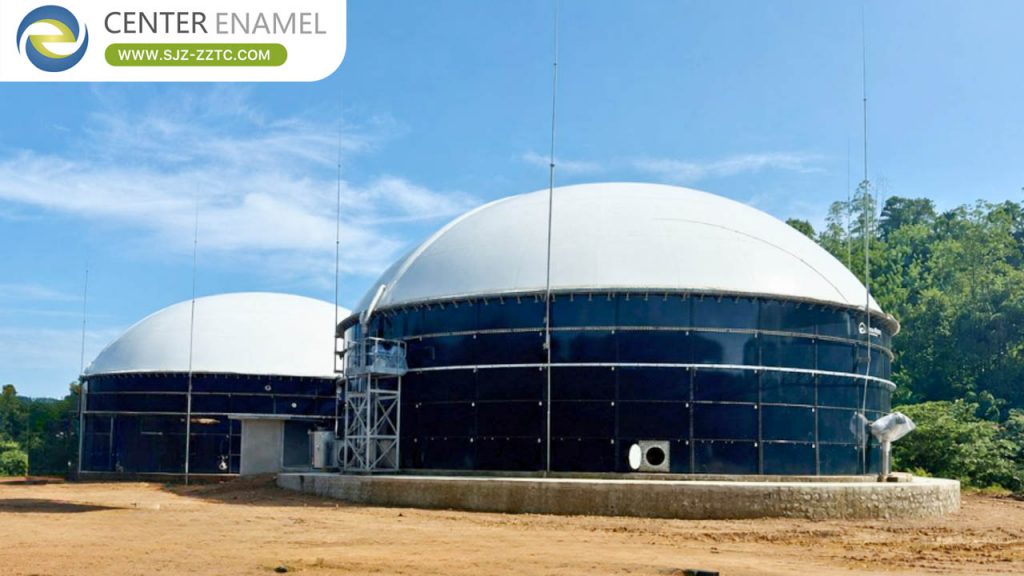
Project / Application: High-salinity pharmaceutical wastewater (acarbose extraction, domestic, and mixed industrial), Xiaoshan, Hangzhou, China. Industry: Pharmaceutical / industrial wastewater. Tank Type: Granular Sludge Anaerobic Reactor. Key Requirements: Stable COD removal under salt up to 6,000 mg/L.
| Field | Value | Source / Evidence |
| Tank Type | Granular Sludge Anaerobic Reactor | Company project reference |
| Tank Quantity | 6 sets | Company project reference |
| Dimensions Per Tank | 12.66 x 24 m | Company project reference |
| Capacity Per Tank | 1,000 m3/day (total 6,000 m3/day) | Company project reference |
| Influent COD | 11,200 mg/L | Company project reference |
| Effluent COD | 3,024 mg/L (>=70% removal) | Company project reference |
| Installation Year | 2019 | Company project reference |
About Company
Shijiazhuang Zhengzhong Technology Co., Ltd (Center Enamel) is a comprehensive high-tech enterprise specializing in wastewater engineering, process section contracting, and equipment manufacturing. The company delivers biogas and wastewater projects through three main lines - EPC (turnkey) contracting, equipment supply, and process packages - covering livestock and municipal wastewater, biomass energy, industrial wastewater, and food waste. Its reactor portfolio spans CSTR, USR, UBF, UASB, IC, and EGSB, backed by in-house Glass-Fused-to-Steel tank manufacturing (enamel firing at 820-930 C) and certifications including ISO 9001, NSF/ANSI 61, and CE-EN 1090. With 35+ years of operation, a 150,000 m2 manufacturing base, and projects in 100+ countries, Center Enamel provides the single-responsibility engineering behind the Jiangdong plant that treated high-salinity pharmaceutical wastewater with granular-sludge anaerobic reactors, removing more than 70% of COD at up to 6,000 mg/L salinity - a scoped industrial solution, not a catalogue product.
Comparison: Discharge Vs Reuse Scope
| Element | Discharge Plant | Reuse / ZLD Plant |
| Core biology | Required | Required |
| Polishing | Permit-based | Membrane + carbon |
| Salt handling | Usually none | Evaporation / crystallizer |
| Complexity | Lower | Much higher |
An industrial wastewater solution is the staged, load-specific integration of pre-treatment, biology, polishing, and sludge handling under a compliance layer - scoped from the pollutant balance, not assembled from a menu.
Frequently Asked Questions
Q1: What are the main stages? A1: Pre-treatment, primary separation, biological treatment, polishing, sludge handling, and controls.
Q2: Does it include sludge handling? A2: Yes; sludge concentration, stabilization, and dewatering are part of any complete solution.
Q3: What about reuse and discharge? A3: Discharge plants need polishing; reuse adds membranes and salt handling.
Q4: Who scopes the solution? A4: An engineer runs a mass balance against the permit before specifying equipment.
Q5: Is a single reactor enough? A5: Rarely; most industrial streams need pre-treatment and polishing around the biological core.
Q6: How is variability handled? A6: Equalization tanks buffer flow and load swings before biology.
Q7: What tank resists corrosive waste? A7: A Glass-Fused-to-Steel tank resists acidic and high-ammonia industrial streams.
Q8: Does scope depend on salt? A8: Yes; high salinity narrows the biological envelope and may need halotolerant processes.
Suggested CTA
Send your influent profile and discharge limit to an engineer, or request a scoped industrial wastewater solution outline for your stream.