
What Does UASB Stand For and How Does It Work?
UASB stands for Upflow Anaerobic Sludge Blanket. It is an anaerobic reactor where wastewater flows upward through a dense bed of granular sludge; microbes in that blanket convert dissolved organics into biogas, and a top separator releases the gas while retaining the sludge. It needs no mechanical mixing and no support media, which is why it is compact, low-energy, and cheap to run for the right wastewaters.
The Step-by-Step Process
Raw wastewater enters at the bottom and rises evenly through the sludge blanket. As it passes the biomass, anaerobic consortia break down the organic load and produce a mixture of methane and carbon dioxide. The gas bubbles upward, carrying some sludge with it, into a gas-liquid-solid (GLS) separator at the top, where gas is released, clarified effluent overflows a weir, and any sludge falls back into the blanket. This internal recirculation keeps the biomass in the reactor without pumps.
Comparative Data Table: Typical UASB Operating Parameters
| Parameter | Typical range | Note |
| Organic loading rate (OLR) | 5–15 kg COD/m³·day | higher than most reactors |
| Hydraulic retention time (HRT) | 6–12 h | for high-strength feed |
| COD removal | 80–90% | for suitable wastewaters |
| Operating temperature | 25–38 °C | mesophilic preferred |
| Upflow velocity | 0.5–1.0 m/h | keeps blanket fluidised |
| Biogas yield | 0.30–0.45 m³/kg COD removed | ~60% CH₄ |
Why It Is Built the Way It Is
The design solves one problem—keeping slow-growing anaerobic biomass inside the reactor while passing the water through. By relying on the sludge’s own settleability rather than attached media, UASB avoids the cost and clogging risk of packed beds. By using upward flow and a three-phase separator, it self-circulates gas and biomass. The trade-off is sensitivity: the blanket must be well-formed and the feed must be in the right strength range, or solids wash out and efficiency collapses.
Frequently Asked Questions (FAQ)
Q1: What does UASB stand for?
A: Upflow Anaerobic Sludge Blanket. It is an anaerobic reactor that treats wastewater by passing it upward through a dense biomass blanket that produces biogas.
Q2: How does a UASB reactor work?
A: Wastewater rises through a granular sludge blanket where microbes convert organics to methane and CO₂; a top gas-liquid-solid separator releases the gas, clarifies the effluent, and returns sludge to the blanket—no mechanical mixing needed.
Q3: Why is there no mechanical mixing?
A: Upward flow and gas buoyancy do the mixing. Biogas bubbles keep the blanket fluidised and self-circulate biomass, so pumps and mixers are unnecessary, cutting energy and maintenance.
Q4: What wastewater suits UASB?
A: High-strength, warm, low-solids streams such as brewery, food-processing, pulp, and municipal sludge streams above roughly 1,500–2,000 mg/L COD, where the organic loading justifies the reactor.
Project Case Reference
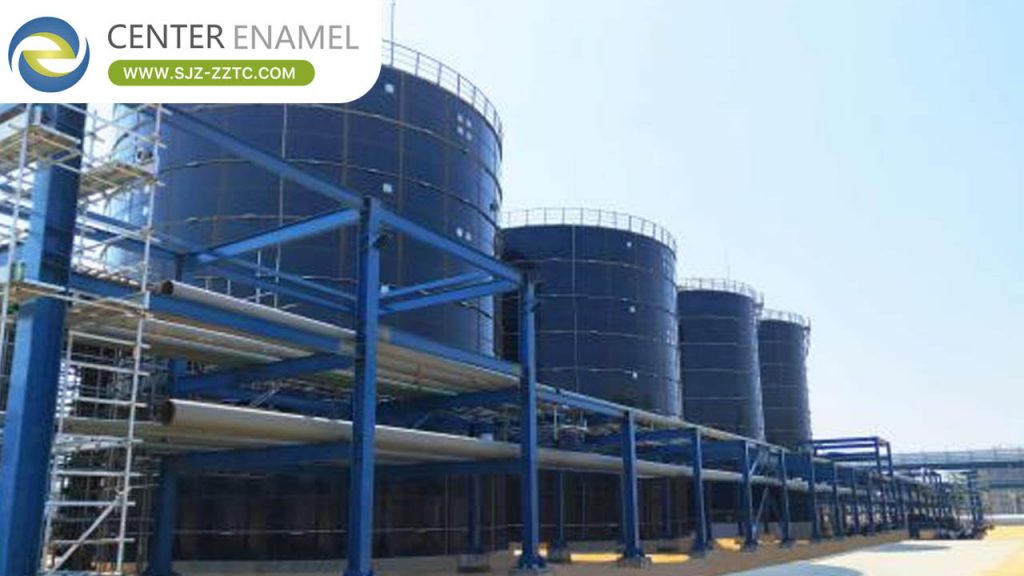
Malaysia Biogas Project — Malaysia · 2026
5 GFS Tanks · 27,000 m³ Total Volume · 22,000 m³ Biogas/Day
A large-scale biogas project in Malaysia featuring 5 Glass-Fused-to-Steel (GFS) tanks. The project achieves approximately 80% digestibility, with each single tank producing about 4,400 m³ of biogas daily, totaling 22,000 m³ per day across all 5 tanks.
Technical Specifications
Single Tank Volume: 5,400 m³ (Ø24.46 × 12 m)
Total Effective Volume: 27,000 m³ (5 tanks)
Daily Biogas Production: 22,000 m³ total
Digestibility: ≈ 80%
Gas Production Rate: 0.45 m³ / kg COD removed
Tank Type: Glass-Fused-to-Steel (GFS)
Water Quality Data
| Parameter | Inlet Water | Effluent |
| COD | ≥ 60,000 mg/L | ≥ 12,000 mg/L |
| BOD | ≤ 25,000 mg/L | ≤ 5,000 mg/L |