
What Does UASB Stand For?
UASB stands for Upflow Anaerobic Sludge Blanket. It is a high-rate anaerobic reactor in which wastewater flows upward through a dense bed of granular sludge; microbes attach to the granules and convert dissolved organics into biogas as the water passes. A gas–liquid–solid separator at the top retains the sludge, giving short hydraulic retention times of 6–12 hours at organic loading rates of 5–15 kg COD/m³·day.
Breaking Down the Name
Upflow = wastewater enters at the bottom and rises; Anaerobic = no oxygen, methanogenic treatment; Sludge Blanket = the suspended, granular microbial bed that does the work and is held in place by the top separator rather than by mixing or packing.
How a UASB Works
Feed enters the bottom distribution system and rises through the blanket. Organics are consumed by the granular sludge (hydrolysis → acidogenesis → acetogenesis → methanogenesis, as in any digester). Biogas rises, hits the three-phase separator, and is collected; treated water exits the top; sludge stays behind.
| Component | Role |
| Bottom distributor | even upflow feed |
| Sludge blanket | granular microbes convert COD |
| Three-phase separator | retain sludge, release gas, clarify water |
| Gas collector | capture CH₄ + CO₂ |
Why It Is High-Rate
Because the granular sludge is dense (20–40 g VSS/L) and highly active, a UASB achieves high loading in a small volume. HRT of hours (vs days for CSTR) and OLR 5–15 kg COD/m³·day make it capital-efficient for the right wastewater—typically soluble, warm (25–38°C), and COD >1,500–2,000 mg/L.
Performance and Sizing
COD removal of 80–90% is typical; biogas yield ~0.30–0.45 m³ per kg COD removed at about 60% CH₄. Sludge yield is low (0.05–0.10 kg VSS/kg COD), so far less biosolids than aerobic. Granule size 1–3 mm and settling 40–80 m/h keep the blanket stable.
Technical Considerations
UASB needs consistent, low-solids, warm feed; high suspended solids or cold temperatures hurt granulation. The tank must be gas-tight and corrosion-resistant, and the three-phase separator precisely built. Retrofitting or scaling a UASB demands customization to the site’s flow and COD.
How to Decide If UASB Fits
Use UASB for soluble, medium-to-high COD (food, brewery, palm, pharmaceutical, municipal) wastewater at 25–38°C. For very high solids or cold feeds, consider CSTR or a hybrid. Match tank and separator to flow and OLR.
Project Case Study
Beijing 5S Pig Farm Wastewater Treatment Project. A 580 m³/day livestock plant using UASB + AOAO, cutting COD from ≥10,000 mg/L to ≤200 mg/L and ammonia from ≥1,000 to ≤80 mg/L. It is a direct, verified UASB application on high-strength animal wastewater with measured inlet/outlet data.
| Project | Beijing 5S Pig Farm Wastewater Treatment |
| Location | Beijing, China |
| Industry | Livestock / Wastewater |
| Application | Pig farm high-strength wastewater |
| Product | UASB + AOAO treatment tanks |
| Capacity | 580 m³/day |
| Quantity | UASB primary + AOAO polishing |
| Material | Glass-Fused-to-Steel (GFS) |
| Standards | ISO 28765, AWWA D103 |
| Status | Delivered reference project |
About Center Enamel
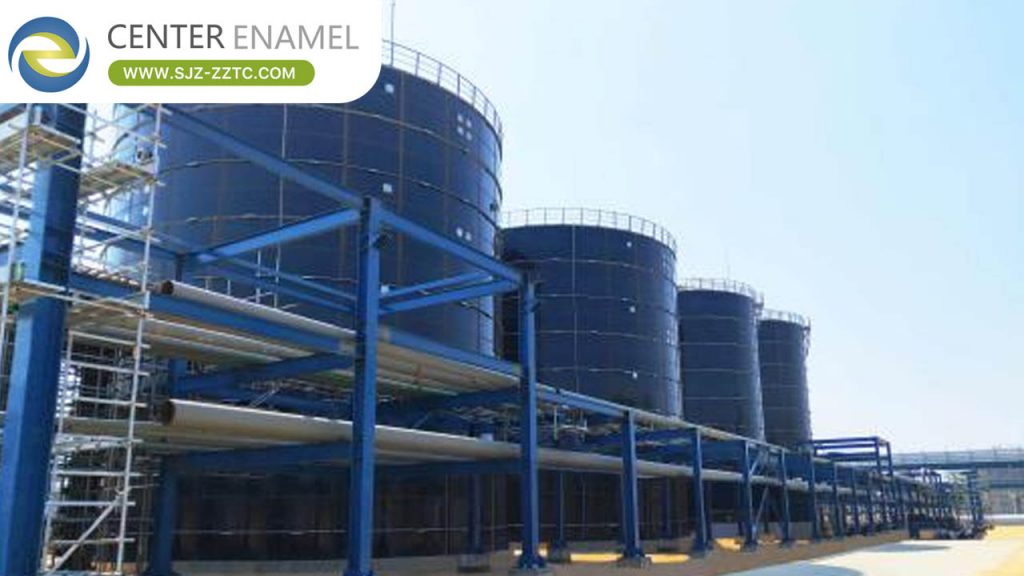
Center Enamel supports UASB and high-rate anaerobic projects through customization capability: bolted GFS reactor tanks can be specified with bottom distribution penetrations, three-phase separator provisions, gas-collection roofs, and access configured to the site’s flow, COD, and temperature. The enamel-fired shell (820–930°C, ISO 28765 / AWWA D103, ISO 9001, CE/EN 1090) resists the H₂S- and moisture-laden anaerobic environment, and the modular panel format lets the reactor be customized and expanded without a full rebuild.
Advantages and Limitations
UASB is compact, low-sludge, and energy-positive for the right wastewater. Limits: it needs soluble, warm, low-solids feed and precise separator design; it is not a universal reactor for every stream.
Comparison: UASB vs CSTR
| Reactor | HRT | OLR | Best feed |
| UASB | 6–12 h | 5–15 kg COD/m³·day | soluble, warm, high COD |
| CSTR | 15–30 days | lower | slurries, manures |
UASB = Upflow Anaerobic Sludge Blanket—a high-rate reactor where upflow wastewater meets a retained granular-sludge blanket, treating COD in 6–12 hours at 5–15 kg COD/m³·day with 80–90% removal. It suits soluble, warm, high-COD wastewater and needs precise, customizable tank and separator design.
Frequently Asked Questions (FAQ)
Q1: What does UASB stand for?
A: Upflow Anaerobic Sludge Blanket—a high-rate anaerobic reactor using a retained granular sludge bed.
Q2: How does a UASB work?
A: Wastewater rises through the sludge blanket; microbes convert COD to biogas; a three-phase separator retains sludge and releases gas.
Q3: Why is it high-rate?
A: Dense granular sludge (20–40 g VSS/L) allows HRT of hours and OLR 5–15 kg COD/m³·day in a small volume.
Q4: What COD can it treat?
A: Typically soluble wastewater >1,500–2,000 mg/L COD at 25–38°C, with 80–90% removal.
Q5: How much biogas?
A: About 0.30–0.45 m³ per kg COD removed at ~60% CH₄; sludge yield is low (0.05–0.10 kg VSS/kg COD).
Q6: What tank is used?
A: A gas-tight, customizable GFS reactor; Center Enamel specifies distributor, separator, and gas-roof provisions.
Share your wastewater flow, COD, temperature, and solids. We will confirm UASB suitability, size the reactor and separator, and specify customizable GFS tanks with the right standards.
.