
What Happens Inside a Digester?
Inside a digester, four microbial stages convert organic matter into biogas: hydrolysis breaks complex organics into soluble compounds, acidogenesis makes acids, acetogenesis forms acetate, and methanogenesis produces methane (55–65% of the biogas) and CO₂. The tank is kept oxygen-free and heated to mesophilic 35–38°C so the methanogens thrive, with gentle mixing and a sealed gas-collection roof completing the picture.
The Digester Environment
A digester is a sealed, heated, often mixed tank that excludes air. Anaerobic conditions are essential—methanogenic archaea cannot tolerate oxygen. The environment is buffered (pH ~6.8–7.4) and warm, creating the stable habitat the four stages need in sequence.
Stage 1 – Hydrolysis
Complex polymers (proteins, fats, carbohydrates, cellulose) are too big for microbes to eat directly. Hydrolytic bacteria secrete enzymes that cleave them into soluble sugars, amino acids, and fatty acids—the rate-limiting first step, especially for fibrous feeds like manure or straw.
Stage 2 – Acidogenesis
Acidogenic bacteria ferment the soluble products into volatile fatty acids (acetate, propionate, butyrate), along with hydrogen, CO₂, and some alcohols. This is where the “acid” phase appears and pH tends to dip before buffering.
| Stage | Microbes | Key outputs |
| Hydrolysis | hydrolytic bacteria | sugars, amino acids, fatty acids |
| Acidogenesis | acidogens | VFA, H₂, CO₂ |
| Acetogenesis | acetogens | acetate, H₂, CO₂ |
| Methanogenesis | methanogens | CH₄, CO₂ |
Stage 3 – Acetogenesis
Acetogenic bacteria convert the longer fatty acids and alcohols into acetate, CO₂, and hydrogen. Acetate is the direct methanogenesis substrate, so this step feeds the final stage.
Stage 4 – Methanogenesis
Methanogens—strict anaerobes—make methane two ways: acetoclastic (splitting acetate into CH₄ + CO₂, ~70% of methane) and hydrogenotrophic (CO₂ + H₂ → CH₄). The result is biogas at 55–65% CH₄, the rest mostly CO₂ with traces of H₂S.
Temperature and Mixing
Mesophilic 35–38°C is the common operating window (thermophilic 50–55°C is faster but less stable). Mixing keeps solids and microbes in contact and prevents stratification, but over-mixing can stress microbes. Gas is collected under a fixed or double-membrane roof.
Technical Considerations
Tank integrity under warm, H₂S-laden, pressurized gas is the core engineering challenge. The shell must resist corrosion and gas permeation; pH, ammonia, and loading rate must be controlled to avoid inhibiting methanogens. Retention time follows the feed (see digestion time).
Project Case Study
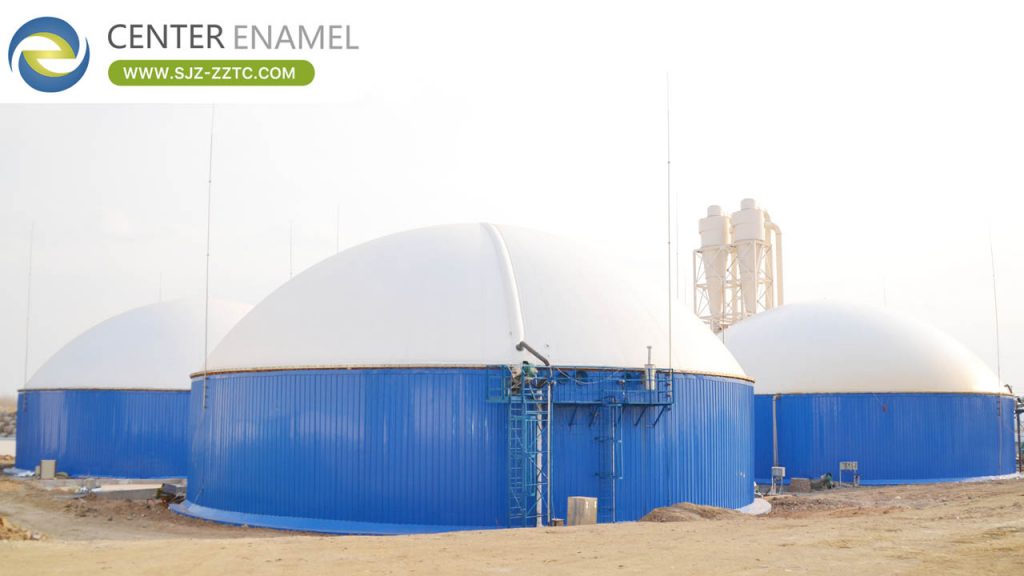
Zhaqi Biogas Project in Inner Mongolia. A medium-temperature CSTR (Continuous Stirred-Tank Reactor) plant processing 900 m³/day of manure and agricultural waste, producing 20,000 m³/day of biogas across 4 reactors (Ø25.98 × 8.4 m). It is a clear working example of the four-stage digestion process running at industrial scale in a cold-climate, insulated design.
| Project | Zhaqi Biogas Project (Inner Mongolia) |
| Location | Xing'an, Inner Mongolia, China |
| Industry | Agriculture / Renewable energy |
| Application | Manure + agri waste digestion |
| Product | 4 CSTR anaerobic digester tanks |
| Capacity | 20,000 m³/day biogas |
| Quantity | 4 Ø 25.98 × 8.4 m reactors |
| Material | Glass-Fused-to-Steel (GFS) |
| Standards | ISO 28765, AWWA D103 |
| Status | Delivered reference project |
About Center Enamel
Center Enamel backs digester supply with certifications and standards that matter for a gas-bearing tank: GFS digester tanks are manufactured under ISO 9001, built to ISO 28765 (enameled-steel tank standard) and AWWA D103 (bolted steel tank standard), CE/EN 1090 structural marking, with NSF/ANSI 61, WRAS, and FM options where potable-adjacent or fire-duty tanks apply. The glass-fused-to-steel shell (fired at 820–930°C) is the corrosion defense that lets the four-stage process run inside without shell degradation from H₂S and moisture.
Advantages and Limitations
The four-stage process is robust and well-proven, yielding both energy and a fertilizer-grade residue. Limits: it is sensitive to shocks (pH, ammonia, toxins), needs heating in cold climates, and demands a gas-tight, corrosion-resistant tank—exactly the conditions certified GFS construction addresses.
Comparison: Mesophilic vs Thermophilic
| Mode | Temp | Rate | Stability |
| Mesophilic | 35–38°C | moderate | high |
| Thermophilic | 50–55°C | faster | lower |
Inside a digester, hydrolysis → acidogenesis → acetogenesis → methanogenesis at 35–38°C turn organics into biogas (55–65% CH₄). The tank must be sealed, heated, mixed, and corrosion-resistant; certified GFS construction provides the gas-tight shell the process needs.
Frequently Asked Questions (FAQ)
Q1: What happens inside a digester?
A: Four anaerobic stages—hydrolysis, acidogenesis, acetogenesis, methanogenesis—convert organics into biogas (55–65% CH₄) at 35–38°C.
Q2: What are the digestion stages?
A: Hydrolysis (breakdown), acidogenesis (acids), acetogenesis (acetate), methanogenesis (methane + CO₂).
Q3: Why is temperature controlled?
A: Methanogens need warm, stable conditions; mesophilic 35–38°C is the reliable default, thermophilic is faster but less stable.
Q4: How is biogas collected?
A: Under a sealed fixed or double-membrane roof; the tank is kept oxygen-free and gently mixed.
Q5: What can harm the process?
A: pH swings, high ammonia, toxins, and temperature shocks that inhibit methanogens.
Q6: What tank is used?
A: A gas-tight, corrosion-resistant digester—Center Enamel supplies certified GFS tanks (ISO 28765 / AWWA D103).
Describe your feed, volume, and climate. We will specify a GFS digester tank with the right heating, mixing, and gas-collection provisions, and confirm certifications and capacity for your project.