
What Happens to Food Waste? From Landfill to Renewable Energy
When you scrape leftover pasta into the bin or throw away vegetable peels, have you ever wondered what happens to food waste next? For most people, food waste disappears from sight and mind. But the reality is that the journey of discarded food has profound environmental and economic consequences. Globally, approximately 1.3 billion tonnes of food are wasted annually, with about 12–14% coming from the food service sector . This waste doesn't simply vanish—it either rots in landfills, where it releases methane, or it can be transformed into renewable energy through advanced technologies like anaerobic digestion. Understanding what happens to food waste is the first step toward more sustainable management.
Landfill: The Default Destination
The most common fate of food waste is the landfill. In many countries, including the United States, approximately 40% of all food produced is wasted, with full-service restaurants alone contributing 6.1 million tons annually . Once buried, food waste decomposes without oxygen—a process called anaerobic decomposition. This produces methane, a greenhouse gas approximately 28–80 times more potent than carbon dioxide in its warming potential over a 20-year period .
Food waste accounts for up to 58% of fugitive methane emissions at landfills . In Michigan, for example, roughly 19% of all landfill-bound waste is food, and landfills are the third-largest source of methane emissions in the state . Nationwide, the EPA estimates that nearly two-thirds of methane from food waste in landfills is not captured, making even well-managed landfills a significant source of climate pollution . The cost is staggering—food waste costs the global economy nearly $940 billion annually and produces 4.4 gigatonnes of CO₂ equivalents .
Methane Emissions: The Climate Impact
Methane released from decomposing food waste contributes up to 10% of all global emissions—equivalent to more than the entire aviation sector. If food waste emissions were considered a country, it would be the third-largest emitter globally . As one expert notes, "It is nearly impossible for the globe to meet emissions targets set forth by the Paris Accords without reducing waste from the food system" .
The problem is particularly acute because food breaks down quickly. Most methane escapes before landfill operators can install or expand gas collection systems. Research comparing anaerobic digestion to landfilling found that landfill disposal generates up to 497,543.50 kg CO₂e per ton of food waste, while anaerobic digestion reduces emissions by up to 78% .
Incineration: The Energy-Intensive Alternative
Some food waste is sent to incineration facilities where it is burned to generate energy. However, because food waste is approximately 70% water, incineration requires more energy to burn and is less efficient than recycling through anaerobic digestion . While incineration with energy recovery is preferable to landfilling, it still releases greenhouse gases and is not considered a sustainable solution compared to methods that capture the energy potential of organic matter .
Anaerobic Digestion: Transforming Waste into Energy
So what happens to food waste when it's recycled instead of landfilled? The answer is anaerobic digestion—a natural biological process that converts organic matter into biogas and nutrient-rich fertilizer . Food waste is collected and taken to a specialist treatment facility where naturally occurring microbes break it down in sealed tanks without oxygen. This process produces biogas (primarily methane and carbon dioxide) and a digestate that can be used as fertilizer .
Studies have shown that anaerobic digestion can reduce waste volume by 60% while generating renewable energy. The biogas can be combusted to generate renewable electricity, upgraded and injected directly into the national gas grid, or used as transport fuel . Meanwhile, the nutrient-rich digestate serves as a sustainable liquid biofertiliser for local farmers . This is particularly valuable because, unlike composting, anaerobic digestion captures methane and uses it to generate energy—composting releases methane into the atmosphere .
The CSTR Process: Core Technology for Food Waste Digestion
At the heart of efficient food waste conversion is the CSTR Process (Continuous Stirred-Tank Reactor). The CSTR reactor is a closed, insulated tank equipped with mechanical stirring that ensures complete mixing of food waste and microorganisms at a constant temperature . This continuous agitation prevents solids from settling, maintains stable fermentation, and maximizes biogas production—critical for handling the diverse composition of restaurant food waste.
Research has demonstrated that anaerobic digestion systems can achieve stable biogas production with methane content typically around 50–60% . The process involves a complex microbial community where fermentative bacteria break down complex organic matter into volatile fatty acids, which are then converted by methanogenic archaea into methane . Studies show that optimum hydraulic retention times range from 30 to 60 days, with removal efficiencies for volatile solids reaching 83–91% .
GFS Tanks: The Infrastructure for Biogas Projects
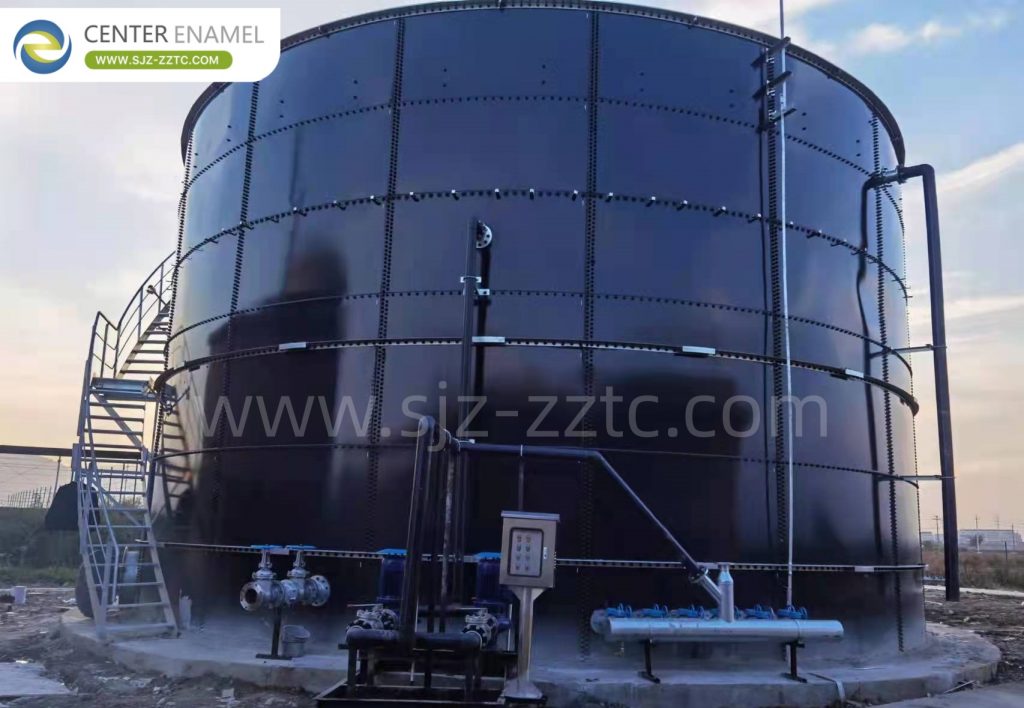
For biogas projects, reliable storage infrastructure is paramount. Glass-Fused-to-Steel (GFS) tanks are manufactured through a high-temperature firing process (820°C–930°C) that fuses glass to steel, creating an inert, inorganic bond. The advantages of GFS tanks in biogas applications are significant:
Superior Corrosion Resistance: The glass coating resists aggressive hydrogen sulfide, acidic compounds, and pH conditions ranging from 1 to 14, ensuring a service life exceeding 30 years with minimal maintenance.
Gas and Liquid Impermeability: The fused glass coating creates a gas-tight seal essential for preventing odor and greenhouse gas leakage.
Modular, Rapid Installation: Bolted panel construction enables fast onsite assembly without large cranes or scaffolding, cutting project durations.
Low Maintenance: The non-porous, smooth enamel surface resists sludge deposits and biofilm formation.
When paired with a Double Membrane Roof, the gas holder is integrated directly on top of the tank, eliminating the need for separate ground-mounted gas holders and saving valuable land area.
Center Enamel: A Leader in Biogas Solutions
Center Enamel (Shijiazhuang Zhengzhong Technology Co., Ltd.) has emerged as a premier EPC Contractor in sustainable energy, with over 36 years of experience, a 150,000㎡ R&D and production base, and an annual production capacity of 250,000 tank sheets. As a full-service provider, Center Enamel delivers turnkey biogas solutions covering the entire project lifecycle—from feasibility studies and process engineering to equipment manufacturing, installation, and commissioning.
Center Enamel's expertise spans more than 100 countries, with successful projects in applications ranging from restaurant food waste treatment to agricultural biogas plants and municipal wastewater facilities. Their solutions are engineered to withstand diverse climates, ensuring long-term reliability. The company's GFS tanks meet rigorous international standards including ISO 9001, NSF/ANSI 61, AWWA D103-09, and EN/ISO 28765, providing assurance of quality and safety.
Conclusion
What happens to food waste depends entirely on how it is managed. Thrown in the bin, it becomes a major source of methane emissions and environmental harm. But when food waste is recycled through anaerobic digestion, it becomes a renewable energy resource—producing biogas for electricity and heat, and fertilizer for agriculture. As research confirms, anaerobic digestion can reduce carbon emissions by up to 78% compared to landfilling . By harnessing the CSTR Process within durable GFS Tanks and relying on experienced EPC Contractor expertise, we can transform what was once a waste problem into a sustainable energy solution. Center Enamel stands ready to support this transition with robust, efficient, and cost-effective biogas project solutions.
Frequently Asked Questions (FAQ)
Q1: Why is food waste in landfills harmful to the environment?
Food waste decomposes without oxygen in landfills, producing methane—a greenhouse gas approximately 28 times more potent than carbon dioxide. Food waste accounts for up to 58% of fugitive methane emissions at landfills .
Q2: What is anaerobic digestion and how does it process food waste?
Anaerobic digestion uses microorganisms to break down food waste in sealed tanks without oxygen. This produces biogas (methane and carbon dioxide) for energy generation and a nutrient-rich digestate that can be used as fertilizer .
Q3: How much emissions can anaerobic digestion save compared to landfilling?
Research shows anaerobic digestion can reduce carbon emissions by up to 78% compared to traditional landfilling of food waste, while also generating renewable energy .