
What Is a Compressed Bio Gas Project?
A compressed bio gas (CBG) project is a complete value chain that upgrades raw biogas to 95–99% methane (biomethane) and compresses it to roughly 200–250 bar for use as a vehicle fuel or CNG replacement. It links feedstock, anaerobic digestion, upgrading, compression, storage, and dispensing into one engineered system with a defined off-take.
The CBG Value Chain
Step one is feedstock and anaerobic digestion producing biogas (55–65% CH₄). Step two is upgrading — removing CO₂, H₂S, and trace siloxanes — to pipeline/vehicle-grade biomethane. Step three is compression, storage in cascades, and dispensing to vehicles or injection. Each step is a capital and integration decision.
Why Compress to CBG?
Compression turns diffuse biogas into a transportable, high-energy-density fuel that replaces compressed natural gas (CNG) in vehicles, or enables grid injection where pipelines allow. For farms and municipalities, CBG converts waste into a priced product rather than just heat or flare.
| Value-chain stage | Function | Key output |
| Feedstock + AD | Produce biogas | 55–65% CH₄ biogas |
| Upgrading | Remove CO₂/H₂S | 95–99% CH₄ biomethane |
| Compression | Raise to 200–250 bar | CBG (vehicle/CNG grade) |
| Storage + dispense | Buffer and fuel | Fleet / grid off-take |
Business Models
The two common models are vehicle fuel (own or third-party fleet, dispenser on-site) and grid injection (where biomethane qualifies). Project bankability depends on feedstock security, off-take contract, and the upgrading/compression guarantee — not just the digester.
Technical Considerations
Upgrading choice (PSA, membrane, amine) sets impurity limits; compression needs biogas dried to a low dew point before the reciprocating compressor. Low-pressure digestate gas is buffered in GFS or steel holders, then compressed into ASME-rated cascades. Corrosion control on H₂S is essential upstream.
How to Scope a CBG Project
Confirm feedstock tonnage and biogas yield, set the upgrading purity (95–99% CH₄), size compression to daily vehicle or grid demand, and specify storage cascades at 200–250 bar. A two-stage CSTR at 35–38°C is typical for manure/organic feed.
Project Case Study
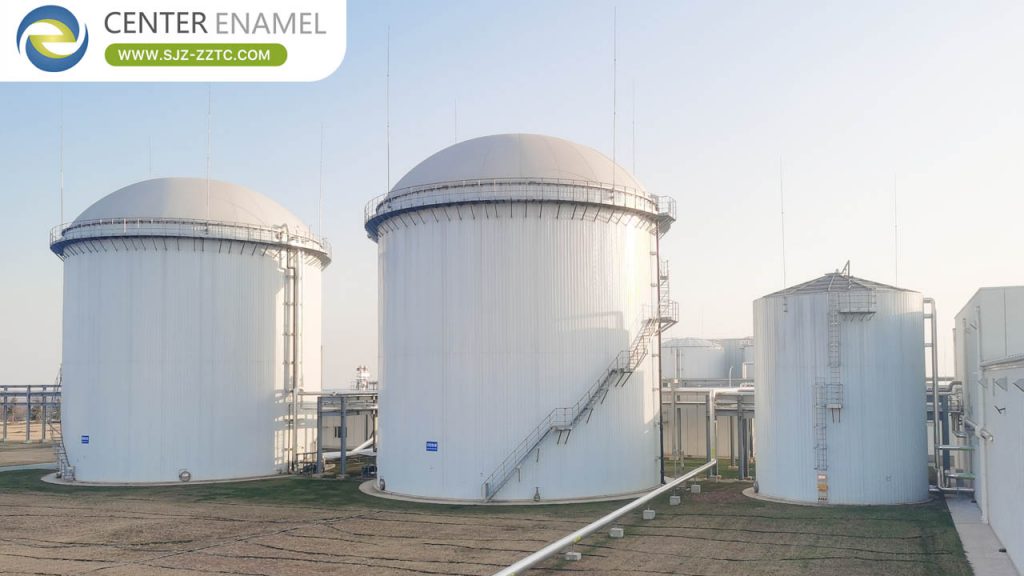
Zhenyuan Group Biogas Project in Henan. A vehicle-grade methane project producing 3,000,000 m³ of methane per year from 650 T/D of farm animal manure and washing wastewater, using medium-temperature CSTR (3 primary reactors Ø15.29 × 15 m + 1 secondary Ø5.22 × 6 m) for two-stage digestion — a documented CBG feedstock-to-vehicle-fuel project.
| Project | Zhenyuan Group Biogas Project in Henan |
| Location | Xinzheng, Henan, China |
| Industry | Agriculture / Renewable Fuel |
| Application | Vehicle-grade methane (CBG feedstock) |
| Product | CSTR anaerobic reactors (GFS) |
| Capacity | 650 T/D feedstock |
| Output | 3,000,000 m³ CH₄/year (vehicle grade) |
| Status | Delivered 2013 |
About Center Enamel
Center Enamel brings industry application experience in renewable vehicle fuel, supplying the bolted GFS anaerobic digester tanks at the core of CBG projects such as the Henan vehicle-grade methane plant above. The company builds digester tankage engineered for continuous wet, corrosive duty — glass fused at 820–930°C — and integrates with the client’s upgrading and compression scope.
Advantages and Limitations
CBG turns waste into a priced, transportable fuel and cuts fossil CNG use. Limits: upgrading and compression are capital-heavy and need a secure off-take; feedstock variability affects yield. Modular GFS digesters de-risk the front end by speeding deployment.
Comparison: Biogas vs CBG vs Grid Injection
| Option | Purity | Use |
| Raw biogas | 55–65% CH₄ | Heat/electricity on-site |
| CBG | 95–99% CH₄ @ 200–250 bar | Vehicle / CNG |
| Grid injection | 95–99% CH₄ | Pipeline (where allowed) |
A CBG project is a feedstock-to-dispenser chain: digest organic waste, upgrade to 95–99% methane, and compress to 200–250 bar for vehicle fuel. Secure feedstock and off-take first, then size digestion, upgrading, and compression. Send your feedstock data and we will scope the digester and tankage.
Frequently Asked Questions (FAQ)
Q1: What is a CBG project?
A: A chain that upgrades biogas to 95–99% methane and compresses it to ~200–250 bar for vehicle fuel or CNG replacement.
Q2: What purity is CBG?
A: 95–99% methane (biomethane), with CO₂, H₂S, and siloxanes removed.
Q3: Why compress biogas?
A: Compression gives transportable, high-density fuel that replaces CNG in vehicles or enables grid injection.
Q4: What tank capacity is available?
A: Center Enamel supplies GFS digester tanks from 200 m³ to 60,000 m³.
Q5: What project experience exists?
A: Henan vehicle-grade methane project: 650 T/D feedstock → 3,000,000 m³ CH₄/year.
Q6: What does scoping need?
A: Feedstock tonnage, biogas yield, upgrading purity, daily compression demand, and off-take contract.
Send your feedstock tonnage, biogas yield, and off-take plan. We will scope the digester, size GFS tankage, and coordinate with your upgrading and compression scope.