
What Is a Compressed Bio Gas Project?
A compressed bio gas (CBG) project upgrades raw biogas (55–65% CH₄) to biomethane (95–99% CH₄) and compresses it to about 250 bar for use as bio-CNG in vehicles or refillable cylinders. It combines an anaerobic digestion front-end, a biogas upgrading skid, and a compression and dispensing unit—an integrated engineering package rather than a single box.
Step 1 – Produce Biogas
A digester converts organic feed (manure, food waste, agri residue) into biogas at ~0.30–0.45 m³/kg COD removed, run at mesophilic 35–38°C. Capacity scales with feed; a large plant can make tens of thousands of m³/day of raw biogas to feed the upgrader.
Step 2 – Upgrade to Biomethane
Upgrading removes CO₂ and traces of H₂S/H₂O to reach 95–99% CH₄ using water scrubbing, PSA, membrane, or amine routes. A raw biogas stream of 22,000 m³/day can yield a significant biomethane volume for compression.
Step 3 – Compress and Dispense
Biomethane is dried, then compressed in multi-stage compressors to ~250 bar and stored in cascade buffers before dispensing as bio-CNG or filling cylinders. Compression power is a key OpEx; waste heat from CHP can help dry the gas.
| Stage | Input | Output | Key spec |
| Digestion | organic feed | biogas 55–65% CH₄ | 35–38°C |
| Upgrading | raw biogas | biomethane 95–99% | CO₂ removed |
| Compression | biomethane | CBG ~250 bar | bio-CNG |
Engineering Considerations
CBG needs tight safety design: gas detection, venting, and explosion-proof electricals at compression; biomethane must meet vehicle fuel specs (H₂S < 15 mg/Nm³, oxygen < 1%). Synchronize digester, upgrader, and compressor capacities; integrate CHP waste heat; and specify corrosion-resistant GFS digester and buffer tanks upstream.
How to Scope a CBG Project
Start from feed availability and target bio-CNG volume, size digestion, pick an upgrader technology, then size compression and storage. A feed-tonnage + off-take sheet lets suppliers quote the integrated package.
Project Case Study
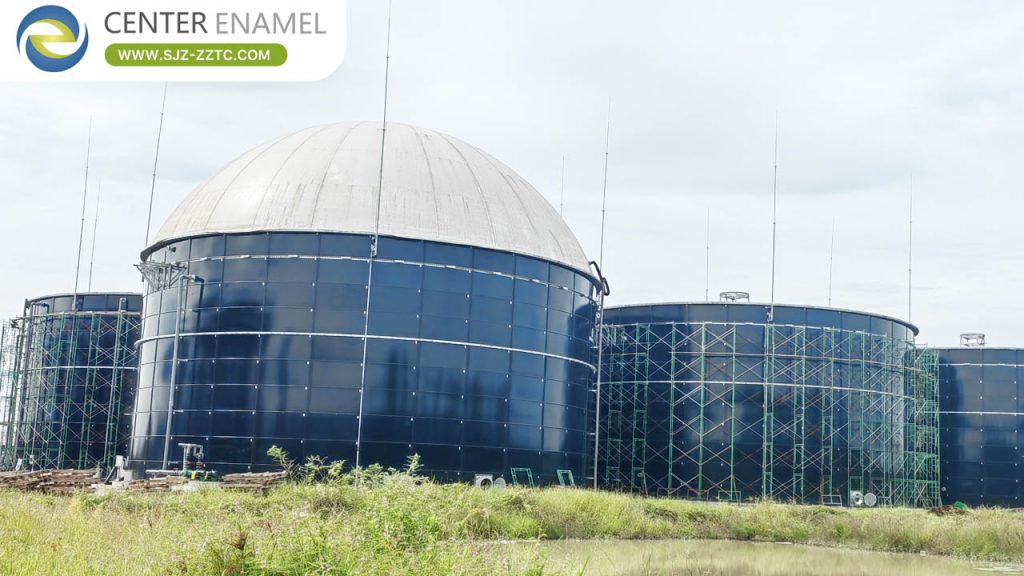
Malaysia Biogas Project. Five GFS tanks producing 22,000 m³/day of biogas (27,000 m³ total volume, ~80% digestibility, 0.45 m³/kg COD), a documented large-scale biogas resource that can feed a CBG upgrading and compression train for vehicle-grade fuel.
| Project | Malaysia Biogas Project |
| Location | Malaysia |
| Industry | Biogas |
| Application | Biogas from organic waste |
| Product | 5 GFS digester tanks |
| Capacity | 22,000 m³/day biogas (27,000 m³ total) |
| Material | Glass-Fused-to-Steel (GFS) |
| Standards | ISO 28765, AWWA D103 |
| Status | Delivered 2026 |
About Center Enamel
Center Enamel demonstrates its engineering capability for CBG projects at the front end: bolted GFS digester and gas-buffer tanks engineered for the corrosive, gas-bearing biogas environment, supplied with integrated double-membrane gasholder roofs and designed to ISO 28765 / AWWA D103, ISO 9001, CE/EN 1090. The company supports EPC coordination so the digester output feeds the upgrader and compressor cleanly and on schedule.
Advantages and Limitations
CBG turns waste into a transport fuel with strong carbon credentials and a clear off-take. Limits: compression and upgrading add CAPEX/OpEx, vehicle-fuel specs are strict, and a firm bio-CNG off-take decides payback. Scale matters.
Comparison: CBG vs Grid Injection
| Off-take | Pressure | Infra need | Best when |
| CBG (bio-CNG) | ~250 bar | compressor + dispenser | vehicle fuel / remote |
| Grid injection | pipeline pressure | grid connection | urban gas grid |
A compressed bio gas project upgrades biogas to 95–99% CH₄ and compresses it to ~250 bar as bio-CNG. It integrates digestion, upgrading, and compression; specify corrosion-resistant GFS digester and buffer tanks and synchronize capacities for a viable vehicle-fuel or cylinder supply.
Frequently Asked Questions (FAQ)
Q1: What is a compressed bio gas project?
A: It upgrades biogas to 95–99% CH₄ biomethane and compresses it to ~250 bar for use as bio-CNG vehicle fuel or cylinders.
Q2: What pressure is CBG?
A: About 250 bar, achieved by multi-stage compression after drying; stored in cascade buffers.
Q3: What are the main components?
A: Digester, biogas upgrader (water/PSA/membrane/amine), dryer, compressor, and storage/dispenser.
Q4: What fuel specs apply?
A: Vehicle biomethane typically needs H₂S < 15 mg/Nm³ and oxygen < 1%; CO₂ removed to 95–99% CH₄.
Q5: What tank does the front end need?
A: Corrosion-resistant GFS digester and gas-buffer tanks; Center Enamel supplies them with gasholder roofs.
Q6: What standards apply to tanks?
A: GFS tanks to ISO 28765 / AWWA D103, ISO 9001, CE/EN 1090.
Share your feed tonnage and bio-CNG target. We will size digester and buffer tanks, coordinate with your upgrader and compressor, and confirm GFS specifications and standards.