
What Is a Gate Fee for Organic Waste?
A gate fee for organic waste is the payment a waste processor receives to accept a load of organic feedstock—the opposite of a disposal cost, also called a tipping fee in some markets. At an anaerobic digestion (AD) or biogas plant, it is revenue earned simply for taking in food waste, manure, or other organics, on top of any energy the plant produces from them.
Gate Fee vs Tipping Fee
The terms overlap. A tipping fee is usually what a landfill or incinerator charges to dispose of waste (you pay them). A gate fee at an AD plant is often the same economic role viewed from the processor's side—but because the organics have value as fuel, the plant may charge a fee to accept them rather than pay to dump them. The sign of the cash flow is the key difference.
How a Gate Fee Is Set
The fee reflects what the alternative disposal costs the generator. Where landfill or incineration is expensive, generators will pay more to send organics to AD; where landfill is cheap, the gate fee shrinks or disappears. Composition also matters—clean, high-energy food waste commands more than wet, contaminated, or low-energy loads that need pre-treatment.
Typical Range (Illustrative)
In many developed markets, gate fees for acceptable organic feedstock are commonly discussed in a broad band of roughly $30–90 per tonne, but the real range is wide: near zero where landfill is cheap, and well above $100 per tonne where landfill diversion is mandated or transport is short. Treat any figure as regional and contract-specific, not universal.
Comparative Data Table: Drivers of the Fee
| Driver | Effect on gate fee | Why |
| Landfill cost | higher → higher fee | AD is the cheaper alternative |
| Diversion mandate | higher → higher fee | forced routing to AD |
| Feedstock energy | higher → higher fee | more biogas value |
| Contamination | lower → lower fee | pre-treatment cost |
| Transport distance | longer → lower fee | haul eats margin |
Technical Considerations
A gate fee only works if the plant can actually use the load. Accepting wet, contaminated, or salty feedstock can upset the digester, so intake contracts specify composition, exclusion lists, and sampling. The fee must also cover receiving, pre-treatment, and any residue disposal—not just the gas value.
Advantages and Limitations
Gate fees diversify revenue and improve biogas-project payback, especially where energy prices are weak. The limits are that they depend on local waste economics (which shift with policy), and over-reliance on them can discourage energy optimization. They are a complement to energy income, not a replacement.
Best Practices / How to Structure One
Set the fee against the local landfill/incineration alternative, specify acceptable composition and contaminants in the intake contract, and price in receiving and residue costs. Use gate fees to fill spare digester capacity after your own streams, so energy remains the core business.
A gate fee for organic waste is payment to accept feedstock at an AD plant—revenue from waste acceptance that complements energy. Its level tracks landfill cost, mandates, feedstock quality, and haul distance, so it is always regional and contract-specific.
Frequently Asked Questions (FAQ)
Q1: What is a gate fee for organic waste?
A: Payment a processor receives to accept organic feedstock at an AD/biogas plant—revenue from waste acceptance, the inverse of a disposal cost (sometimes called a tipping fee).
Q2: How is a gate fee set?
A: Mainly by the local alternative-disposal cost: where landfill/incineration is expensive or mandated for diversion, generators pay more to send organics to AD.
Q3: What range is typical?
A: In many developed markets a broad band of roughly $30–90 per tonne is commonly discussed, but the real range runs from near zero (cheap landfill) to over $100 (mandated diversion, short haul). It is regional and contract-specific.
Q4: Does it help biogas plants?
A: Yes—it diversifies revenue and improves payback, especially where energy prices are weak, but it should complement rather than replace energy optimization.
Q5: Gate fee vs tipping fee—same thing?
A: Overlapping but opposite cash flow: a tipping fee is what you pay a landfill to dump; a gate fee is what an AD plant charges to accept valuable organics.
Q6: Can any organic waste earn a fee?
A: Only acceptable, usable loads. Contaminated, salty, or wet feedstock may earn less or be rejected because pre-treatment and digester risk erode the margin.
Project Case Reference
Malaysia Biogas Project — Malaysia · 2026
5 GFS Tanks · 27,000 m³ Total Volume · 22,000 m³ Biogas/Day
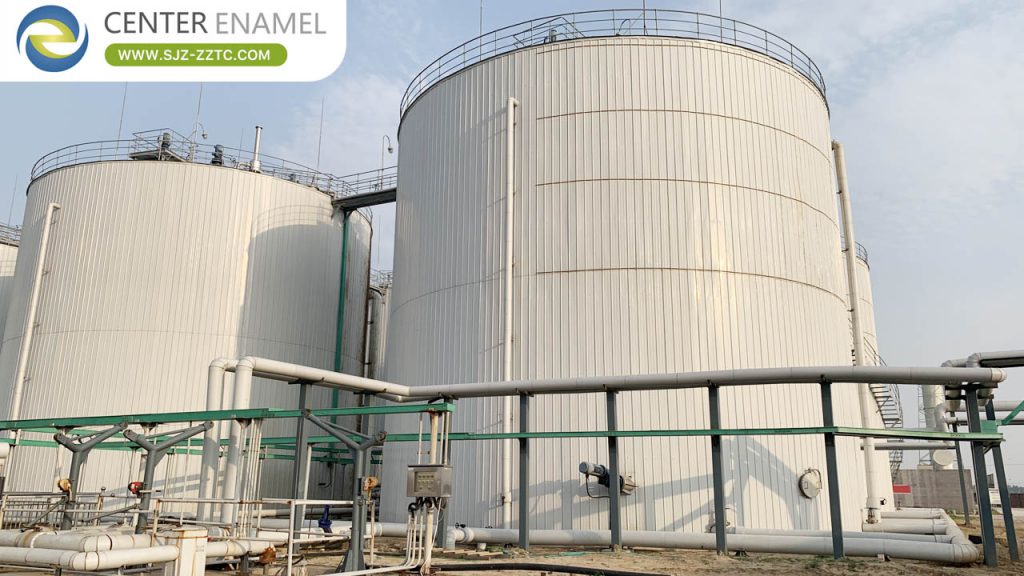
A large-scale biogas project in Malaysia featuring 5 Glass-Fused-to-Steel (GFS) tanks. The project achieves approximately 80% digestibility, with each single tank producing about 4,400 m³ of biogas daily, totaling 22,000 m³ per day across all 5 tanks.
Technical Specifications
Single Tank Volume: 5,400 m³ (Ø24.46 × 12 m)
Total Effective Volume: 27,000 m³ (5 tanks)
Daily Biogas Production: 22,000 m³ total
Digestibility: ≈ 80%
Gas Production Rate: 0.45 m³ / kg COD removed
Tank Type: Glass-Fused-to-Steel (GFS)
Water Quality Data
| Parameter | Inlet Water | Effluent |
| COD | ≥ 60,000 mg/L | ≥ 12,000 mg/L |
| BOD | ≤ 25,000 mg/L | ≤ 5,000 mg/L |