
What Is An Anaerobic Fermentation Solution? A Plain Explanation
An anaerobic fermentation solution is an integrated, sealed biological system that converts organic waste into biogas without oxygen, bundling receiving and pre-treatment, a heated reactor (usually a CSTR), gas handling, and energy off-take under one scope. It is the right choice when the feed is high in volatile solids and there is a practical use for the methane, because the value is the gas, not just the waste removed.
What The Term Covers
The word 'solution' matters: it is the whole delivered system, not a single tank. It includes how the feed is received and prepared, how it is held at temperature in a sealed reactor, how the biogas is captured and conditioned, and how the energy is used or upgraded. A tank sold alone is a component; a solution is the component plus the biology plus the guarantee.
How The Biology Works
In the absence of oxygen, hydrolytic and methanogenic microbes break volatile solids into biogas. The gas is roughly 55-65% methane, with the rest mostly carbon dioxide. At 35-38 C a mesophilic digester returns about 0.30-0.45 m3 of biogas per kg of COD removed and produces far less sludge than aerobic treatment.
| Parameter | Typical Value | Why It Matters |
| Methane content | 55-65% of biogas | Sets fuel value |
| Biogas yield | 0.30-0.45 m3 / kg COD removed | Sets digester size |
| Mesophilic temperature | 35-38 C | Stable microbiology |
| Retention time | 20-40 days (CSTR) | Sets reactor volume |
When It Is The Right Choice
Choose anaerobic fermentation when the feed is energy-dense (manure, food waste, high-strength agro-industrial effluent) and you have a heat, power, or biomethane off-take. The sealed reactor is usually a Glass-Fused-to-Steel tank for corrosion resistance and fast assembly. Avoid it for dilute, cold, or inhibitory feeds, where aerobic or hybrid trains win.
Project Case Study: Malaysia Biogas Project
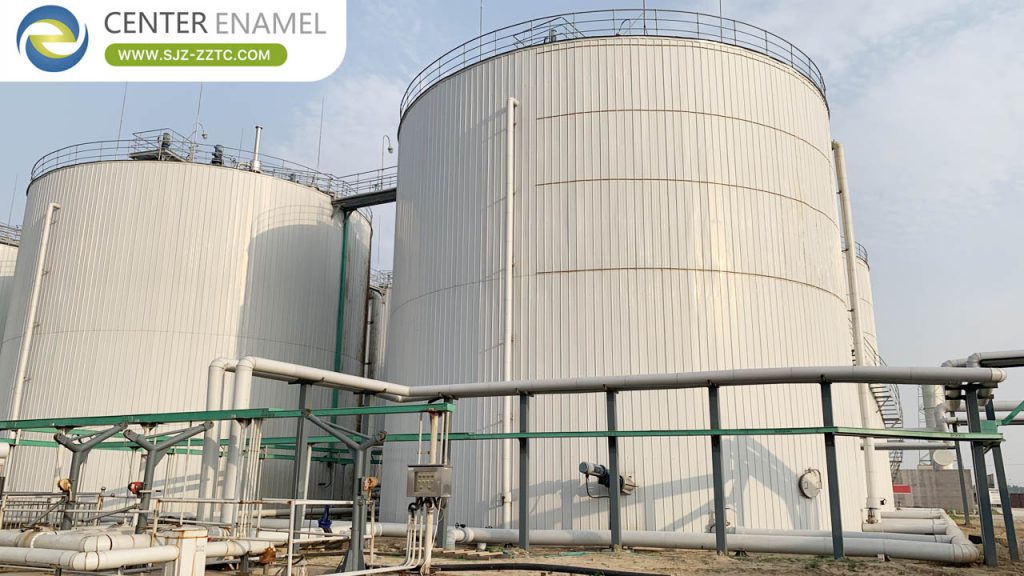
Project / Application: Large-scale biogas from agro-industrial wastewater, Malaysia. Industry: Food and agro-industrial. Tank Type: Glass-Fused-to-Steel (GFS). Key Requirements: High-rate digestion of high-strength effluent with reliable daily gas output.
| Field | Value | Source / Evidence |
| Tank Type | GFS (Glass-Fused-to-Steel) | Company project reference |
| Tank Quantity | 5 Nos. | Company project reference |
| Dimensions Per Tank | O24.46 x 12 m | Company project reference |
| Volume Per Tank | 5,400 m3 | Calculated from supplied diameter and height |
| Total Effective Volume | 27,000 m3 (5 tanks) | Company project reference |
| Daily Biogas Production | 22,000 m3 total | Company project reference |
| Digestibility | approx 80% | Company project reference |
| Gas Yield Rate | 0.45 m3 / kg COD removed | Company project reference |
About The Supplier
Shijiazhuang Zhengzhong Technology Co., Ltd (Center Enamel) manufactures the Glass-Fused-to-Steel digester tanks at the heart of anaerobic fermentation solutions, with enamel firing at 820-930 C and certifications including ISO 9001, NSF/ANSI 61, and CE-EN 1090. The Malaysia reference is a 5-tank, 27,000 m3 system producing 22,000 m3 of biogas per day, showing the solution delivered as tankage plus high-rate digestion.
Comparison: What The Solution Must Include
| Component | Purpose | Often Overlooked |
| Pre-treatment | Clean, pumpable feed | Packaging and grit |
| Sealed reactor | Holds retention and gas | Heating and mixing |
| Gas handling | Conditioning and use | Desulphurisation |
| Off-take | Energy recovery | Stable demand |
An anaerobic fermentation solution is a sealed biology wrapped in a tank and a guarantee. Define the feed and the off-take first, then bundle the digester and the process so the biogas output is measured, not hoped for.
Frequently Asked Questions
Q1: What is anaerobic fermentation? A1: Oxygen-free digestion where microbes turn organics into methane-rich biogas.
Q2: What does the solution include? A2: Pre-treatment, a sealed heated reactor, gas handling, and off-take under one scope.
Q3: How is biogas made? A3: Microbes break volatile solids into 55-65% methane biogas at 35-38 C.
Q4: When is it the right choice? A4: When the feed is energy-dense and there is a use for the methane.
Q5: What yield is typical? A5: About 0.30-0.45 m3 per kg of COD removed at mesophilic temperatures.
Q6: What tank is used? A6: A sealed Glass-Fused-to-Steel CSTR, corrosion-resistant and fast to build.
Q7: What temperature is used? A7: Mesophilic digestion typically runs at 35-38 C.
Q8: Can the gas run vehicles? A8: After upgrading to biomethane, yes, at vehicle-grade specification.
Suggested CTA
Describe your organic feedstock and off-take goal to an engineer, or request an anaerobic fermentation solution scope.