
What Is Biogas Power? Definition, Working Principle & Complete Benefits
Many people are familiar with solar power and wind power, but what is biogas power and why it has become an indispensable part of global renewable energy?Biogas power refers to generating electricity and heat by using biogas produced from anaerobic fermentation of organic waste. It converts agricultural waste, livestock manure, kitchen waste, crop residues and industrial organic wastewater into clean combustible biogas, then drives generator units to produce stable electric power.
As countries accelerate carbon neutrality and energy transition, biogas power stands out as a reliable base-load renewable energy. Unlike intermittent solar and wind energy, biogas power can operate 24/7 steadily, solving rural and industrial power shortages while realizing waste recycling, environmental governance and circular economic development.
What Is Biogas Power Exactly?
Biogas power is a form of biomass power generation. Its core fuel is biogas, mainly composed of 55%–70% methane and 30%–45% carbon dioxide, with a small amount of water vapor and trace impurities.
Biogas is produced naturally when organic waste decomposes in an oxygen-free sealed environment. After purification, desulfurization and dehydration, biogas can be supplied to biogas generators, internal combustion engines or gas turbines to generate electricity. The waste heat from power generation can also be recovered for heating, forming a combined heat and power (CHP) system.
Simply put:Organic Waste → Anaerobic Fermentation → Biogas → Generator → Biogas Power
How Does Biogas Power Work?
The whole working process of biogas power can be divided into five clear steps:
1. Raw Material Collection
Collect biodegradable organic waste including livestock manure, kitchen waste, agricultural grass and straw, food processing wastewater and cassava residues. These raw materials are rich in carbohydrates, protein and fiber, suitable for anaerobic fermentation.
2. Pretreatment & Fermentation
Raw materials are crushed, mixed and adjusted for moisture and carbon-nitrogen ratio, then sent into sealed anaerobic tanks. Under oxygen-free conditions, microorganisms decompose organic matter through hydrolysis, acidification, acetogenesis and methanogenesis to produce raw biogas.
3. Biogas Purification
Raw biogas contains hydrogen sulfide and water vapor, which may corrode generators. Professional purification removes impurities, improves methane purity and ensures safe and efficient combustion.
4. Power Generation
Purified biogas is transported to biogas generator sets. The gas burns to drive the engine and convert mechanical energy into electric energy for factory use, farm power supply and grid connection.
5. Residue Recycling
Fermented biogas slurry and biogas residue are rich in nutrients, processed into organic fertilizer for farmland planting, achieving a closed-loop waste-to-energy cycle.
Key Benefits of Biogas Power
1. Stable and Continuous Power Supply
Unlike solar power limited by day and night, or wind power affected by weather, biogas power can run stably all year round, providing reliable power for rural areas, livestock farms and industrial parks. It effectively eases power shortage and unstable grid supply in remote regions.
2. Environmental Protection and Carbon Reduction
Biogas power replaces fossil fuel power generation, reducing carbon dioxide emissions. Proper disposal of organic waste avoids random stacking, odor pollution and water eutrophication. It also reduces methane release from natural waste decomposition, making it an effective carbon reduction method.
3. Reduce Energy and Operating Costs
Biogas is produced from free waste resources. Enterprises and farms can generate electricity by themselves, greatly cutting electricity purchase costs. Recycle biogas residue into organic fertilizer to reduce chemical fertilizer expenditure, improving overall economic benefits.
4. Promote Circular Agriculture and Rural Development
Biogas power builds a circular economy model of “planting — breeding — waste — biogas — fertilizer”. It improves rural living environment, eliminates waste pollution, and creates new income sources for farmers.
5. Policy Support and Sustainable Value
In many countries, biogas power projects enjoy renewable energy subsidies, tax incentives and environmental policy support. It helps enterprises meet emission standards, enhance green image and achieve long-term sustainable operation.
Four Core Anaerobic Technologies of Center Enamel
To realize efficient biogas production and stable biogas power generation, Center Enamel provides four mature anaerobic technologies suitable for different raw materials and project scales:
CSTR Process (Completely Stirred Tank Reactor): Ideal for high-solid raw materials such as napier grass, crop straw, kitchen waste and livestock manure. Full mechanical stirring prevents scum crusting and sediment accumulation, ensuring stable fermentation and high biogas yield, perfectly for large-scale biogas power plants.
UASB Process (Upflow Anaerobic Sludge Blanket): Suitable for low-solids organic wastewater from starch factories, palm oil mills and food processing plants. It features low operating cost, high organic removal efficiency and stable running performance for medium-sized biogas power projects.
USR Process (Upflow Solids Reactor): With simple structure, low investment and easy maintenance, it adapts to scattered small rural biogas projects and small farm biogas power stations, requiring minimal daily management.
IC Process (Internal Circulation Reactor): Adopts biogas-driven internal circulation, with 3–5 times higher treatment load than traditional reactors. It saves construction land, ideal for industrial zones and biogas power projects with limited site area.
Advantages of GFS Tanks for Biogas Power Projects
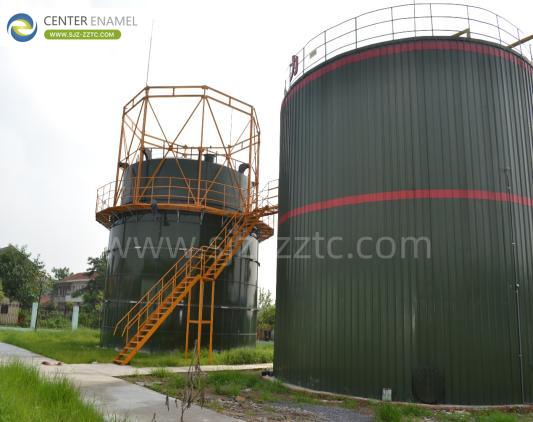
Glass-Fused-to-Steel (GFS) Tanks are the core equipment of biogas power projects, with irreplaceable technical advantages:
- Outstanding corrosion resistance, resisting pH 1–14 acid erosion and long-term microbial corrosion.
- Strong climate adaptability, resisting high temperature, heavy rainfall, high humidity and ultraviolet aging in tropical and subtropical regions.
- Excellent airtight bolted structure, preventing biogas leakage and improving fermentation efficiency and power output.
- Service life over 30 years with ultra-low maintenance cost, far more durable than concrete tanks.
- Factory prefabricated modular design, on-site bolt assembly, short construction period and convenient later capacity expansion.
Why Choose Center Enamel for Biogas Power Projects
- Provide customized anaerobic process design and one-stop solutions according to local raw materials, climate and power demand.
- Own more than 200 enamel patents and Asia’s largest GFS tank production base, ensuring stable quality and delivery cycle.
- Comply with ISO 28765, AWWA D103, CE international standards; every tank passes 1500V high-voltage spark test.
- Rich global project experience in Southeast Asia, South Asia, Europe and other regions, familiar with local environmental policies, terrain and tropical construction difficulties.
- Offer full turnkey EPC services including project design, equipment manufacturing, installation, commissioning and lifelong after-sales support, reducing investment risks for clients.
Biogas power is a clean, stable and profitable renewable energy that perfectly turns organic waste into valuable electric power, balancing environmental protection, energy supply and economic benefits. With mature four major anaerobic technologies, high-performance GFS Tanks and rich overseas engineering experience, Center Enamel delivers reliable full-chain solutions for global biogas power projects. It helps farms, factories and rural areas realize waste recycling, stable power supply and low-carbon circular development, continuously empowering the global renewable energy transition.