
What Is Biological Wastewater Treatment? Principles, Processes, Benefits and Full-Scale Solutions
In modern environmental engineering, biological wastewater treatment is the most widely used, cost-effective, and sustainable method to remove organic pollutants from water. Whether for municipal sewage, industrial effluent, agricultural wastewater, or food processing drainage, biological treatment serves as the core step in achieving clean discharge and resource recovery. This article explains what biological wastewater treatment is, how it works, what processes are included, and why it is irreplaceable in global water treatment systems.
What Is Biological Wastewater Treatment?
Biological wastewater treatment is a technology that uses natural microorganisms — including bacteria, fungi, algae, and protozoa — to absorb, decompose, and convert organic pollutants in wastewater into harmless substances such as carbon dioxide, water, biomass, and even methane biogas.
Unlike physical or chemical methods that rely on filtration, sedimentation, or chemical dosing, biological treatment uses natural metabolic activities of microbes to clean water. It is environmentally friendly, low-cost, and high-efficiency, making it the foundation of nearly all modern wastewater treatment plants (WWTPs).
How Does Biological Wastewater Treatment Work?
Microorganisms in biological systems “eat” organic contaminants as their food source. Under controlled conditions (temperature, pH, oxygen, nutrients), microbes break down pollutants into stable, non-toxic end products.
The reaction can be divided into two major categories:
Aerobic biological treatment: Occurs with oxygen; microbes decompose organics into CO₂ and water.
Anaerobic biological treatment: Occurs without oxygen; microbes produce methane-rich biogas.
Together, they form the complete system of biological wastewater treatment used globally.
Main Types of Biological Wastewater Treatment
Biological wastewater treatment is generally divided into aerobic processes and anaerobic processes. Each supports different wastewater types and treatment goals.
1. Aerobic Biological Wastewater Treatment
Aerobic processes require oxygen and are suitable for low-to-moderate concentration wastewater.
- Activated Sludge Process: Most common municipal and industrial system.
- MBR (Membrane Bioreactor): High-efficiency filtration + biological treatment.
- Biofilters & Trickling Filters: Microorganisms attach to media for pollutant removal.
- SBR (Sequencing Batch Reactor): Periodic operation for flexible wastewater flow.
Aerobic treatment produces high-quality effluent but consumes more energy for aeration.
2. Anaerobic Biological Wastewater Treatment
Anaerobic processes operate without oxygen and excel at high-strength organic wastewater, such as from slaughterhouses, distilleries, food factories, agriculture, and breweries.
Advantages of anaerobic treatment:
- Very low energy consumption
- Produces methane biogas as renewable energy
- Less sludge production
- Extremely high COD removal efficiency
- Suitable for high-concentration wastewater
Today, anaerobic treatment is an important part of biological wastewater treatment and is widely used in industrial ETP and municipal STP projects.
Advantages of Biological Wastewater Treatment
Biological wastewater treatment is preferred by engineers and investors worldwide for many reasons:
- High efficiency: Effectively removes BOD, COD, ammonia nitrogen, and phosphorus.
- Low cost: Lower operational cost than physical-chemical-only systems.
- Eco-friendly: Uses natural microbes, no secondary pollution.
- Stable performance: Mature technology with long-term reliability.
- Resource recovery: Anaerobic systems can produce biogas for heat, power, or Bio-CNG.
- Wide application: Works for domestic sewage, industrial effluent, livestock wastewater, and food processing wastewater.
Applications of Biological Wastewater Treatment
Biological systems are used in almost every field of water treatment:
- Municipal STP: Domestic sewage from cities, communities, and buildings.
- Industrial ETP: Food, beverage, brewery, slaughterhouse, textile, and chemical wastewater.
- Agricultural wastewater: Livestock manure, crop processing drainage.
- Rural decentralized treatment: Small-scale, low-cost eco-friendly systems.
- Food & beverage plants: High-organic wastewater with high biodegradability.
For high-concentration organic wastewater, anaerobic biological wastewater treatment is the most cost-effective choice.
Four Core Anaerobic Processes in Biological Wastewater Treatment
In industrial and high-strength biological wastewater treatment, four advanced anaerobic technologies are widely applied as the core treatment units:
1. CSTR (Continuous Stirred-Tank Reactor)
Equipped with mechanical stirring, CSTR supports high-solid, high-fiber wastewater. It prevents crusting and stratification, ensuring stable and efficient treatment. Ideal for slaughterhouse, distillers grains, and agricultural waste wastewater.
2. UASB (Upflow Anaerobic Sludge Blanket)
UASB uses high-activity granular sludge to achieve high organic loading. It has a small footprint and excellent COD removal rate, widely used in soluble high-concentration wastewater after pretreatment.
3. USR (Upflow Solid Reactor)
USR features a simple structure, low investment, and strong anti-clogging performance. It can directly treat high-suspended solids wastewater without complex pretreatment, perfect for small and medium-sized projects.
4. IC (Internal Circulation Reactor)
IC reactor uses internal circulation to improve treatment efficiency by 3–5 times over traditional systems. It is compact, high-load, and widely used in large-scale industrial wastewater treatment plants.
These four anaerobic technologies greatly improve the efficiency and economy of biological wastewater treatment.
Advantages of GFS Tanks in Biological Wastewater Treatment
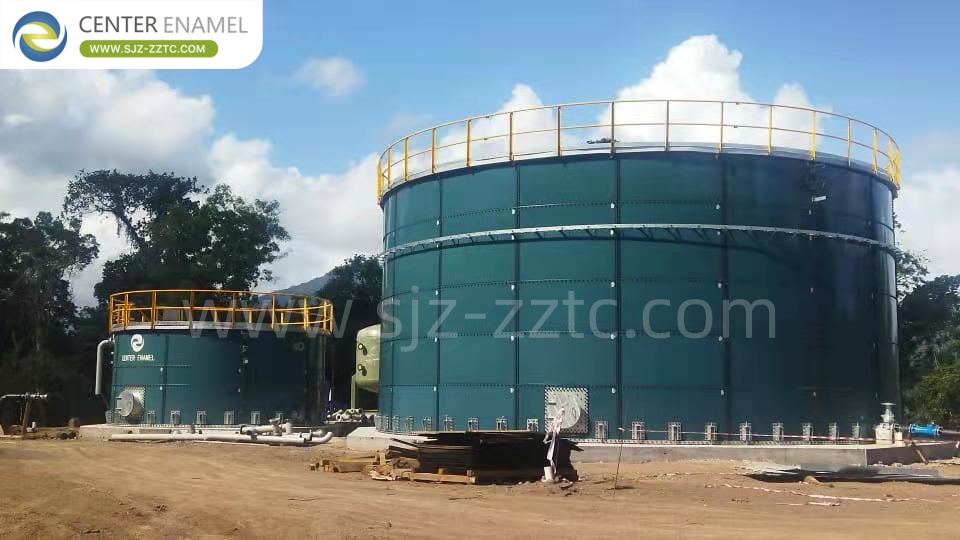
GFS Tanks (Glass-Fused-to-Steel Tanks) are the most popular reactor and storage tanks used in biological wastewater treatment systems worldwide.
Key advantages:
- Superior corrosion resistance: Resists acid, alkali, oil, and salt for decades.
- Excellent airtightness: Prevents biogas leakage and odor emissions.
- Modular bolted design: Fast installation, no on-site welding, short construction period.
- Long service life: Over 30 years of stable use.
- Smooth surface: Reduces scaling, adhesion, and maintenance cost.
- High compatibility: Fully supports CSTR, UASB, USR, IC and all biological processes.
GFS Tanks have become the standard equipment for modern biological wastewater treatment projects.
Center Enamel: Rich Experience in Biological Wastewater Treatment and Biogas Projects
As a leading global EPC contractor specializing in biological wastewater treatment, anaerobic systems, and waste-to-energy projects, Center Enamel provides full turnkey solutions for municipal STP, industrial ETP, anaerobic digestion, and biogas production.
Core Strengths
- Over 200 patented enamel technologies, meeting ISO, AWWA, and international standards.
- Full turnkey EPC: design, manufacturing, transportation, installation, commissioning, and after-sales.
- Customized biological wastewater treatment systems for different wastewater characteristics.
- Rich global project experience in Asia, Africa, Europe, and the Americas.
- High-efficiency anaerobic processes and high-performance GFS Tanks integrated solutions.
- Professional on-site installation and long-term operational support.
Typical Project Scope
- Municipal and domestic biological wastewater treatment
- Industrial ETP for food, brewery, distillation, slaughterhouse, and aquaculture
- High-concentration organic wastewater anaerobic treatment
- Biogas production and renewable energy projects
- GFS Tanks for biological reactors and wastewater storage
With strong technology and rich experience, Center Enamel helps customers achieve stable effluent, energy recovery, and environmental compliance.
Biological wastewater treatment is the most sustainable, economical, and effective way to purify water in the world. It uses natural microorganisms to remove organic pollutants and can even recover energy in the form of biogas. Supported by four advanced anaerobic processes — CSTR, UASB, USR, IC — and reliable GFS Tanks, biological treatment systems deliver high performance, low cost, and long service life.
As a professional EPC provider, Center Enamel has accumulated extensive experience in biological wastewater treatment and biogas projects. We are committed to providing safe, efficient, and green solutions for global customers in wastewater treatment and energy recycling.