
What is Cassava Effluent? Environmental Impacts, Biogas Potential & Treatment
What is Cassava Effluent?
Cassava effluent, also widely known as cassava processing wastewater, refers to the liquid waste generated throughout cassava washing, peeling, crushing, starch extraction, filtration, and tapioca flour production processes. It is a high-concentration organic industrial wastewater containing abundant starch residues, carbohydrates, protein, suspended solids, volatile fatty acids, and trace cyanide compounds.
With high COD and BOD levels, high moisture content and easy acidification, cassava effluent is one of the most polluting agricultural industrial wastewaters across tropical and subtropical cassava-producing regions. Without proper treatment, it becomes a major threat to water ecology and rural living environments.
Environmental Impacts of Cassava Effluent
Untreated cassava effluent discharged directly into rivers, lakes and farmland causes severe ecological damage.
First, it triggers water eutrophication. Rich nitrogen, phosphorus and organic matter lead to rapid algae growth, oxygen depletion, and massive death of aquatic organisms, destroying river food chains.
Second, it causes soil degradation. Effluent seeps into farmland, raising soil acidity, damaging crop root systems, and reducing land fertility and crop yields.
Third, it releases odor and greenhouse gases. Under natural decomposition, cassava effluent produces unpleasant odor, methane and carbon dioxide, worsening global warming and affecting residents’ living quality.
Fourth, it endangers drinking water safety. Harmful substances and residual cyanide infiltrate groundwater, bringing potential health risks to rural households relying on well water.
Therefore, scientific treatment and resource utilization of cassava effluent have become urgent tasks for the cassava industry.
How Does Cassava Effluent Generate Biogas
Cassava effluent is an ideal raw material for biogas production due to its rich organic nutrients. It generates biogas through natural anaerobic digestion in an oxygen-free sealed environment, divided into four stable biological stages:
- Hydrolysis Stage: Hydrolytic bacteria decompose macromolecular starch and organic matter in cassava effluent into small-molecule sugars and amino acids.
- Acidification Stage: Small-molecule organics are converted into volatile fatty acids, hydrogen and carbon dioxide.
- Acetogenesis Stage: Intermediate fatty acids are further decomposed into acetic acid, the key precursor for methane production.
- Methanogenesis Stage: Methanogenic bacteria convert acetic acid into biogas, composed of 55%–70% methane and 30%–45% carbon dioxide.
- The produced biogas is clean renewable energy, while the fermented sludge can be processed into organic fertilizer, realizing a closed-loop circular economy.
Energy Benefits of Cassava Effluent Biogas Production
Converting cassava effluent into biogas delivers remarkable energy and economic value.
First, replace fossil fuels. Biogas can be used for factory power generation, boiler heating and production energy supply, reducing reliance on diesel, coal and imported natural gas.
Second, realize factory energy self-sufficiency. Cassava starch plants consume large amounts of electricity and heat; self-produced biogas greatly cuts energy costs and improves profit margins.
Third, optimize regional renewable energy structure. Biogas belongs to clean biomass energy, helping cassava-producing countries increase green energy proportion and reduce carbon emissions.
Fourth, create additional economic income. Surplus biogas can be supplied to surrounding villages for cooking and living use, bringing extra revenue for processing enterprises.
Four Main Anaerobic Technologies for Cassava Effluent
Center Enamel provides four mature anaerobic technologies tailored to different cassava effluent concentrations, project scales and site conditions.
CSTR Process (Completely Stirred Tank Reactor)
Adopts full mechanical stirring to mix organic waste and microbial flora evenly. It is suitable for high-solids mixed cassava effluent, preventing scum and sediment accumulation and ensuring stable biogas output all year round. Ideal for large-scale cassava starch factories.
UASB Process (Upflow Anaerobic Sludge Blanket)
Features low operating cost and high organic removal efficiency. Wastewater flows upward through the sludge blanket to degrade pollutants efficiently, perfect for medium and large-sized liquid cassava effluent treatment.
USR Process (Upflow Solids Reactor)
Simple structure, low investment and easy maintenance. Without complex stirring systems, it adapts to small cassava processing workshops and decentralized rural biogas projects.
IC Process (Internal Circulation)
With 3–5 times higher treatment load than traditional reactors, IC Process saves construction land significantly. It is the best choice for cassava industrial parks with limited land resources.
Advantages of GFS Tanks in Cassava Effluent Biogas Projects
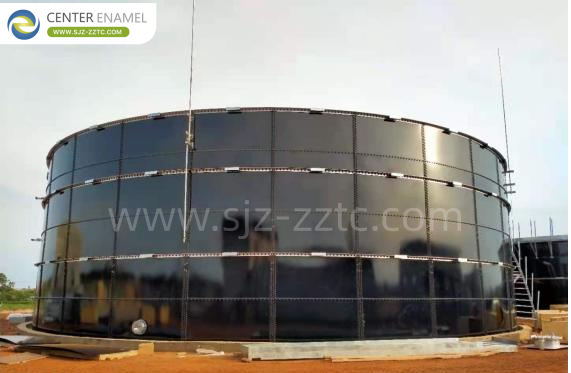
GFS Tanks (Glass-Fused-to-Steel Tanks) are the core equipment for cassava effluent biogas projects, with irreplaceable strengths:
- Super Corrosion Resistance: Fused at over 820°C, GFS Tanks withstand pH 1–14, resisting acid corrosion, volatile fatty acids and trace cyanide from cassava effluent.
- Excellent Airtightness: Sealed bolted structure prevents biogas and odor leakage, improving gas production efficiency and avoiding secondary pollution.
- Long Service Life: Up to 30+ years service life, far exceeding concrete and ordinary steel tanks, with low later maintenance costs.
- Fast Modular Installation: Factory prefabricated panels, on-site bolt assembly, no long curing period, shortening construction cycle greatly.
- Strong Climate Adaptation: Resists high temperature, heavy rainfall and tropical humidity, suitable for long-term outdoor operation in cassava-producing regions.
Center Enamel’s Advantages in Cassava Effluent Biogas Projects
As a professional global EPC contractor, Center Enamel has comprehensive strengths in cassava effluent treatment and biogas projects.
- Customized Technical Solutions: Tailor CSTR, UASB, USR and IC processes according to local cassava effluent characteristics and tropical climate.
- Leading Manufacturing Strength: Owns Asia’s largest GFS tank production base with 200+ patented enamel formulas.
- Strict International Standards: Complies with ISO 28765, AWWA D103, CE and other certifications; each tank passes 1500V high-voltage spark testing.
- Rich Industrial Experience: Deep understanding of cassava industry traits and wastewater treatment demands in Southeast Asia and South Asia.
- One-Stop EPC Service: Covers project design, equipment manufacturing, installation, commissioning and full after-sales support.
Cassava effluent is a high-pollution yet valuable organic renewable resource. Random discharge destroys water and soil ecology, while anaerobic digestion can turn it into clean biogas and organic fertilizer. With four mature anaerobic technologies, high-performance GFS Tanks and professional EPC capability, Center Enamel provides reliable full-cycle solutions for global cassava effluent treatment, helping the cassava industry achieve environmental protection, energy saving and long-term sustainable development.