
What Is CBG Storage Pressure?
Compressed biomethane (CBG) is stored at 200-250 bar in cascade banks of steel pressure vessels rated to ASME, PED, or equivalent codes, a pressure chosen to match NGV1 vehicle refueling and to buffer production against dispensing demand. The 200-250 bar band is not arbitrary; it is the shared standard of compressed natural gas vehicles, so CBG storage is built to the same pressure envelope as CNG.
Why 200-250 Bar
Vehicle CBG tanks and dispensers are designed for the CNG pressure envelope, so storing at 200-250 bar lets a dispenser fill a vehicle directly. It also packs enough methane into a vessel to make storage and tube-trailer transport economical rather than bulky.
Design Parameter Table
| Parameter | Typical value or range | Why it matters |
| Storage pressure | 200-250 bar | NGV vehicle standard |
| Bank split | Low / medium / high | Efficient cascade fill |
| Vessel code | ASME / PED | Legal rating |
| Buffer need | Hours to days of output | Decouples production |
| Transport | Tube trailers | Move gas off-site |
| Limitation to check | Thermal expansion | Allow for heat |
Cascade vs Single Buffer
| Option | Pressure setup | Best for |
| Cascade banks | Low/medium/high tiers | Efficient dispensing |
| Single buffer | One 250 bar bank | Small steady use |
| Tube trailer | Mobile 250 bar | Off-site transport |
Project Case Study
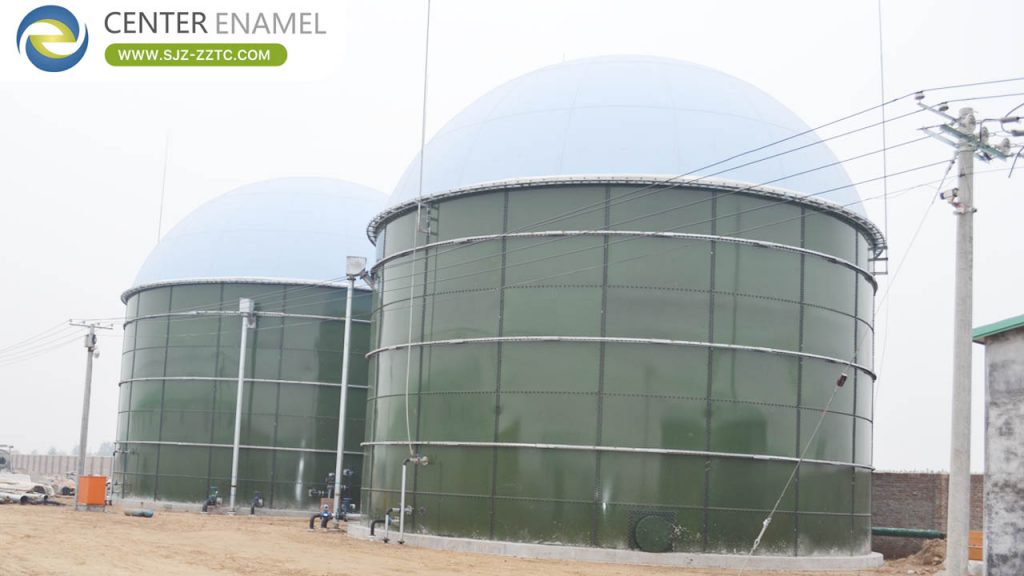
Zhenyuan Group Biogas Project, Henan. Producing 3 million m³ per year of vehicle-grade methane from 650 tonnes per day of manure and washing wastewater, this plant requires compressed storage and filling infrastructure at vehicle pressure so the gas can be dispatched to vehicles rather than flared or stranded.
| Project | Zhenyuan Group Biogas Project, Henan |
| Location | Xinzheng, Henan, China |
| Industry | Agriculture / Renewable Fuel |
| Application | Vehicle-grade methane production |
| Product | CSTR primary 3 × Ø15.29 × 15 m, secondary Ø5.22 × 6 m |
| Result | 3,000,000 m³ vehicle-grade CH₄ per year |
| Status | Delivered 2013 |
About Shijiazhuang Zhengzhong Technology Co., Ltd (Center Enamel)
Shijiazhuang Zhengzhong Technology Co., Ltd (Center Enamel) supplies the product technology for CBG storage through its pressure-vessel manufacturing capability (I/II class license, ASME, ISO 9001), building the cascade banks and buffer vessels rated for 200-250 bar service. The upstream GFS digester tanks and the downstream steel pressure vessels are engineered as one fuel system.
Store CBG at 200-250 bar in ASME/PED-rated cascade steel banks for efficient dispensing, or in tube trailers to move it off-site. Send your daily output and fill pattern and we will size the banks and vessels.
Frequently Asked Questions (FAQ)
Q1: What pressure is CBG stored at?
A: Typically 200-250 bar, matching the NGV vehicle and CNG pressure envelope.
Q2: Why 200-250 bar for CBG?
A: It lets a dispenser fill CNG-compatible vehicles directly and makes storage economical.
Q3: What vessels hold CBG?
A: Steel pressure vessels rated to ASME, PED, or equivalent codes for 200-250 bar.
Q4: How does cascade storage work?
A: Low, medium, and high banks let a vehicle fill from the closest pressure first, saving energy and time.
Q5: Is CBG pressure the same as CNG?
A: Yes, both use the 200-250 bar envelope and NGV1 connectors.
Q6: How much buffer is needed?
A: Enough for hours to days of output so production and dispensing are decoupled.
Suggested CTA
Send your CBG output and dispensing pattern. We will size the cascade banks and pressure vessels for your site.