
What Is Co-Digestion?
Co-digestion is the simultaneous anaerobic digestion of two or more different feedstocks in one reactor to exploit their properties — typically pairing a carbon-rich substrate (food waste, crop residue, fat) with a nitrogen-rich, well-buffered one (animal manure). The goal is a balanced feed at C:N 20–30:1 that stabilizes pH, lifts methane yield, and improves digester throughput versus any single stream.
Why Co-Digest Different Feedstocks
Single feedstocks rarely hit the sweet spot: manure is low in carbon and prone to ammonia inhibition; food waste is rich but acidic and nitrogen-heavy; residues are carbon-rich but dry and slow. Mixing them averages out nutrient, moisture, and inhibitory extremes so the 35–38°C culture runs steadily at 55–65% methane.
Common, Stable Feedstock Pairs
The most proven pair is food waste plus cattle or pig manure: the manure supplies buffer and inoculum while the food waste supplies readily degradable volatile solids (VS). Other pairs include manure plus crop residue, and manure plus industrial organic sludge. Each blend is tuned for C:N and TS.
| Pair | C source | N / buffer source | Result |
| Food waste + manure | food waste | manure | high gas, stable |
| Crop residue + manure | straw/grass | manure | balanced C:N |
| Sludge + manure | sludge VS | manure | dilutes inhibitor |
| Fat + manure | grease | manure | energy boost |
Technical Considerations
Blend to C:N 20–30:1 and 8–12% TS, ramp new feed gradually to avoid shock, monitor VFA and pH, and design mixing for heterogeneous streams. Yields run about 0.30–0.45 m³ biogas per kg COD removed; a wet CSTR at 35–38°C with 15–30-day HRT is the standard platform. Tankage must resist H₂S and variable pH.
How to Scope a Co-Digestion Project
Inventory each feedstock’s TS, VS, and C:N; set blend ratios for C:N 20–30:1; confirm no toxicants (e.g. high ammonia, disinfectants); size the CSTR by combined VS load; then specify corrosion-resistant GFS tankage. A per-feedstock table lets suppliers model gas output accurately.
Project Case Study
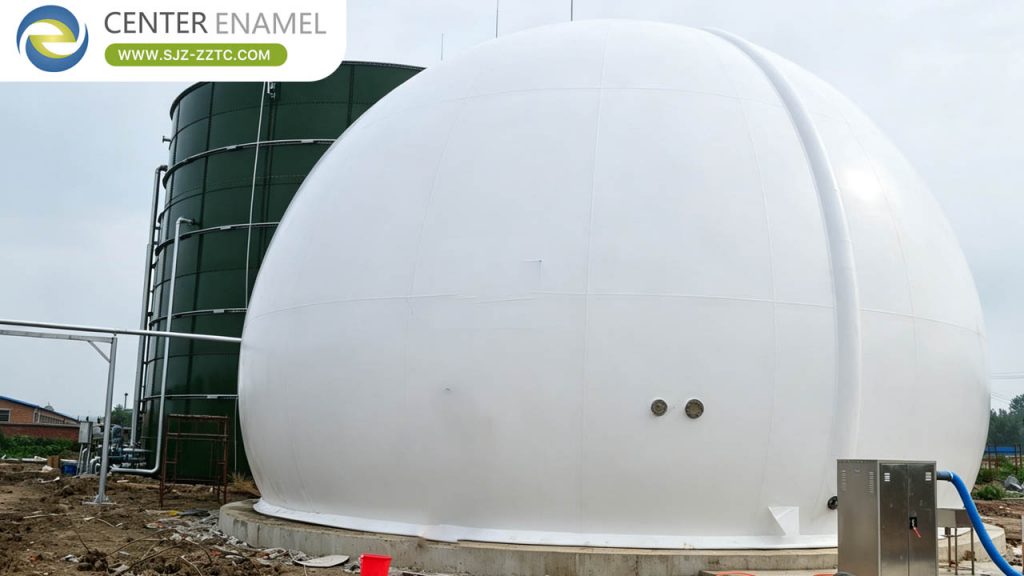
Pakistan Biogas Project. A CSTR plant converting food waste and napier grass (Pennisetum purpureum) into renewable biogas, producing 100 m³/day. Delivered with Center Enamel, it is a documented co-digestion project pairing an organic waste stream with energy grass for stable biogas output.
| Project | Pakistan Biogas Project |
| Location | Pakistan |
| Industry | Waste-to-Energy / Biogas |
| Application | Food waste + napier grass co-digestion |
| Product | CSTR anaerobic digester |
| Capacity | 100 m³ biogas/day |
| Partner | Center Enamel |
| Status | Delivered |
About Center Enamel
Center Enamel applies its engineering capability to co-digestion plants, modeling blend ratios, C:N balance, and digester sizing, then supplying bolted Glass-Fused-to-Steel (GFS) CSTR tankage engineered for heterogeneous, variable feed. The company supports process design, tank customization, and overseas installation, as demonstrated on the Pakistan food-waste-and-grass CSTR project above.
Advantages and Limitations
Co-digestion lifts gas yield, stabilizes pH, and lets plants accept multiple waste streams — improving economics. Limits: feed variability needs monitoring; incompatible streams (high salt, toxins) must be excluded; and permitting may require feed-source controls. Modular GFS tanks ease capacity scaling as new streams are added.
Comparison: Single vs Co-Digestion
| Factor | Single feed | Co-digestion |
| C:N | often off | 20–30:1 tuned |
| pH stability | variable | buffered |
| Biogas yield | lower | higher |
| Feed flexibility | low | high |
Co-digestion mixes complementary feedstocks in one digester to balance C:N at 20–30:1, add buffer, and raise biogas — food waste plus manure being the classic stable pair. Scope by per-feedstock TS/VS/C:N, size a mesophilic CSTR, and specify H₂S-resistant GFS tankage.
Frequently Asked Questions (FAQ)
Q1: What is co-digestion?
A: Digesting two or more feedstocks together — e.g. food waste plus manure — to balance nutrients and raise biogas.
Q2: Why co-digest?
A: It averages out C:N, moisture, and inhibitors, stabilizing pH and lifting methane yield versus single streams.
Q3: Which pairs work best?
A: Food waste + manure, crop residue + manure, and sludge + manure are proven, stable combinations.
Q4: What C:N should be targeted?
A: 20–30:1 total; this keeps the 35–38°C culture productive and avoids ammonia or carbon limitation.
Q5: What tank material suits co-digestion?
A: Glass-Fused-to-Steel, glass fused at 820–930°C, resists H₂S and variable pH from mixed feeds.
Q6: What project experience exists?
A: Delivered food-waste-and-grass CSTR co-digestion in Pakistan and manure-and-residue CSTR in Inner Mongolia.
List your available feedstocks with TS, VS, and C:N. We will model blend ratios, size a mesophilic CSTR, and quote GFS co-digestion tankage for your plant.