
What Is Livestock Waste? A Complete Guide to Anaerobic Digestion Solutions
Livestock waste—the manure, urine, bedding, wash water, and organic byproducts generated by cattle, pigs, poultry, and other farm animals—is one of agriculture's most significant environmental challenges and, simultaneously, its greatest untapped energy resource. When properly managed through modern anaerobic digestion technologies, animal waste transforms from a pollution liability into a valuable source of renewable biogas, organic fertilizer, and sustainable farm income.
What Is Livestock Waste?
Livestock waste, also called animal waste, refers to the liquid and solid waste products generated by animal species like cattle, sheep, pigs, and poultry raised for food, fibre, or other products. The primary components include:
Manure: A combination of animal faeces and urine
Bedding material: Materials like straw, sawdust, or woodchips used for animal comfort
Wash water: Water used for cleaning animal housing or milking parlours
Slurry: A semi-liquid mixture of manure and wastewater, often including bedding material
Spilled feed: Uneaten or wasted feed for animals
Carcasses: Remains of deceased livestock
The amount of waste generated varies substantially depending on waste type, farm size, animal age, diet composition, and feeding regimens. For example, average daily manure output per head of cattle is approximately 10–20 kg, while sheep produce about 2 kg and chickens produce 0.1 kg.
Environmental Impact of Livestock Waste
The environmental footprint of livestock waste is considerable. Globally, livestock-related greenhouse gas emissions from manure processes and enteric fermentation amounted to 3.5 billion tonnes CO₂ equivalent in 2018—15% higher than in 1990 and representing two-thirds of all agricultural emissions.
Soil Pollution: Traditional manure application without proper management plans has led to overfertilization, runoff of toxic constituents, leaching of contaminants, and accumulation of heavy metals such as zinc and copper. These metals can bioaccumulate through food chains and pose health hazards to soil fauna and humans.
Water Pollution: Animal waste presents serious risks of water contamination through multiple pathways. Direct discharge of untreated animal wastewater from industrial facilities, stormwater runoff from manure-saturated fields, and leaching from overapplied agricultural lands all contribute to eutrophication and groundwater contamination. Ammonia concentrations as low as 5 mg/L can cause observable salmon mortality.
Air Pollution: Livestock operations are a predominant contributor to ammonia emissions, which react with atmospheric compounds to form harmful particulate matter. Additionally, decomposing manure releases methane—a potent greenhouse gas with a global warming potential significantly higher than carbon dioxide.
Traditional Livestock Waste Disposal Methods and Their Drawbacks
Burial
Burial of mortalities and solid waste has been an accepted practice for many years, but it comes with significant environmental concerns. As carcasses decay, body fluids are released into surrounding soil, with the potential to impact ground and surface water over time. The carcass often becomes anaerobic with little decomposition taking place, and winter burial is difficult. Additionally, locating suitable burial sites and digging holes is both time-consuming and expensive.
Rendering
Rendering can recycle carcasses into usable products such as pet foods. However, in many areas rendering services are not available, and costs have increased significantly because of transportation and regulation changes. New regulations have caused renderers to be more selective, with nerve tissue from some livestock not accepted for rendering.
Composting
While composting can be a biosecure, environmentally sound, and cost-effective management tool, it has limitations. Downsides include nuisance odors, attraction of insects such as flies, and the need for sufficient base and cover materials to capture body fluids and prevent groundwater contamination. Temperature management is critical—piles must reach sufficient temperatures to destroy pathogens.
Incineration
Incineration is highly effective at reducing carcass volume and destroying disease-causing organisms, but relies on access to a portable incinerator and sufficient fuel supply. The cost of fuel and the air emissions from burning make this method increasingly less attractive.
Open Lagoons and Land Application
Open lagoons for liquid manure storage are no longer sufficient to meet modern standards for odor control, groundwater protection, and carbon mitigation. When manure is applied to land without proper nutrient management planning, excess nitrogen and phosphorus run off into waterways, causing algal blooms and aquatic ecosystem damage.
Converting Livestock Waste to Biogas: Advantages
Anaerobic digestion offers a compelling alternative to traditional disposal methods by transforming waste into value. This biological process breaks down organic matter in the absence of oxygen, producing biogas—a renewable fuel composed primarily of methane (55-65%) and carbon dioxide.
Environmental Benefits: Anaerobic digestion achieves exceptional organic matter removal, with studies demonstrating COD removal efficiencies exceeding 95%. The process captures methane that would otherwise escape into the atmosphere, with biogas systems capable of reducing greenhouse gas emissions by 52 kg CO₂ equivalent per ton of swine/food waste compared to composting, which emits 268 kg CO₂ equivalent. A medium-scale AD plant processing 250 tons of dairy manure per day can prevent approximately 3,439 tons of fossil-derived CO₂ emissions annually.
Economic Benefits: Farms generate renewable energy on-site, reducing reliance on grid electricity and fossil fuels. A 250 t/d dairy manure plant produces 352 kWe of electricity and 327 kWth of heat, with the biogas method evaluated as more beneficial to the environment across multiple impact categories. The digestate serves as a nutrient-rich, pathogen-free organic fertilizer, reducing the need for expensive chemical fertilizers.
Circular Economy: Anaerobic digestion transforms a waste product into renewable energy and stabilized fertilizer, closing the nutrient loop and supporting sustainable agricultural practices.
Anaerobic Digestion Processes for Livestock Waste
CSTR Process
The CSTR Process (Continuous Stirred-Tank Reactor) is the most commonly used reactor configuration for livestock manure and high-solids organic waste. The bioreactor consists of a tank with one or more mechanical stirrers that continuously or periodically agitate the contents. This mixing enables broth homogeneity, better contact between microorganisms and substrate, and constant temperature throughout the reactor, preventing the formation of microbial floccules and accumulation of volatile fatty acids that inhibit biogas production. The CSTR can operate under different temperatures and organic loading rates of 2–5 kg/m³/day, making it highly adaptable for various livestock waste types.
UASB Reactor
The Up-flow Anaerobic Sludge Blanket (UASB) reactor is a cylindrical or rectangular column with a gas separator on top. At the bottom, a dense blanket of flocculated sludge forms through self-immobilization of microorganisms. The combined action of gravity and substrate upward flow suspends the sludge blanket, and effluent recycling is not necessary. UASB reactors offer compactness, high loading rates, low sludge production, short HRT and SRT times, and low operational cost with high methane production rates. However, substrates with high TS mass fractions are not appropriate for UASB treatment due to particle accumulation tendencies.
USR Reactor
The Up-flow Solids Reactor (USR) is specifically designed for agricultural waste treatment, allowing solids to move upward through the reactor with the liquid flow. This configuration is particularly suitable for high-solid feedstocks where solids retention is beneficial. USR reactors are widely used in biogas plants treating agricultural waste in China, alongside CSTR and UASB technologies.
Center Enamel: Professional Biogas Solutions Provider
Center Enamel stands as a global leader in providing the specialized engineering infrastructure necessary for livestock wastewater and manure treatment. With decades of innovation and a project footprint in more than one hundred countries, the company delivers essential containment and processing solutions that make high-efficiency biological recovery a reality.
Core Infrastructure Products:
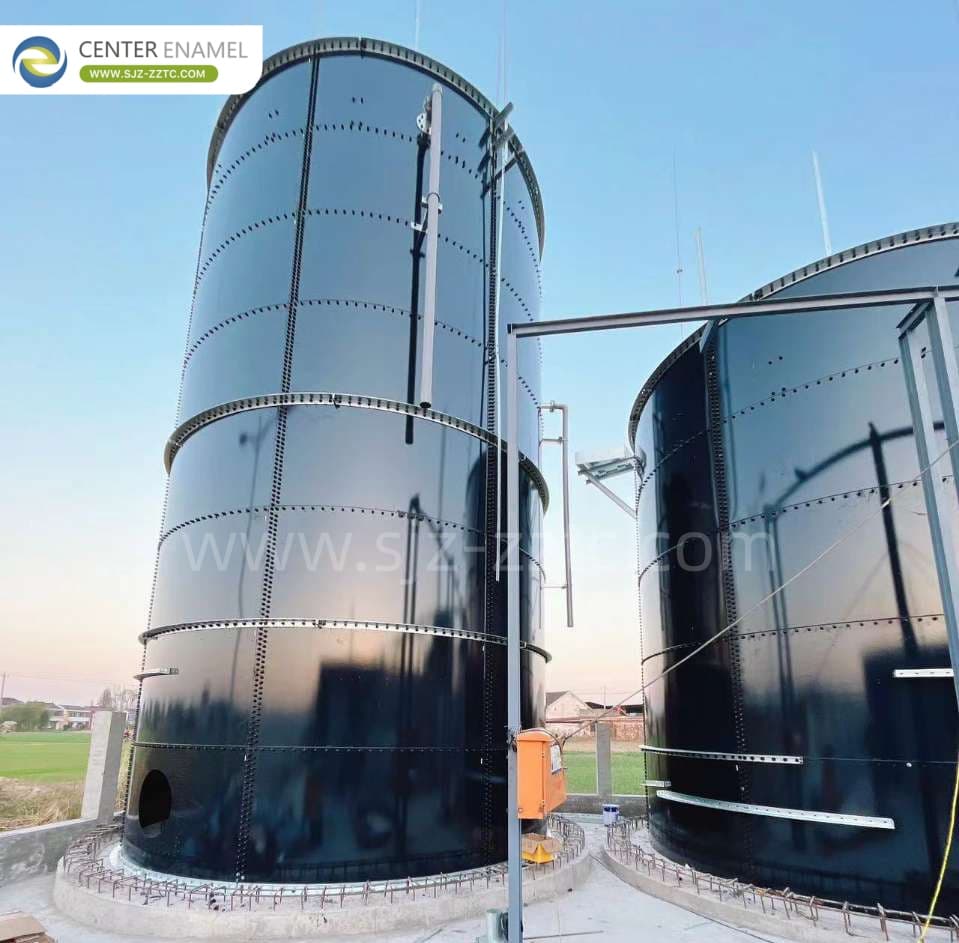
GFS Tanks (Glass-Fused-to-Steel): These tanks are the global benchmark for anaerobic reactors in agricultural projects. By fusing high-tech glass enamel to specialized steel at high temperatures, the material combines the structural strength of steel with the chemical inertness of glass. This provides unparalleled resistance to the organic acids and ammonia vapors generated during livestock waste processing. The modular bolted design allows for rapid site assembly and expansion as farm operations grow.
Double Membrane Biogas Holders: These state-of-the-art gas holders integrate seamlessly with livestock wastewater treatment infrastructure, providing dynamic, low-pressure gas storage above the digester tank. Constructed from specialized multi-layered composite fabric with exceptional resistance to corrosive biogas elements, the system maintains a gas-tight seal while accommodating natural fluctuations in biogas production—ensuring maximum methane capture and stable supply to utilization equipment.
EPC Contractor Services: Center Enamel provides comprehensive engineering, procurement, and construction services from concept to commissioning, with project success demonstrated across installations including the Shandong Heze Biogas Project, the Inner Mongolia Hinggan League Bio-Natural Gas Project, and major livestock wastewater projects for Muyuan Group.
Conclusion
Livestock waste is no longer just an environmental liability—it is a valuable resource waiting to be unlocked. By moving beyond traditional disposal methods like burial, rendering, and open lagoon storage, farmers can adopt anaerobic digestion technologies that capture methane for renewable energy while producing stabilized organic fertilizer. With proven systems like CSTR, UASB, and USR reactors, and world-class infrastructure from providers like Center Enamel, the transition from waste to energy is both technologically feasible and economically viable, supporting sustainable agriculture for generations to come.
FAQs
Q1: What are the main types of livestock waste and how are they classified?
Livestock waste primarily includes manure, urine, bedding material, wash water, slurry, spilled feed, and carcasses. In regulatory frameworks like the UK system, animal waste is classified into Category 1 (very high-risk, e.g., TSE-infected animals), Category 2 (high-risk, e.g., manure and fallen stock), and Category 3 (low-risk, e.g., bones, hides, and feathers) to ensure safe disposal handling.
Q2: What is the difference between CSTR, UASB, and USR anaerobic digestion processes?
CSTR (Continuous Stirred-Tank Reactor) uses mechanical mixing to handle high-solids feedstocks like livestock manure and is highly adaptable. UASB (Up-flow Anaerobic Sludge Blanket) relies on self-immobilized granular sludge and is best suited for low-solids wastewater treatment. USR (Up-flow Solids Reactor) allows solids to flow upward with liquid, specifically designed for agricultural waste with higher solids content.
Q3: How does converting livestock waste to biogas benefit the environment compared to traditional disposal?
Anaerobic digestion captures methane that would otherwise be released during decomposition, reducing greenhouse gas emissions by up to 52 kg CO₂ equivalent per ton of waste compared to composting. It also prevents water contamination from runoff and leachate, reduces odor, and produces stabilized digestate that serves as pathogen-free organic fertilizer, closing the nutrient loop.