
What is Napier Grass Used For? The Premier Feedstock for Biogas Production
Napier grass (Pennisetum purpureum), also known as elephant grass, is one of the most versatile and valuable plants in tropical and subtropical agriculture. While it is widely recognized as a high-yielding animal fodder, its most transformative application lies in renewable energy production. This fast-growing perennial grass has emerged as the premier feedstock for biogas production, offering a sustainable pathway to convert agricultural biomass into clean, renewable energy.
Napier Grass: A Multi-Purpose Agricultural Resource
Napier grass has long been cultivated across Africa, Asia, and South America primarily as a fodder crop for dairy cattle. Its popularity among farmers stems from its remarkable characteristics: it grows rapidly, thrives with minimal water and nutrient inputs, and can be harvested multiple times per year . In Kenya, it is an integral component of the "push-pull" pest management strategy, where it serves as a "pull" crop to attract stemborer pests away from maize fields.
However, the value of Napier grass extends far beyond animal feed. Its high lignocellulosic content—comprising cellulose, hemicellulose, and lignin—makes it an ideal substrate for anaerobic digestion . This has positioned Napier grass as a cornerstone of sustainable energy initiatives, particularly in regions seeking to reduce reliance on fossil fuels and manage agricultural waste effectively.
The Science: How Napier Grass Becomes Biogas
The conversion of Napier grass into biogas occurs through anaerobic digestion, a biological process where microorganisms break down organic matter in an oxygen-free environment. The process unfolds in four stages: hydrolysis, acidogenesis, acetogenesis, and methanogenesis, ultimately producing methane-rich biogas.
Napier grass is particularly well-suited for this process due to its composition. It contains approximately 80–92% cellulose and hemicellulose—structural carbohydrates that are readily degradable in anaerobic digesters . However, the grass also contains lignin, a complex polymer that can inhibit microbial access to fermentable sugars. This is why pretreatment is often necessary to maximize biogas yields.
Biogas Yield: What Research Shows
Research has consistently demonstrated Napier grass's exceptional potential for biogas production. Studies using biochemical methane potential (BMP) assays have shown that untreated Napier grass can achieve methane production rates of approximately 219 m³ CH₄ per ton of volatile solids in a mesophilic continuously stirred tank reactor operated at 35°C .
The timing of harvest significantly influences biogas yield. Research using the automatic methane potential test system (AMPTS-III) found that 2-month-old Napier grass achieved the highest cumulative biogas volume of 3,083 mL, with a biomethane potential of 412.70 NmL/g VS—representing a 50% increase over 1-month samples and a 14% increase over 3-month samples . This highlights the importance of harvest timing in optimizing energy recovery.
Enhancing Biogas Yield through Pretreatment
While Napier grass delivers excellent biogas yields, various pretreatment strategies can enhance methane production by breaking down the lignocellulosic structure. The table below summarizes key pretreatment methods and their effects:
| Pretreatment Method | Process Conditions | Methane Yield Enhancement |
| Hydrothermal Fermentative (HFP) | 35°C for 12 hours | 65% increase in biodegradability; 184.5 m³ CH₄/ton dry biomass |
| Alkaline (NaOH) | 0.6% NaOH, 90°C, 2 hours | 70% increase in methane yield |
| Alkaline (2% NaOH) | Ambient conditions | 45.61% increase in methane yield |
| Thermal Hydrolysis (HTP) | 175°C | 35% higher methane yield |
| Biological (Microbial Consortium) | 21-day treatment | Up to 49% increase in methane yield |
The hydrothermal fermentative pretreatment (HFP) approach at 35°C for 12 hours has proven particularly effective, achieving the highest overall methane production while requiring lower energy input compared to high-temperature thermal methods .
Co-Digestion: Maximizing Biogas Potential
Napier grass is often most effective when co-digested with other organic substrates. Research on co-digestion of pig manure with Napier grass found optimal methane production at a pig manure-to-Napier grass ratio of 1.18, organic loading rate of 0.62 g VS/L, and total solids content of 4.8%, yielding 331.59 mL/gVS .
Similarly, co-digestion of Napier grass with hydrolyzed food waste at a 1:1 ratio achieved biogas production yields of 1,161.33 mL/g VS after 60 days, with methane yield reaching 614.37 mL/g VS and methane concentration of 67.29% . These findings demonstrate that co-digestion can significantly enhance biogas production compared to mono-digestion.
GFS Tanks: Essential Storage for Biogas Projects
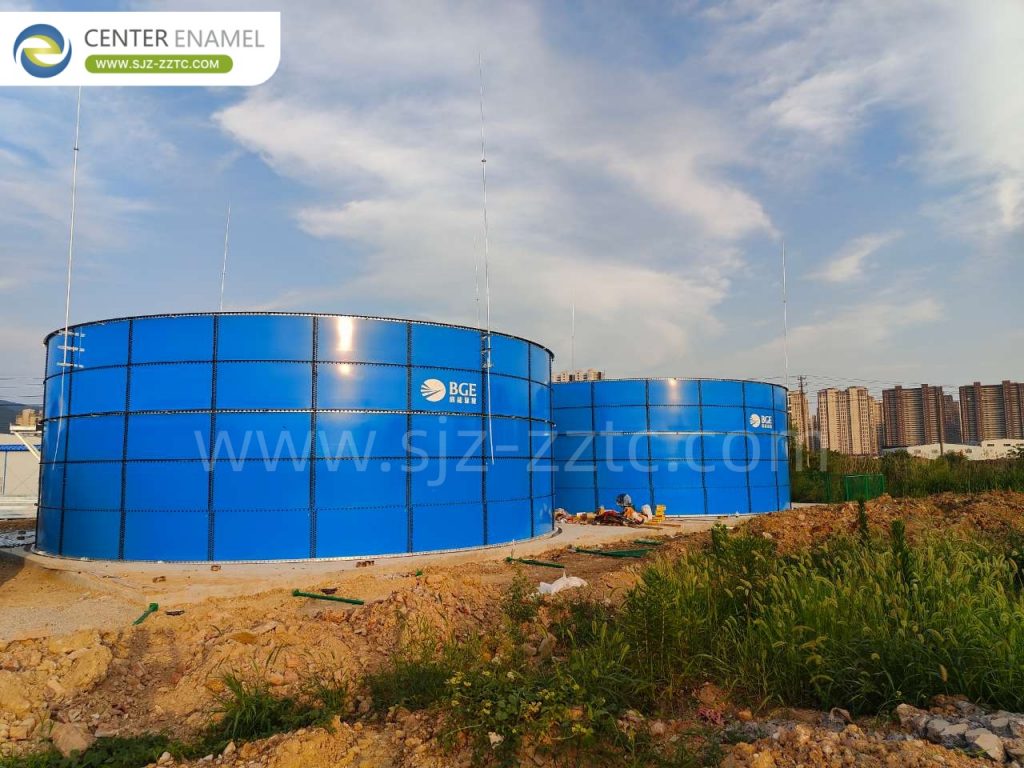
A reliable biogas storage solution is critical for operational efficiency, safety, and maximizing energy recovery. Glass-Fused-to-Steel (GFS) tanks from Center Enamel provide the industry's premier solution for biogas containment, combining unmatched durability with superior corrosion resistance .
Key advantages of GFS tanks for biogas storage:
Superior Corrosion Resistance: The glass coating, fused to steel at 820°C–930°C, creates an inert, non-porous barrier that resists the aggressive organic acids and hydrogen sulfide produced during anaerobic digestion .
Gas Tightness: Precision-engineered bolted construction with specialized gaskets ensures safe containment of biogas with no leakage .
High Durability: Designed to withstand high pressures and demanding operational conditions with a service life exceeding 30 years .
Rapid Installation: The modular bolted design allows for quick on-site assembly by small teams, dramatically reducing project timelines .
Scalability: Tanks are available in various sizes and configurations to accommodate projects of all scales .
Center Enamel's GFS tanks are widely used in anaerobic digestion systems, including CSTR reactors, UASB, and other biogas processing applications .
Center Enamel: Your Partner in Biogas Solutions
Center Enamel is a global leader in providing professional biogas storage solutions, with a proven track record across over 100 countries . The company's commitment to quality, innovation, and sustainability makes it the ideal partner for biogas projects of all scales.
What Center Enamel offers:
Comprehensive Product Range: GFS tanks, stainless steel tanks, fusion bonded epoxy tanks, and biogas holders .
International Certifications: ISO 9001, CE, NSF/ANSI 61, WRAS, and AWWA D103-09 standards ensure world-class quality .
Application Versatility: Solutions for agricultural, industrial, municipal, and waste-to-energy biogas projects .
Proven Global Track Record: Successful projects include biogas tanks in France (2,752 m³), Sweden (5,504 m³), and Inner Mongolia biogas projects with double membrane roofs .
Center Enamel's expertise extends to dairy farm wastewater treatment and anaerobic digestion systems, where GFS tanks provide the durable, low-maintenance infrastructure essential for reliable, long-term energy generation .
FAQ Section
Q1: What is Napier grass primarily used for in biogas production?
A: Napier grass is used as a feedstock for anaerobic digestion, where its high cellulose and hemicellulose content (80–92%) is broken down by microorganisms to produce methane-rich biogas. Research has demonstrated that Napier grass can achieve methane yields of up to 412.70 NmL/g VS, making it one of the most effective energy crops for biogas production .
Q2: How does pretreatment improve biogas production from Napier grass?
A: Pretreatment methods such as alkaline treatment, hydrothermal fermentation, and thermal hydrolysis break down the lignocellulosic structure of Napier grass, making fermentable sugars more accessible to anaerobic microorganisms. Alkaline pretreatment with 0.6% NaOH at 90°C can enhance methane yields by up to 70%, while hydrothermal fermentative pretreatment has shown a 65% increase in biodegradability .
Q3: What makes GFS tanks suitable for biogas storage?
A: Glass-Fused-to-Steel (GFS) tanks offer superior corrosion resistance against the aggressive organic acids and hydrogen sulfide produced during anaerobic digestion, excellent gas tightness for safe containment, high durability with a service life exceeding 30 years, and rapid installation through modular bolted design, making them the industry standard for biogas storage .