
What Is New in Anaerobic Digestion?
What is new in anaerobic digestion is less a single breakthrough and more a convergence of higher-rate reactors, smarter operation, and fuller resource recovery: expanded high-rate systems (EGSB, IC-type reactors), two-stage configurations, widespread co-digestion, biogas upgrading paired with CO₂ use, and AI/digital-twin-driven control that stabilizes and lifts yield.
Higher-Rate Reactors
The shift from long-retention tank digesters to high-rate granular-sludge reactors—EGSB and internal-circulation (IC) types— lets plants treat strong streams at OLR 5–15 kg COD/m³·day with 6–12 h retention instead of days. Smaller footprint, faster startup, and the same ~60% methane biogas make them the default for new industrial and sidestream projects.
Two-Stage and Co-Digestion
Separating acidogenesis from methanogenesis in two-stage systems lets each step run at its best conditions, raising rate and resilience. Co-digestion—mixing complementary feedstocks to hold C:N near 20–30:1—has moved from novelty to standard practice for boosting yield and absorbing diverse organic wastes.
Biogas Upgrading and CO₂ Value
Upgrading to ~98% biomethane is now routine where offtake exists, and the separated biogenic CO₂ is increasingly captured for beverages, dry ice, greenhouse enrichment, or methanol rather than vented. Treating CO₂ as a second product, not waste, is one of the clearest recent shifts in project economics.
Comparative Data Table: Then vs Now
| Dimension | Older norm | Current direction |
| Reactor | long-retention tank | EGSB / IC, high-rate |
| Operation | setpoint + manual | digital twin + AI control |
| CO₂ | vented | captured / used |
| Feed | single stream | co-digestion, C:N balance |
| Monitoring | lab grabs | continuous on-line |
Digitalization and AI
Continuous on-line metering plus digital twins and AI control is turning AD from a craft into a measurable, optimizable process. Feed optimization, real-time control, and early-warning of instability (via VFA, alkalinity, and gas composition) now routinely lift and stabilize yield rather than relying on operator intuition alone.
Emerging Frontiers
Thermophilic operation, microbial and gene-level insights into digester communities, and better handling of trace contaminants such as PFAS and pharmaceuticals are active research fronts. None is yet universal, but each points at higher rates, better resilience, and broader feedstock acceptance.
Advantages and Limitations
The new wave raises yield, shrinks footprint, and adds revenue from CO₂ and certificates. Limits: high-rate and two-stage systems demand better feed control and instrumentation; digitalization is only as good as the data feeding it. The fundamentals—steady feeding, mesophilic 35–38°C, balanced C:N—still decide success.
Best Practices / How to Apply What Is New
For new builds, favor high-rate reactors sized to your COD and consider two-stage where feed is variable. Adopt continuous metering and AI-assisted control incrementally, capture CO₂ if offtake exists, and keep co-digestion within a C:N 20–30:1 window. Technology helps; disciplined operation still wins.
What is new in anaerobic digestion is a maturation, not a revolution: high-rate EGSB/IC reactors, two-stage and co-digestion practice, biogas upgrading with CO₂ capture, and AI-driven digital operation. Together they lift yield, shrink footprint, and turn more of the resource into value—built on the same steady, mesophilic fundamentals.
Frequently Asked Questions (FAQ)
Q1: What is new in anaerobic digestion?
A: A convergence of high-rate reactors (EGSB/IC), two-stage and co-digestion practice, biogas upgrading with CO₂ capture, and AI/digital-twin operation—not one single breakthrough.
Q2: Which reactors are advancing?
A: EGSB and internal-circulation (IC) granular-sludge reactors treat at OLR 5–15 kg COD/m³·day with 6–12 h retention—far smaller footprint than tank digesters.
Q3: How is digitalization changing it?
A: Continuous on-line metering plus digital twins and AI control optimize feed, hold conditions steady, and warn of instability early—lifting and stabilizing yield.
Q4: What about CO2 and contaminants?
A: Biogenic CO₂ is now captured for beverages, dry ice, greenhouses, or methanol; PFAS/pharmaceutical trace removal is an active frontier, not yet universal.
Q5: Does new tech replace the basics?
A: No. Steady feeding, mesophilic 35–38°C, and C:N near 20–30:1 still decide success; technology amplifies disciplined operation.
Q6: Is two-stage worth it?
A: For variable or difficult feed, separating acidogenesis from methanogenesis raises rate and resilience; for steady single streams, a well-run single stage often suffices.
Project Case Reference
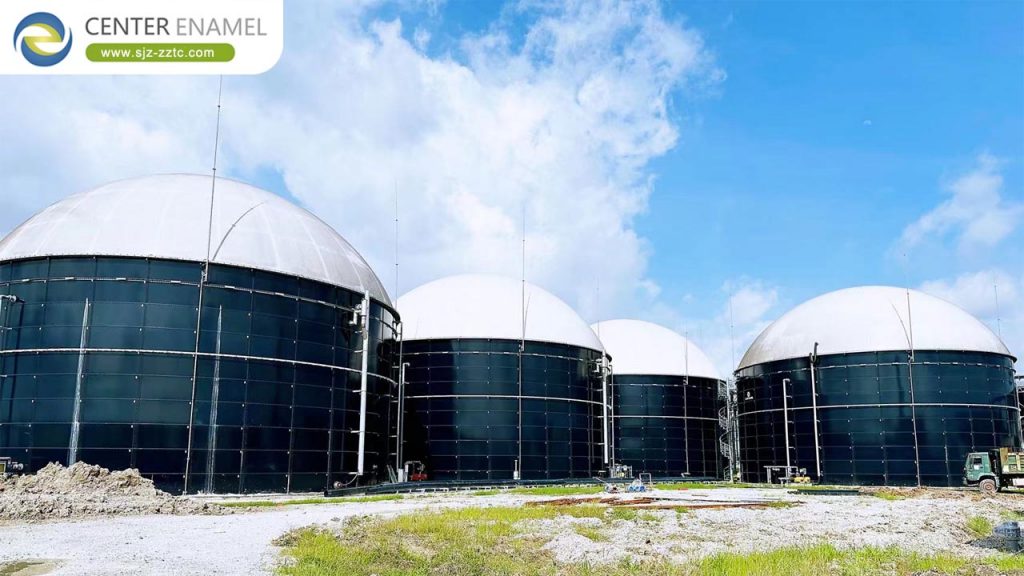
Malaysia Biogas Project — Malaysia · 2026
5 GFS Tanks · 27,000 m³ Total Volume · 22,000 m³ Biogas/Day
A large-scale biogas project in Malaysia featuring 5 Glass-Fused-to-Steel (GFS) tanks. The project achieves approximately 80% digestibility, with each single tank producing about 4,400 m³ of biogas daily, totaling 22,000 m³ per day across all 5 tanks.
Technical Specifications
Single Tank Volume: 5,400 m³ (Ø24.46 × 12 m)
Total Effective Volume: 27,000 m³ (5 tanks)
Daily Biogas Production: 22,000 m³ total
Digestibility: ≈ 80%
Gas Production Rate: 0.45 m³ / kg COD removed
Tank Type: Glass-Fused-to-Steel (GFS)
Water Quality Data
| Parameter | Inlet Water | Effluent |
| COD | ≥ 60,000 mg/L | ≥ 12,000 mg/L |
| BOD | ≤ 25,000 mg/L | ≤ 5,000 mg/L |